Overlanding is rarely just about getting from one destination to another. Once a trip moves beyond paved roads and reliable cellular coverage, communication becomes an important part of navigation, coordination, and safety. A group may need to warn another vehicle about a difficult obstacle, coordinate a turn at an unmarked trail junction, stop the convoy when someone falls behind, or communicate during an emergency.
The right communication setup depends on the type of trip, group size, terrain, vehicle configuration, and how far vehicles may separate. Short recreational trips may only require simple handheld radios, while extended backcountry expeditions can benefit from vehicle-mounted radios combined with satellite communication.
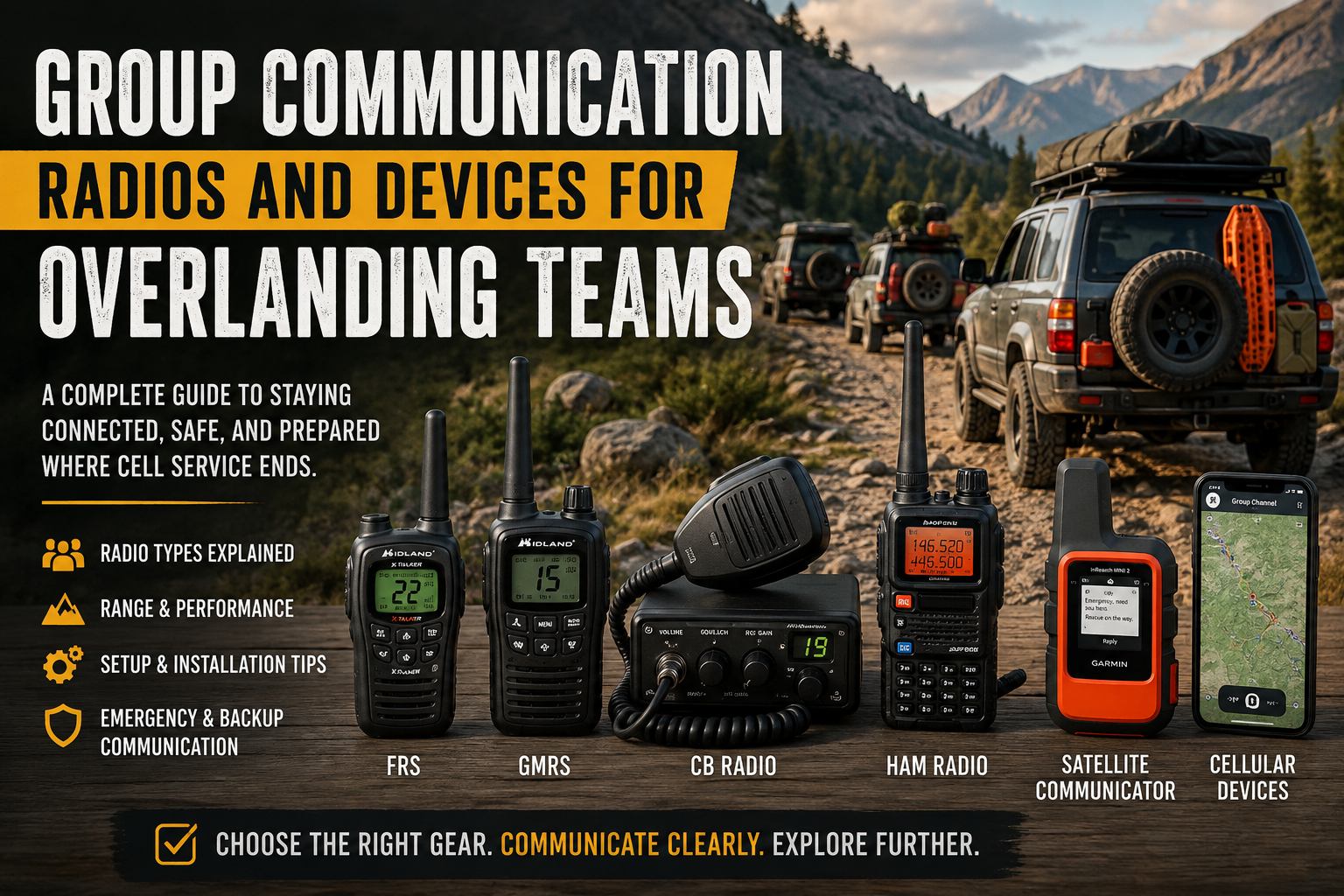
Common options include General Mobile Radio Service (GMRS), Family Radio Service (FRS), Citizens Band (CB), amateur (ham) radio, satellite communicators, and cellular-based push-to-talk devices. These systems work in very different ways. Some are designed primarily for short-range local communication, while others can provide communication or emergency messaging far beyond the reach of terrestrial radio.
For most overlanding teams, there is no single device that does everything well. A practical setup usually starts with a reliable local communication method and adds another technology when the trip takes vehicles beyond dependable cellular coverage.
Why Communication Matters for Overlanding Teams
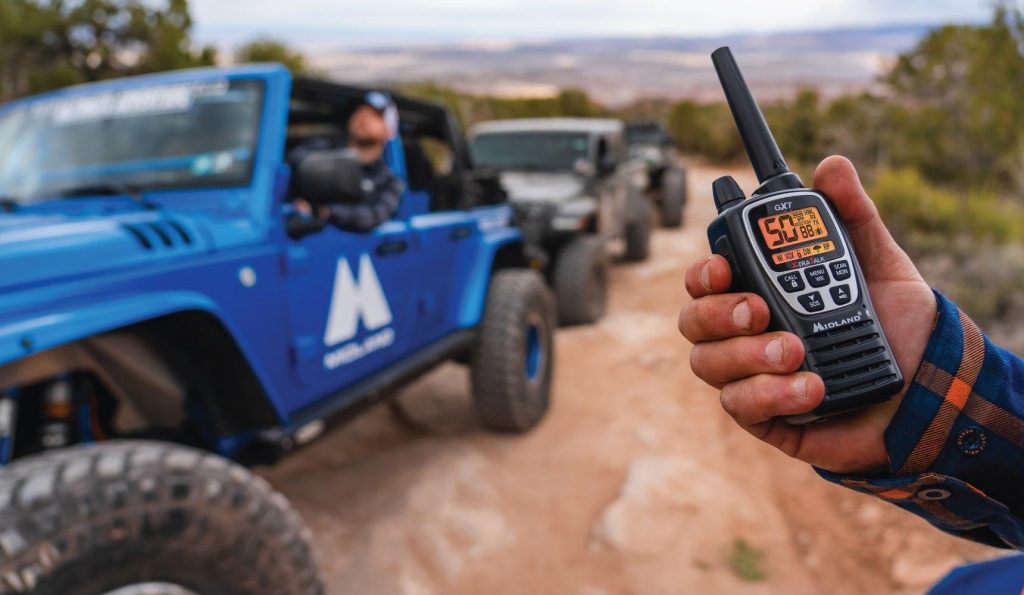
Communication becomes more important as an overlanding group moves farther from roads, towns, and cellular infrastructure. A radio allows vehicles to communicate without stopping, while satellite-based equipment can provide an additional communication path when the group is outside terrestrial network coverage.
Staying Connected When Vehicles Become Separated
Convoys do not always remain together. A vehicle may need to stop because of a mechanical problem, take a different line through an obstacle, or become separated from the group because of traffic, terrain, or a wrong turn.
A radio provides direct vehicle-to-vehicle communication without requiring every driver to make a phone call. The lead vehicle can warn the group about a difficult section ahead, while a trailing vehicle can report that another member has fallen behind.
This is particularly useful when vehicles are moving at different speeds. Instead of repeatedly stopping to regroup, drivers can communicate their location and coordinate where the convoy should wait.
For larger groups, establishing a primary channel and simple call signs before departure can make communication much more efficient.
Coordinating Trail Navigation and Obstacles
Off-road routes often involve narrow tracks, blind corners, steep climbs, water crossings, rocks, mud, and other obstacles that cannot always be seen by the next vehicle.
A driver who reaches an obstacle first can use the radio to communicate what is ahead. For example, the lead vehicle might tell the rest of the group that a narrow bridge is approaching or that a particular line through a rocky section is preferable.
Radios are especially useful when vehicles are close enough for direct communication but cannot see one another. They allow drivers to coordinate movement while keeping their attention on driving rather than repeatedly checking a phone.
However, radio communication should complement—not replace—proper trail assessment. A driver should still evaluate an obstacle personally rather than blindly following instructions from another vehicle.
Emergency Communication
Communication can become critical when something goes wrong. A vehicle breakdown, accident, injury, lost traveler, severe weather event, or other emergency may require immediate coordination between members of the group.
A local radio can be effective for alerting nearby vehicles. For example, if one vehicle becomes disabled, the driver can quickly tell the convoy to stop or return rather than trying to contact every person individually.
But a conventional radio is not automatically an emergency communication system. Its usefulness depends on whether another compatible radio is within usable range. Terrain, distance, vegetation, and obstacles can prevent a transmission from reaching another vehicle.
For trips into genuinely remote areas, a satellite communicator or dedicated emergency beacon can provide an additional layer of protection. Satellite-based distress systems can transmit emergency signals through satellite infrastructure rather than relying on nearby vehicles or cellular towers.
Communication When Cellular Service Is Unavailable
One of the biggest advantages of traditional two-way radios is that they can communicate directly between compatible radios without a cellular network.
That makes them useful in areas where smartphones show “No Service.” Mountain valleys, deserts, forests, remote trails, and other isolated areas can have little or no cellular coverage.
Satellite communicators take a different approach. Instead of communicating directly between nearby vehicles, they can use satellite networks for functions such as two-way messaging, location sharing, and emergency communication, depending on the device and service.
This means a remote overlanding team can combine technologies: use radios for immediate vehicle-to-vehicle communication and satellite equipment when communication must extend beyond the group or cellular infrastructure.
Why Relying Only on Smartphones Can Be Risky
Smartphones are extremely useful for overlanding. They can provide navigation, mapping, messaging, photography, weather information, and other tools. However, they should not necessarily be treated as the only communication method on a remote trip.
The biggest limitation is network dependence. A smartphone’s conventional calls and messages generally require access to a cellular network. When coverage disappears, those functions may no longer work.
Smartphones also require battery power and can be damaged by water, dust, vibration, heat, or impact. Navigation and other demanding applications can consume battery quickly, which can become a problem when charging opportunities are limited.
The better approach is redundancy. Use a smartphone for everyday connectivity and navigation, a radio for local group communication, and satellite-based equipment when the route takes the team beyond dependable terrestrial coverage.
Types of Communication Devices for Overlanding

Overlanders have several communication technologies to choose from, but they are not interchangeable. Each system has different operating frequencies, range characteristics, licensing requirements, equipment options, and emergency capabilities.
The most appropriate choice depends on how far vehicles travel from one another and how remote the trip is.
GMRS Radios
General Mobile Radio Service (GMRS) is a two-way radio service commonly used for short- to medium-range personal communication in the United States. It operates in the UHF range around 462 and 467 MHz and supports both handheld and higher-powered mobile equipment.
GMRS is particularly well suited to overlanding because compatible equipment can include handheld radios, vehicle-mounted radios, external antennas, and repeater-capable systems. The service also shares several frequencies with FRS, which allows compatible radios to communicate on shared channels when configured appropriately. The FCC has authorized higher-power GMRS operation on designated channels than FRS, while GMRS also has additional repeater channels.
What GMRS Is
GMRS is intended for personal two-way radio communication. Unlike simple low-power walkie-talkies, GMRS equipment can include mobile radios designed for installation in vehicles and systems capable of using repeaters to extend coverage.
For an overlanding convoy, that flexibility is valuable. A group can use handheld radios when people leave their vehicles and use vehicle-mounted units with external antennas while driving.
Range and Performance
GMRS range varies considerably in real-world conditions. Radio advertisements may quote very large distances under ideal conditions, but actual vehicle-to-vehicle range can be much shorter.
Terrain is one of the biggest factors. Mountains, hills, dense vegetation, buildings, and other obstructions can block or weaken UHF signals. Vehicle antenna height and installation also affect performance.
GMRS can work particularly well when vehicles have a relatively clear path between them. In difficult terrain, a properly installed external antenna and, where legally and practically appropriate, a repeater can improve coverage.
Licensing Considerations
In the United States, GMRS operation requires an FCC license. GMRS and FRS are related services, but they do not have identical rules or equipment capabilities. The fact that a retail radio is marketed as a “GMRS/FRS” unit does not remove the licensing requirement when it is operated under GMRS rules.
Licensing requirements vary by country, so international overlanders should check the regulations of every country where the equipment will be operated rather than assuming U.S. rules apply.
Why GMRS Is Popular for Overlanding Groups
GMRS offers a useful combination of simplicity, vehicle-installation options, handheld portability, and higher-power capability than basic FRS operation.
For many recreational overlanding groups operating in the United States, it is a practical middle ground between simple walkie-talkies and the additional technical and licensing requirements associated with amateur radio.
FRS Radios
Family Radio Service (FRS) is designed primarily for short-range personal two-way communication using low-power radios. FRS is commonly associated with inexpensive handheld walkie-talkies that require little setup.
How FRS Differs From GMRS
FRS and GMRS share some frequencies, but their operating rules and equipment capabilities differ. FRS is limited to lower-power operation, while GMRS permits higher-power equipment and additional system options under its rules. FCC rules also permit certain GMRS/FRS shared-channel operation.
The practical difference for an overlanding team is that FRS is generally simpler but offers less flexibility for building a vehicle-based communication system.
Advantages and Limitations
The main advantage of FRS is simplicity. A group can purchase compatible handheld radios, charge them, select a channel, and communicate without installing antennas or radios in vehicles.
They are useful when vehicles remain relatively close together or when group members need communication while hiking around a campsite.
The limitations become more obvious as trips become longer or terrain becomes more difficult. FRS radios generally have less power and fewer installation options than GMRS equipment, and their practical range can fall significantly in mountains, forests, and other obstructed environments.
When FRS Makes Sense for Casual Trips
FRS can make sense for family camping trips, short recreational convoys, campground communication, or situations where vehicles remain close together.
For a serious backcountry expedition where vehicles may become separated by substantial distances or difficult terrain, a more capable communication system is usually preferable.
CB Radios
Citizens Band (CB) radio is a traditional vehicle-to-vehicle communication system that has been used by drivers for decades. CB operates in the 27 MHz range and uses a dedicated set of channels for short-range communications.
How CB Radio Works
CB radios transmit voice over designated CB channels. A typical vehicle installation consists of a radio, microphone, coaxial cable, and external antenna.
Unlike cellular communication, CB does not depend on a mobile phone network. Vehicles equipped with compatible CB radios can communicate directly when they are within usable radio range.
In the United States, individual CB operator licenses are not required, but equipment and operating rules still apply. FCC rules limit CB transmitter output to 4 watts of carrier power.
Typical Range and Limitations
CB range is strongly affected by antenna installation, terrain, interference, atmospheric conditions, and the surrounding environment. Real-world vehicle-to-vehicle communication is typically much more limited than the long-distance figures sometimes associated with favorable radio propagation.
A properly installed antenna is particularly important because CB operates at a lower frequency than GMRS and uses relatively large antennas.
Advantages for Vehicle-to-Vehicle Communication
CB remains useful when a group wants a traditional vehicle-mounted communication system without relying on cellular coverage.
Its biggest practical advantage is compatibility with the established CB ecosystem. However, equipment availability and group adoption matter: a CB system is useful for a convoy only if the other vehicles have compatible radios.
CB vs. GMRS
For many modern overlanding groups, GMRS offers more flexibility because it supports handheld and mobile equipment, higher-power operation under applicable rules, and repeater use.
CB can still be attractive to people who prefer a traditional vehicle-mounted setup or already have CB equipment. The better choice depends on the group’s equipment, location, regulatory requirements, and communication needs.
Amateur (Ham) Radios
Amateur radio, commonly called ham radio, provides significantly broader communication possibilities than basic personal radio services. It can support local communication as well as long-distance communication using different frequencies, antennas, repeaters, and propagation techniques.
What Ham Radio Offers
Ham radio can provide access to a large range of frequencies and operating modes. Depending on the license class, equipment, and frequency used, operators can communicate through local repeaters or establish much longer-distance contacts.
For an experienced overlander, this can provide capabilities that go well beyond simple convoy communication.
Range and Capabilities
Range depends heavily on frequency, antenna, terrain, power, propagation, and whether a repeater or other infrastructure is involved.
A handheld amateur radio may be useful for local communication, while a properly installed mobile radio with a suitable antenna can provide substantially greater capability. Repeater networks can also allow communication across areas that would otherwise be beyond direct line-of-sight range.
However, ham radio is not simply a more powerful version of a GMRS walkie-talkie. Operators need to understand radio procedures, frequency privileges, interference rules, and licensing requirements.
Licensing Requirements
In the United States, amateur radio operators must obtain an appropriate FCC license before transmitting on amateur frequencies. The entry-level Technician license requires passing a written examination; higher license classes provide additional privileges.
Rules differ between countries, so international overlanders need to verify the applicable amateur-radio regulations and reciprocal operating privileges before transmitting abroad.
When Ham Radio Is Worth Considering
Ham radio is most worthwhile for overlanders who are willing to learn radio fundamentals and obtain the required license.
It can be particularly useful for technically inclined travelers, long-distance expeditions, operators who regularly travel through areas with repeater coverage, or anyone who wants communication capabilities beyond basic convoy coordination.
For a casual weekend group that simply wants to tell the vehicle ahead about an obstacle, ham radio may provide more complexity than necessary.
Satellite Communicators
Satellite communicators provide a different type of connectivity. Rather than depending on nearby radios or terrestrial cellular towers, compatible devices communicate through satellite networks.
Two-Way Satellite Messaging
Two-way satellite communicators can allow users to send and receive text-based messages when conventional cellular coverage is unavailable. This can be valuable when an overlander needs to communicate with someone outside the immediate convoy.
Unlike a traditional radio, however, satellite messaging is generally not designed for continuous real-time voice communication between nearby vehicles.
GPS Location Sharing
Many satellite communication systems can also transmit location information. A traveler can share coordinates or tracking information with selected contacts, allowing others to monitor progress during a remote trip.
This can add an important layer of situational awareness when a group is traveling far beyond normal cellular coverage.
SOS and Emergency Communication
Emergency capabilities are one of the strongest reasons to carry satellite-based equipment in remote areas. Depending on the type of device and service, an SOS function can transmit an emergency alert and location information through satellite infrastructure.
Dedicated 406 MHz distress beacons are specifically designed to send distress signals to satellite-based search-and-rescue systems, which can then relay information through ground stations and rescue coordination centers.
A satellite communicator should still be treated as part of an emergency plan rather than a guarantee of immediate rescue. Users need to understand their device’s coverage, subscription requirements, battery limitations, sky visibility requirements, and emergency procedures.
Why Satellite Devices Complement, Rather Than Replace, Radios
Satellite communication and radio solve different problems.
A GMRS, FRS, CB, or amateur radio can provide fast, direct communication between nearby members of a convoy. A satellite communicator can extend communication beyond the immediate group and provide a potential link to people outside the trail area.
For example, two vehicles approaching a difficult obstacle may communicate instantly by radio, while a satellite device can be used to send a location update to family members or initiate emergency communication if the situation becomes serious.
For remote overlanding, combining these technologies is often more resilient than depending entirely on either one.
Cellular-Based Communication Devices
Cellular communication remains extremely useful wherever mobile network coverage is available. It can also provide features that traditional radios do not, including one-to-one messaging, group chats, location sharing, photographs, and internet-based communication.
Push-to-Talk Cellular Devices
Push-to-talk over cellular (PoC) devices use cellular or data networks to provide a radio-like communication experience. Users press a button to speak, but the communication is transported through a cellular or internet connection rather than directly over a local radio frequency.
This can provide very broad coverage when a suitable network connection exists.
The limitation is fundamental: if the device cannot access an appropriate cellular or data network, its normal PoC functionality may not work.
Smartphone-Based Communication
Smartphones can also function as communication hubs through voice calls, messaging applications, group chats, location sharing, and internet-based push-to-talk services.
They are convenient because most travelers already carry one, and they can combine communication with navigation and other travel tools.
However, smartphones remain dependent on battery power and network availability for many communication functions. Remote overlanders should therefore avoid treating an internet-based communication application as equivalent to a direct radio link.
Benefits and Limitations in Remote Areas
Cellular-based communication is excellent when coverage is available. It can provide richer communication than conventional voice radio, including photos, detailed messages, maps, and live location sharing.
Its weakness is coverage dependency. Remote trails may have weak or nonexistent cellular service, and coverage can disappear quickly when a route enters a mountain valley or moves away from populated areas.
For this reason, cellular devices are best viewed as one layer of an overlanding communication system—not the only layer. A practical setup can use cellular communication where available, local radio for convoy communication, and satellite equipment for genuinely remote sections of a trip.
GMRS vs. FRS vs. CB vs. Ham vs. Satellite Communication
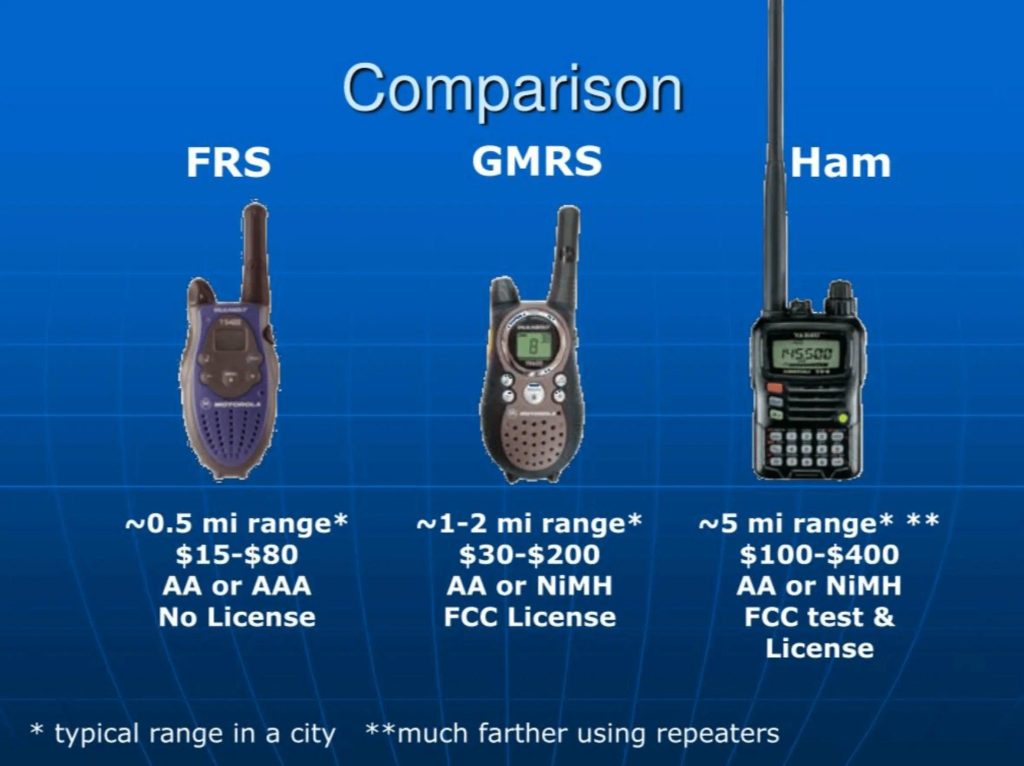
Choosing an overlanding communication system becomes much easier when the major technologies are compared by what they actually do on the trail. GMRS, FRS, CB, amateur radio, and satellite communicators are designed for different purposes, so the “best” option depends on whether the priority is convoy communication, long-distance capability, simplicity, or emergency connectivity.
| Feature | GMRS | FRS | CB | Ham Radio | Satellite Communicator |
|---|---|---|---|---|---|
| Typical range | Short to moderate; highly terrain-dependent | Short-range | Short-range; highly dependent on antenna and conditions | Potentially local to very long distance | Very broad satellite coverage, depending on service |
| Terrain performance | Good for local convoy use but affected by hills and obstacles | More limited in difficult terrain | Can work well vehicle-to-vehicle but terrain still matters | Excellent flexibility when using appropriate frequencies/repeaters | Not dependent on nearby cellular towers, but requires suitable satellite visibility |
| Licensing | License required in the U.S. | No individual U.S. license | No individual U.S. license in the U.S. | Amateur license required to transmit | Service subscription commonly required; regulations vary by country |
| Communication method | Direct radio or repeater | Direct radio | Direct radio | Direct radio, repeaters, and other amateur modes | Satellite-based messaging/data |
| Vehicle installation | Excellent | Usually unnecessary | Excellent | Excellent | Usually portable |
| Emergency capability | Useful for contacting nearby group members | Useful for nearby group members | Useful for nearby CB users | Potentially extensive, depending on equipment and coverage | Strong option for remote messaging/SOS on supported systems |
| Cost | Moderate | Low | Low to moderate | Moderate to high | Moderate to high, often with service costs |
| Best use case | Most organized overlanding groups | Casual trips and close-range communication | Traditional vehicle convoys | Experienced radio operators and advanced users | Remote-area communication and emergency redundancy |
Range
Radio range should never be judged by the largest number printed on a product package. Actual communication distance depends on frequency, antenna, transmitter power, receiver sensitivity, terrain, elevation, vegetation, and whether the communication is direct or uses a repeater.
GMRS generally provides a strong balance for vehicle-to-vehicle communication, particularly when mobile radios use properly installed external antennas. FRS is more appropriate when vehicles and people remain relatively close together.
CB remains useful for vehicle communication, but its performance depends heavily on antenna installation and operating conditions. Amateur radio has the greatest flexibility because licensed operators can use different bands, antennas, modes, and repeater systems.
Satellite communicators are different: they are not normally intended for continuous local voice communication between convoy vehicles. Instead, they can provide messaging and location services through satellite networks when terrestrial communication is unavailable.
Terrain Performance
Terrain can have a greater effect on radio communication than transmitter power alone. A hill or mountain between two vehicles can block direct communication, while dense forest can reduce usable range.
UHF systems such as GMRS and FRS are particularly dependent on relatively clear paths for reliable direct communication. CB operates at a lower frequency and has different propagation characteristics, but it is still affected by terrain and local interference.
Amateur radio gives experienced users more options for adapting to terrain. Repeaters positioned at elevated locations can extend communication beyond what two vehicles could achieve directly.
Satellite communicators largely avoid the problem of needing another nearby radio, but they still need a suitable view of the sky. Mountains, dense vegetation, canyon walls, and other obstructions can interfere with satellite communication or make message transmission slower.
Licensing
Licensing is an important consideration because radio rules differ between services and countries.
In the United States, GMRS requires an FCC license, while FRS operation does not require an individual license. CB also does not require an individual operator license, although users must comply with the applicable equipment and operating rules. Amateur radio requires an appropriate amateur license before transmitting.
International overlanders should not assume that a radio legal to use in one country is automatically legal in another. Frequency allocations, power limits, licensing requirements, and restrictions on imported radio equipment can vary significantly.
Communication Method
GMRS, FRS, CB, and amateur radio primarily provide direct radio communication. Depending on the service and equipment, a signal can travel directly from one radio to another or through a repeater.
Satellite communicators use a completely different communication path. Messages are sent through satellite infrastructure and can then reach contacts outside the immediate area. Modern satellite communicators can support two-way messaging, location sharing, tracking, and interactive SOS functions on supported services.
This makes satellite equipment complementary to local radios rather than a direct replacement for them.
Vehicle Installation
GMRS, CB, and amateur radio can all be installed in vehicles with an external antenna. A properly mounted external antenna can offer advantages over a handheld radio’s small integrated antenna.
FRS is generally used as a handheld system, making it easier to deploy but less suitable for a dedicated vehicle communication installation.
Satellite communicators are normally portable. They can be kept inside the vehicle, carried while hiking, or mounted where they have a suitable view of the sky.
Emergency Capabilities
A radio is excellent for communicating with nearby members of an overlanding group, but it should not automatically be considered a guaranteed emergency link. If nobody compatible is within range, a radio transmission may not reach anyone who can help.
Satellite communicators can provide a separate emergency pathway. Supported devices can transmit an SOS and GPS location through their satellite network, with some services providing two-way communication with an emergency response coordination center.
For remote expeditions, this distinction is important: radios are primarily for local coordination, while satellite communication can provide a way to reach beyond the immediate group.
Cost
FRS is generally the least expensive way to equip a group with basic short-range handheld communication. CB equipment can also be relatively affordable, although a quality vehicle antenna and installation add to the total cost.
GMRS typically costs more when a group moves from basic handheld units to dedicated mobile radios and external antennas. Amateur radio can cost considerably more depending on the radio, antenna system, installation, and accessories.
Satellite communication adds another consideration: the hardware may require an ongoing service subscription for messaging, tracking, or SOS functions.
Best Use Case
For many recreational overlanding groups, GMRS is the most practical primary communication system because it combines handheld portability with vehicle-mounted options.
FRS is suitable for simple trips where vehicles stay relatively close. CB remains a reasonable choice for users who prefer traditional vehicle-based communication. Amateur radio is best suited to people willing to learn the technology and meet licensing requirements.
For remote expeditions, a satellite communicator is an important secondary system because it can provide communication beyond the range of local radios and cellular networks.
What to Look for in an Overlanding Radio
Buying an overlanding radio involves more than choosing the model with the highest advertised range. A radio needs to perform reliably inside a moving vehicle, survive dust and vibration, operate for extended periods, and remain usable when conditions become difficult.
The most important factors include real-world range, power, antenna quality, durability, battery life, hands-free operation, and channel features.
Real-World Range
Advertised radio range is often based on ideal conditions, such as open terrain with unobstructed line of sight. Those conditions rarely represent what an overlanding convoy encounters.
Mountains, hills, trees, buildings, canyon walls, and even the position of the vehicles can reduce usable range. A radio that claims many miles under ideal conditions may provide substantially less vehicle-to-vehicle communication in dense forest or mountainous terrain.
For this reason, look at range as a combination of radio + antenna + terrain + installation, rather than treating the radio’s advertised distance as a guaranteed specification.
In open, relatively flat terrain, vehicles may maintain communication over greater distances. In mountainous terrain, two vehicles can lose contact even when they appear relatively close because a ridge blocks the radio path.
A practical overlanding setup should therefore be tested in the actual environments where the group expects to travel.
Power Output
Power output affects how strongly a radio can transmit, but more power does not automatically mean better communication.
Handheld radios operate from batteries and generally have less power than vehicle-mounted units. A mobile radio connected to the vehicle’s electrical system can support higher power levels where the applicable radio service permits them.
Higher transmit power can help overcome some signal losses, but it cannot reliably transmit through a mountain. If terrain blocks the radio path, simply increasing power may provide little benefit.
A better approach is to combine appropriate power with a good antenna, sensible antenna placement, and realistic expectations about terrain.
For handheld radios, battery capacity is also important. A higher-power setting can increase battery consumption, so users should consider whether maximum output is actually necessary for routine convoy communication.
Antenna Quality and Placement
The antenna is one of the most important parts of a vehicle radio system. A high-quality radio connected to a poorly positioned or poorly installed antenna can perform worse than a less expensive radio with an effective antenna setup.
Vehicle-mounted antennas can be installed using magnetic mounts, hood mounts, roof mounts, or permanent mounting systems. Each approach involves trade-offs involving installation effort, antenna height, grounding, durability, and the likelihood of damage from branches or obstacles.
A higher antenna position can improve the radio’s effective line of sight, but the highest possible mounting point is not automatically the best choice. Overlanding vehicles frequently pass under branches and through narrow trails, so an antenna must be positioned where it can survive the environment.
The antenna also needs to be appropriate for the radio’s frequency and properly installed. For vehicle systems, the ground-plane characteristics of the mounting location can affect antenna performance.
Weather Resistance and Durability
Overlanding equipment is exposed to conditions that ordinary consumer electronics may never encounter.
Look for a radio that can tolerate exposure to dust, rain, mud, vibration, temperature changes, and occasional impacts. For handheld units, a stated water-resistance rating can be useful, but the rating should be understood correctly. Water resistance does not necessarily mean the device can withstand prolonged submersion or high-pressure water.
Vehicle-mounted equipment should also be installed where it is protected from direct water exposure and excessive heat.
Durability matters because a communication device is most valuable when conditions become difficult. A radio that works perfectly at home but fails after repeated vibration, dust exposure, or rough trail use is not a dependable overlanding tool.
Battery Life and Charging
Battery life becomes especially important when vehicles spend several days away from reliable electrical infrastructure.
Handheld radios should ideally have replaceable or swappable batteries so a depleted battery does not take the entire communication system offline. Carrying spare batteries can be more useful than relying entirely on a single large-capacity pack.
USB-C charging can also simplify an overlanding setup because many vehicles and portable power systems already support USB charging. However, users should check the radio’s actual charging requirements rather than assuming every USB-C port will provide the required power.
Vehicle-mounted radios have an advantage because they can draw power from the vehicle’s electrical system. Even so, installation should use appropriate fusing and wiring rather than connecting the radio directly to an unsuitable circuit.
For longer expeditions, consider how the radio will fit into the vehicle’s broader power system. A portable power station, auxiliary battery, solar system, or other charging source can help keep handheld radios and other communication equipment operational.
Hands-Free Communication
Hands-free operation can make radio communication much easier while driving.
A push-to-talk microphone lets the driver transmit without reaching toward the main radio. Remote microphones can be mounted near the steering wheel or another convenient location.
Headsets and earpieces can be useful when road noise, engine noise, or wind makes the radio speaker difficult to hear. They can also reduce the need to increase speaker volume inside the cabin.
VOX, or voice-operated transmission, allows a radio to transmit when it detects speech. While convenient in some situations, VOX can be problematic inside noisy vehicles because engine noise, tire noise, or other sounds may trigger unwanted transmissions.
For most overlanding drivers, a conveniently positioned push-to-talk control is often easier to manage predictably than relying entirely on VOX.
Channels and Privacy Features
A convoy should establish its communication channels before leaving. Simply buying compatible radios does not guarantee that every vehicle will be configured correctly.
Many radios support features such as CTCSS and DCS tones. These are commonly described as privacy codes, but the term can be misleading. They generally do not encrypt the conversation or prevent another radio from receiving the transmission. Instead, they can help radios ignore transmissions that do not use the selected tone.
This distinction is important for overlanders. A group should never assume that a channel or privacy code makes its conversation confidential.
For organized groups, it is useful to establish a primary channel and at least one backup channel. Everyone should know the channel settings before the convoy starts moving.
When choosing a radio, also consider how easy it is to change channels while driving. Complicated menus can become a distraction, particularly when the driver needs to concentrate on a difficult trail section.
Handheld vs. Mobile-Mounted Radios for Overlanding
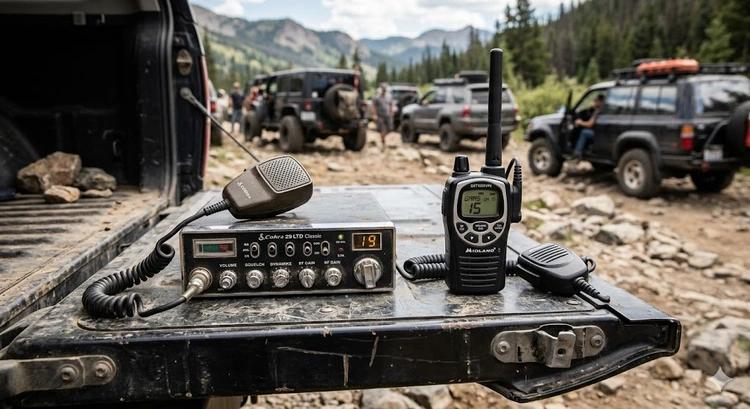
The choice between a handheld radio and a vehicle-mounted radio depends largely on how the communication system will be used. Handheld units prioritize portability and simplicity, while mobile radios generally provide greater installation flexibility, external antenna options, and power capability.
For many overlanding teams, the best solution may be to use both.
Handheld Radios
Handheld radios are compact, portable two-way radios with an integrated antenna and rechargeable or replaceable battery.
Their biggest advantage is flexibility. A driver can use the radio inside the vehicle, then take it when walking around camp, spotting a vehicle through an obstacle, checking a campsite, or hiking a short distance away.
Portability
A handheld radio can move with the user rather than remaining attached to a vehicle. This makes it particularly useful for groups where people frequently leave their vehicles.
A spare handheld can also serve as a useful backup if a vehicle-mounted system develops a problem.
Ease of Use
Handheld radios usually require little installation. Charge the battery, configure the appropriate channel, and the unit can be ready for use.
This makes them attractive for occasional overlanders who do not want to modify their vehicles.
Battery Limitations
Battery life is the major limitation. Heavy transmission, high-power settings, cold temperatures, and extended use can reduce operating time.
A serious overlanding trip should include a charging strategy and, ideally, spare batteries. Relying on one battery for several days can leave a vehicle without communication at exactly the wrong time.
Best Situations for Handheld Units
Handheld radios work particularly well for:
- Short trips and casual convoys
- Family camping
- Small groups
- Communication around camp
- Spotters guiding vehicles through obstacles
- Backup communication
- Travelers who do not want permanent vehicle installation
For short-range communication between vehicles that remain close together, a good handheld radio can be all that is necessary.
Vehicle-Mounted Radios
A mobile-mounted radio is installed inside the vehicle and connected to the vehicle’s electrical system and an external antenna.
The biggest advantage is the ability to create a more capable communication system without relying entirely on the small antenna and battery of a handheld radio.
Higher Power Options
Depending on the radio service and applicable regulations, mobile radios can offer higher transmit power than handheld units.
However, power should be considered alongside antenna quality and terrain. A higher-powered radio cannot eliminate a mountain or other major obstruction between vehicles.
External Antennas
A vehicle-mounted radio can use an external antenna positioned on the vehicle. This can provide advantages over the small antenna integrated into a handheld radio.
A properly selected and installed antenna can improve the effectiveness of the radio system, particularly when the antenna has a suitable mounting location and is matched to the radio’s operating frequency.
For overlanding, antenna durability is also important. A setup that performs well on pavement but repeatedly catches branches on narrow trails may not be practical.
Better Range Potential
Mobile radios can offer greater range potential because they can combine vehicle power, an external antenna, and a more substantial radio installation.
Actual range will still depend on terrain, antenna placement, frequency, interference, and whether communication is direct or through a repeater.
The important point is that a mobile radio’s advantage is not simply its transmitter power. The entire radio system—including the antenna and installation—contributes to its performance.
Permanent vs. Temporary Installation
A permanent installation keeps the radio and antenna ready whenever the vehicle is used. It can be neat and convenient, but it requires more installation work and may involve drilling or modifying the vehicle.
A temporary setup can be removed when the vehicle is used for everyday driving or when the owner wants to transfer the equipment between vehicles.
Magnetic antenna mounts and removable radio mounts can simplify temporary installations, although users should consider how securely the equipment will remain attached during rough trail driving.
Which Setup Is Best for Your Overlanding Team?
For most groups, the decision does not have to be handheld or mobile. A combination can provide better redundancy.
A vehicle-mounted radio can serve as the primary communication system while driving, especially during larger convoys or remote trips. Handheld radios can then be used by passengers, trail spotters, or drivers who leave their vehicles.
For a small group taking occasional weekend trips, handheld GMRS radios may be sufficient. For larger convoys or frequent backcountry travel, vehicle-mounted radios with properly installed external antennas offer greater capability.
A particularly robust setup is to equip each vehicle with a mobile radio while keeping at least one charged handheld radio available as a backup. For remote expeditions, satellite communication can then provide a separate communication path if the convoy becomes separated or a situation develops beyond the range of local radio communication.
How Far Can Overlanding Radios Communicate?
There is no single distance that applies to every overlanding radio. The usable range of a radio depends on its frequency, antenna, power, terrain, elevation, surrounding vegetation, interference, and whether the signal has a clear line of sight.
This is why a radio advertised as having a particular maximum range may perform very differently on an actual trail. A realistic expectation is more useful than a manufacturer’s best-case number.
Typical Real-World Ranges
For overlanding, think of radio range as a variable rather than a fixed specification.
A handheld radio may communicate effectively between vehicles that are relatively close together, but its usable range can decrease significantly when hills, dense vegetation, or other obstacles intervene. A vehicle-mounted radio with an external antenna can generally provide better range potential.
In ideal open terrain, two properly configured radios may communicate considerably farther than they would in a forest or mountain environment. However, there is no reliable way to guarantee a specific distance without considering the actual equipment and terrain.
The best approach is to test the radios before an important trip and establish the distance at which communication becomes unreliable.
Line-of-Sight Communication
Many terrestrial radio systems perform best when there is a relatively clear path between the transmitting and receiving antennas.
This is known as line-of-sight communication. The higher the antennas are positioned and the fewer obstacles between them, the better the conditions can be for radio communication.
This explains why two vehicles on opposite sides of a hill can lose contact even when they are only a short distance apart. The physical distance between the vehicles may be small, but the terrain blocks the radio path.
Elevation can work in the opposite direction. Two vehicles positioned at elevated locations with a relatively unobstructed path may communicate over considerably greater distances.
Mountain and Forest Conditions
Mountains are among the most challenging environments for vehicle-to-vehicle radio communication.
A steep ridge, canyon wall, or mountain can completely obstruct a direct signal. Dense forests can also reduce usable range, particularly when vehicles are traveling along winding trails where the signal path repeatedly changes.
This is one reason convoy leaders should avoid assuming that a radio will maintain contact throughout an entire mountain route.
If a group knows that the trail includes sections where communication may be blocked, it should establish meeting points and procedures for lost communication before departure.
Repeaters can sometimes improve coverage for compatible radio systems because they are installed at elevated locations and can receive and retransmit signals over a larger area. However, repeater availability and radio-service rules vary, and direct radio communication should not be assumed to work everywhere.
Flat/Open Terrain
Open terrain generally provides more favorable conditions for direct radio communication.
Deserts, plains, open grasslands, and other areas without major physical obstructions can allow vehicles to communicate at greater distances than they might in mountainous or heavily wooded environments.
A properly installed vehicle antenna can also help make better use of these conditions. Antenna height and placement influence how effectively the radio system can communicate over an unobstructed path.
Even in open country, atmospheric conditions, interference, antenna problems, and radio configuration can affect performance.
Vehicle-to-Vehicle Communication
Overlanding radios are usually used for vehicle-to-vehicle communication, so the relevant question is not “How far can this radio transmit?” but rather:
How reliably can the vehicles in my convoy communicate in the terrain where we are traveling?
For example, a convoy traveling close together on an open dirt road may have no difficulty communicating. The same radios could experience significantly shorter usable range when the convoy enters a forest or begins traveling through a mountain pass.
Vehicle-mounted radios generally have an advantage because they can use an external antenna and vehicle power. Handheld radios are easier to carry and deploy but have smaller antennas and limited battery capacity.
Why Radio Range Claims Vary
Radio manufacturers cannot know the exact terrain, antenna installation, vehicle configuration, interference, and environmental conditions in which every customer will use a radio.
As a result, advertised range figures are often based on favorable test conditions rather than typical overlanding conditions.
When comparing radios, pay attention to more than the advertised range. Consider:
- Radio frequency and service
- Legal transmit power
- Antenna type and quality
- Antenna mounting position
- Terrain and elevation
- Expected convoy spacing
- Battery capacity
- Vehicle installation
- Repeater availability
- Weather and environmental conditions
For most overlanders, reliable communication over the expected convoy distance is more valuable than an impressive maximum-range number.
The best way to determine practical performance is to test the complete setup in conditions similar to those expected on the trip. A radio that consistently maintains communication between the lead and trailing vehicles on your usual trails is more useful than one with a larger theoretical range that performs poorly in real terrain.
Best Communication Setup for Different Overlanding Scenarios
The ideal overlanding communication setup changes depending on the trip. A family spending a weekend at a nearby campsite has very different communication requirements from a convoy crossing a remote mountain range.
Instead of choosing the most expensive equipment available, match the communication system to the distance, terrain, group size, and level of remoteness involved.
Short Weekend Overlanding Trips
For a short weekend trip where vehicles remain relatively close together, a simple handheld radio system may be enough.
FRS radios can work for casual communication when the group stays close and does not need extensive vehicle-based equipment. GMRS handheld radios are another practical option, particularly for groups that want more flexibility and may eventually add vehicle-mounted radios.
The primary goals should be simplicity, sufficient battery life, and easy communication between vehicles.
A basic setup can include:
- One compatible handheld radio for each vehicle
- Spare or replaceable batteries
- Vehicle charging capability
- A primary communication channel
- A backup channel
- A simple procedure for vehicles that become separated
For short trips within cellular coverage, smartphones can provide a useful additional communication method.
Large Convoys and Group Trips
Large convoys benefit from a more organized communication system.
When many vehicles are traveling together, communication can quickly become confusing if everyone talks at once. A consistent radio system, clear channel assignments, and simple communication rules become increasingly important as the group grows.
GMRS is a practical choice for many U.S.-based recreational convoys because it supports handheld and vehicle-mounted equipment. A vehicle-mounted radio with an external antenna can serve as the primary system, while handheld units provide flexibility outside the vehicles.
The group should establish:
- A primary radio channel
- A backup channel
- Simple call signs
- Rules for emergency transmissions
- A procedure for lost vehicles
- A radio-check procedure before departure
Large groups should also avoid unnecessary transmissions. Keeping conversations brief makes it easier for the lead or trailing vehicle to communicate important information.
Remote Backcountry Expeditions
Remote expeditions require a more redundant communication strategy.
When the route travels far beyond cellular coverage, relying on a single radio system can create a significant communication gap if vehicles separate beyond radio range or terrain blocks the signal.
A stronger setup can combine:
- Vehicle-mounted radios
- Handheld radios
- Spare batteries
- Satellite communication
- GPS/location-sharing capability
- A backup power source
- Clearly defined emergency procedures
The radio system handles local convoy communication, while satellite equipment provides an additional communication pathway when the group needs to reach people outside the immediate radio network.
For extremely remote travel, the group should also have a clear emergency plan. Everyone should know who is responsible for initiating emergency communication and how the satellite device or other emergency equipment should be used.
Family Overlanding and Camping
Families generally benefit from communication equipment that is simple enough for everyone to use.
Handheld radios can be useful when family members split up around a campsite, walk short distances, or travel in multiple vehicles. A simple interface is often more valuable than advanced features that inexperienced users may find confusing.
Battery management is especially important. Children or passengers may use handheld radios more frequently than expected, so spare batteries or a convenient charging system are useful.
For family trips, the communication system should prioritize:
- Ease of operation
- Durable construction
- Good battery life
- Simple channel selection
- Clear audio
- Convenient charging
- Easy-to-understand emergency procedures
A smartphone can supplement the system when cellular service is available, but it should not be the only communication method when traveling into areas without coverage.
International Overlanding Trips
International overlanding introduces another issue: radio regulations vary by country.
A radio that is legal to transmit with in one country may operate under different frequency allocations, power limits, licensing rules, or equipment requirements elsewhere.
This is particularly important for travelers crossing multiple borders. Before entering another country, verify which frequencies and radio services are permitted and whether an individual license, local authorization, or other documentation is required.
Satellite communicators can also be useful for international travel, but their availability and legal status can vary depending on the country and service. Travelers should verify local regulations and service coverage before departure.
For an international expedition, a practical approach is to combine:
- A locally legal terrestrial radio system
- Smartphone/cellular communication where available
- Satellite communication for remote areas
- Backup power and spare batteries
- Printed or offline copies of important emergency information
The key is to avoid assuming that equipment rules are identical across borders.
How to Set Up Radios for an Overlanding Convoy
A radio is only useful to an overlanding convoy when everyone knows how to use it. Before departure, the group should agree on the communication system, channels, call signs, and procedures for common situations.
A few minutes of preparation can prevent confusion when vehicles become separated or encounter an unexpected obstacle.
Choose a Primary Communication System
Start by selecting one radio system that every vehicle in the convoy can use.
For example, a group may choose GMRS as its primary system and ensure that every vehicle has a compatible radio configured correctly. Mixing incompatible systems can create communication problems when the convoy needs to coordinate quickly.
If the group uses different types of radios, make sure there is a known channel or system through which everyone can communicate.
The primary system should be simple enough that every driver can operate it without taking significant attention away from driving.
Assign a Primary Channel
Choose one channel for normal convoy communication.
Everyone should configure their radio before the vehicles start moving. If the system uses CTCSS or DCS tones, those settings should also be confirmed.
Avoid changing channels randomly during the trip. If the group needs to move to another channel, establish a clear instruction such as “Switch to the backup channel.”
Establish a Backup Channel
A backup channel gives the group somewhere to move if the primary channel becomes congested or experiences interference.
The backup channel should be configured before departure rather than selected during an emergency.
For a large convoy, it can also be useful to establish a separate channel for nonessential conversations while keeping the primary channel available for navigation and safety communication.
Create Simple Radio Call Signs
Call signs help identify who is speaking, especially when several people are using the same channel.
They do not need to be complicated. A convoy could use identifiers such as “Lead,” “Two,” “Three,” and “Tail.”
For example:
“Lead, this is Tail. Vehicle Three has stopped.”
The important thing is consistency. Everyone should know which call sign belongs to which vehicle.
Establish Communication Rules
Before departure, agree on a few simple rules:
- Keep routine transmissions short.
- Identify the vehicle you are calling.
- Identify yourself when necessary.
- Avoid unnecessary conversations on the primary channel.
- Give important instructions clearly.
- Confirm critical information.
- Keep the emergency channel or procedure clear for urgent situations.
These rules become particularly valuable when the group contains many vehicles.
Perform a Radio Check Before Departure
Do not wait until the convoy is deep into the trail to discover that one vehicle’s radio cannot communicate.
Perform a radio check before leaving the meeting point.
Confirm that each radio:
- Powers on correctly
- Is configured to the correct channel
- Has sufficient battery or vehicle power
- Has clear transmit and receive audio
- Can communicate with the other vehicles
- Has the correct antenna connected and positioned properly
A short test while the vehicles are together can identify configuration problems before they become important.
Set Procedures for Vehicle Separation and Emergencies
The convoy should have a plan for what happens if a vehicle disappears from sight or loses radio contact.
For example, the group might agree that the trailing vehicle reports when the convoy becomes separated and that the lead vehicle stops at a predetermined location if a member fails to catch up.
The procedure should also address emergencies. Everyone should know which radio channel to use, how to announce an emergency, and who is responsible for coordinating the group.
If satellite communication is available, the team should also decide who carries the device and who has authority to initiate emergency messaging.
A communication plan does not need to be complicated. The goal is to make the expected response obvious when drivers are tired, stressed, or dealing with difficult terrain.
How to Mount and Install a Vehicle Radio
A vehicle-mounted radio can provide a more capable communication setup than a handheld unit, but installation quality matters. Poor antenna placement, unsafe wiring, an inconvenient microphone position, or a poorly protected radio can reduce reliability and create distractions while driving.
The exact installation process varies by radio, vehicle, and radio service, so always follow the equipment manufacturer’s installation requirements and applicable electrical and radio regulations.
Choosing the Radio Mounting Location
Start by selecting a location that allows the driver to operate the radio without taking significant attention away from the trail.
The radio should be:
- Securely mounted
- Easy to reach
- Protected from unnecessary water exposure
- Away from excessive heat
- Positioned so the display can be seen when needed
- Installed without interfering with airbags, controls, or passenger movement
Under-dash locations, center consoles, overhead mounting areas, and dedicated vehicle accessory panels can all work depending on the vehicle.
Avoid placing the radio where it can interfere with steering, pedals, gear selection, airbag deployment, or other essential controls.
For an overlanding vehicle, durability is also important. The radio should be firmly secured so repeated vibration and rough terrain do not loosen the mounting hardware.
Installing the Antenna
The antenna is one of the most important components of a vehicle radio system.
Choose an antenna designed for the specific frequency and radio service being used. An antenna intended for one frequency range may not perform properly on another.
Common vehicle mounting options include magnetic mounts, hood mounts, roof mounts, and permanent mounts. The best choice depends on the vehicle, antenna, terrain, and how frequently the equipment will be removed.
A higher and more open antenna position can provide useful advantages, but overlanding vehicles must also deal with low branches, rocks, narrow trails, and other obstacles. A physically vulnerable antenna is not necessarily a good trail antenna.
The antenna cable should be routed carefully to prevent crushing, sharp bends, abrasion, and interference with doors or moving components. Any permanent installation should also protect cable entry points against water intrusion.
For systems where antenna grounding or a vehicle ground plane is important, follow the antenna manufacturer’s installation requirements rather than assuming that any mounting location will perform equally well.
Routing Power Safely
Vehicle radios should have a properly designed power connection.
Do not simply connect a radio to an arbitrary wire because it appears convenient. The circuit should be appropriately protected with the required fuse or circuit protection, and wiring should be sized for the equipment’s electrical demand.
Power cables should be routed away from excessive heat, sharp edges, moving parts, and areas where they could become pinched.
For installations connected directly to the vehicle battery, appropriate circuit protection should be positioned according to the equipment and vehicle electrical requirements.
If the overlanding vehicle uses an auxiliary battery or power-management system, the radio can potentially be integrated into that system. This can help prevent communication equipment from unnecessarily draining the vehicle’s starting battery during extended stops.
Positioning the Microphone
The microphone should be positioned where the driver can reach it without making awkward movements.
A remote microphone mounted near the driver can be particularly useful because it keeps the radio itself out of the immediate operating area.
The microphone cable should be routed so it does not interfere with steering, shifting, seat movement, or other vehicle controls.
For vehicles with substantial road and engine noise, consider whether the microphone provides adequate audio clarity. A poor microphone position can make transmissions difficult for the rest of the convoy to understand even when the radio itself is working correctly.
Testing the System Before Hitting the Trail
Never consider a radio installation complete until the entire system has been tested.
First, verify that the radio powers on correctly and that all controls work as expected. Then check transmission and reception with another compatible radio.
Test the system from inside the vehicle and, if practical, at different distances. Pay attention to audio clarity rather than simply whether another radio can barely hear the transmission.
A good pre-trip test should also include:
- Checking the antenna connection
- Confirming the selected channel
- Confirming CTCSS/DCS settings where applicable
- Checking the microphone
- Inspecting power wiring and fuses
- Checking battery or auxiliary-power availability
- Testing communication between multiple convoy vehicles
- Confirming the backup communication method
If possible, test the equipment in terrain similar to the route you plan to travel. A system that works perfectly in a driveway may behave differently once hills, forests, and vehicle separation are introduced.
Radio Communication Etiquette for Overlanding
Good radio etiquette keeps a convoy’s communication channel usable. This becomes increasingly important as the number of vehicles increases or the trail becomes more difficult.
The objective is simple: make important information easy to hear and understand while keeping unnecessary transmissions to a minimum.
Keep Transmissions Short
Radio channels are shared communication spaces. Long conversations can prevent other drivers from transmitting important information.
Keep routine messages concise and communicate only what the group needs to know.
Instead of explaining a situation for several minutes, give the essential information first. Additional details can be provided if another driver asks for them.
Identify Who You Are Calling
Start a transmission by identifying the person or vehicle you want to reach.
For example:
“Lead, this is Three. Large rock ahead on the right.”
This is much clearer than simply saying, “There’s a rock ahead,” especially when multiple vehicles are using the same channel.
Avoid Unnecessary Chatter
Casual conversation can quickly fill a busy convoy channel.
A little friendly conversation is fine, but the primary channel should remain available for navigation, trail conditions, vehicle problems, and safety-related information.
If the group has a secondary channel, nonessential conversations can be moved there when appropriate.
Use Clear Language
Radio communication should be easy to understand, particularly when the vehicle is moving over rough terrain or dealing with engine and road noise.
Use ordinary language and avoid unnecessarily complicated terminology.
When giving directions, be specific. Instead of saying “Watch out,” explain what the driver should expect:
“Narrow section ahead. Stay to the left of the large rock.”
Clear instructions reduce the chance of misunderstanding.
Confirm Important Instructions
If a message contains an important instruction, confirm that you received it.
For example:
“Lead, Three. Copy—stopping at the junction.”
This gives the sender confidence that the information was understood.
Confirmation is particularly valuable when communicating about obstacles, route changes, regrouping points, or emergencies.
Establish Emergency Communication Procedures
Every group should establish what qualifies as an emergency and how an emergency transmission should begin.
A simple procedure could require a driver to clearly state that the message is an emergency before providing the location and nature of the problem.
For example:
“Emergency, Emergency. This is Vehicle Four. We have a medical problem at the trail junction.”
The exact procedure should be agreed upon before departure.
Remember that a radio transmission does not automatically reach emergency services. A local radio may only reach other compatible radios within usable range. For remote expeditions, satellite communication or another appropriate emergency communication method can provide an additional way to request assistance.
Common Overlanding Communication Mistakes to Avoid
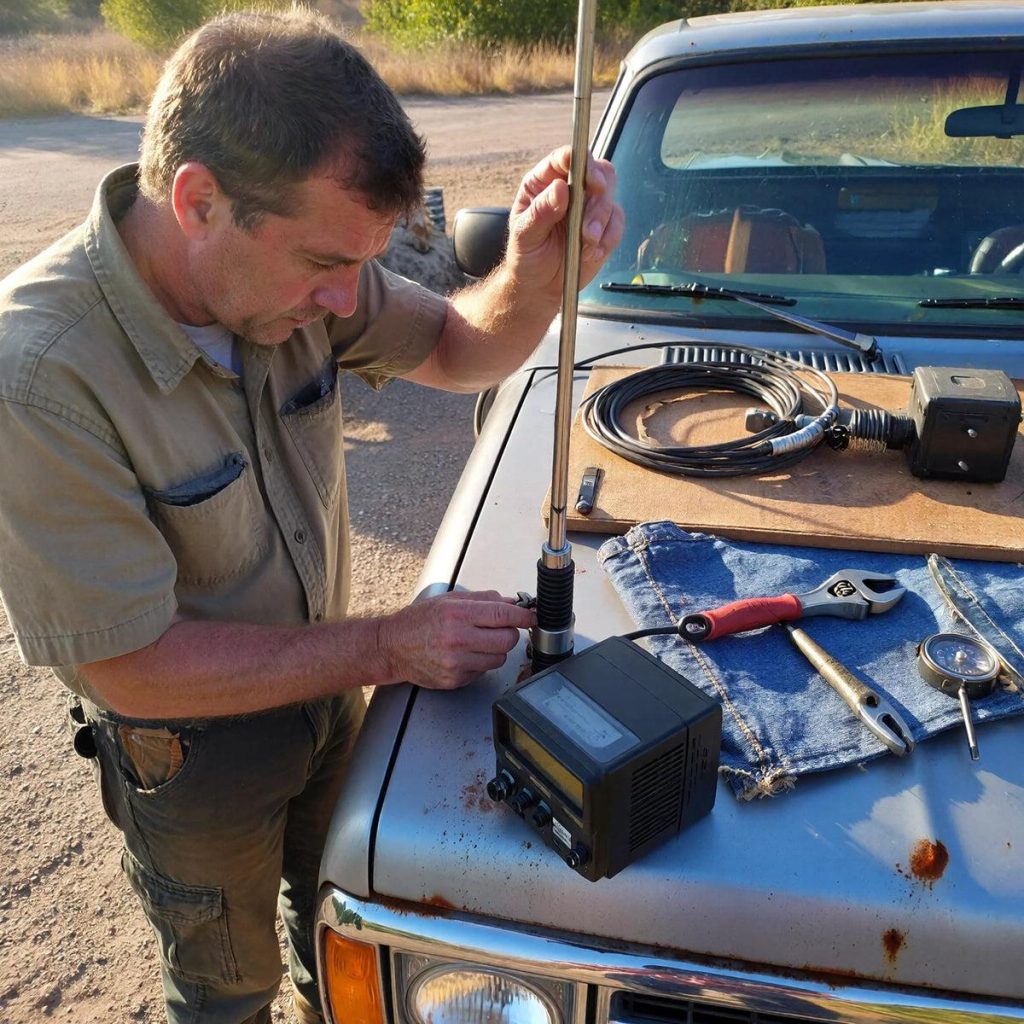
A communication system can appear simple until the convoy actually needs it. Many problems come not from the radio itself but from poor planning, incorrect configuration, unrealistic expectations, or a lack of backup equipment.
Avoiding these common mistakes can make an overlanding communication setup considerably more reliable.
Buying Based Only on Advertised Range
Maximum range figures are often measured under conditions that do not resemble real trails.
Mountains, forests, hills, buildings, antenna placement, and vehicle orientation can dramatically change usable range.
Instead of choosing a radio solely because it advertises the greatest distance, consider the terrain and convoy spacing you actually expect.
Using Incompatible Radio Systems
A group cannot communicate simply because everyone owns a “walkie-talkie.”
Different radio services, frequencies, channel configurations, and operating rules can prevent communication.
Before a trip, make sure every vehicle’s equipment is compatible and configured correctly. If the group uses different radio systems, establish exactly how communication will work before departure.
Ignoring Licensing Requirements
Radio regulations vary by service and country.
For example, GMRS operation in the United States requires an FCC license, while FRS and CB have different licensing rules. Amateur radio also requires the appropriate license before transmitting. International travelers must consider the regulations of each country they enter.
Never assume that a radio sold legally in a particular market can automatically be used in every country.
Choosing a Poor Antenna
A radio’s performance can be limited by its antenna.
A low-quality antenna, incorrect frequency range, poor mounting location, damaged cable, or bad installation can reduce communication reliability.
For vehicle-mounted systems, pay particular attention to antenna type, mounting position, cable routing, and the requirements of the radio service.
Forgetting Spare Batteries
A handheld radio is useless when its battery is empty.
This is especially easy to overlook on multi-day trips where vehicles may spend long periods away from reliable charging.
Carry spare batteries when the radio supports them, and have a practical charging method available. Include radios in the vehicle’s overall power-management plan rather than treating them as an afterthought.
Relying on One Communication Method
No single communication technology works perfectly everywhere.
A radio may lose contact when terrain blocks the signal. Cellular service may disappear completely. A satellite communicator may require an unobstructed view of the sky and sufficient battery power.
For remote travel, redundancy is therefore more important than having one exceptionally expensive device.
A practical combination can include local radio communication, a smartphone, and satellite communication.
Failing to Test Radios Before Departure
A radio that has never been tested should not be considered ready for an expedition.
Before leaving, verify the channel, tones, antenna, microphone, battery, power connection, and communication between vehicles.
A short test at the meeting point can reveal incorrect settings that would otherwise become a problem miles into the trail.
Assuming a Radio Provides True Emergency Communication Everywhere
This is one of the most important mistakes to avoid.
A two-way radio does not automatically provide a connection to emergency services. Its usefulness depends on another compatible radio, repeater, or other communication infrastructure being within effective range.
If the convoy is truly remote, consider carrying a satellite communicator or another appropriate emergency signaling device.
The safest communication strategy is layered: use radios for immediate group coordination, cellular communication when coverage exists, and satellite-based communication when the trip takes you beyond reliable terrestrial networks.
How to Build a Redundant Communication System
Remote overlanding is one of those situations where communication redundancy can make a major difference. A single device may work perfectly for most of a trip but become useless if its battery dies, the vehicle is damaged, cellular coverage disappears, or terrain blocks the signal.
A redundant communication system uses multiple technologies so that losing one communication method does not leave the group completely disconnected.
Primary Radio
Start with a primary radio system for day-to-day convoy communication.
For many overlanding groups, this can be a GMRS system with compatible handheld or vehicle-mounted radios. Other groups may choose CB or amateur radio depending on their equipment, experience, and applicable regulations.
The primary radio should handle routine communication such as:
- Trail navigation
- Obstacle warnings
- Vehicle spacing
- Regrouping
- Mechanical problems
- Route changes
- Communication between the lead and trailing vehicles
The system should be simple enough that every driver knows how to use it before the trip begins.
Backup Radio
A backup radio provides another option if the primary unit fails.
For example, a driver using a vehicle-mounted radio could keep a charged handheld radio inside the vehicle. If the vehicle radio loses power or its antenna becomes damaged, the handheld can provide short-range communication.
The backup does not necessarily need to provide the same performance as the primary system. Its main purpose is to prevent a single equipment failure from eliminating local communication.
Spare batteries are equally important. A backup radio with a dead battery is not much of a backup.
Satellite Communicator
A satellite communicator adds a communication pathway that does not depend on nearby convoy vehicles or cellular towers.
Depending on the device and service, satellite equipment can support two-way messaging, location sharing, tracking, and SOS functionality.
This makes it particularly valuable when traveling through remote areas where the group may become separated or where terrestrial communication infrastructure is unavailable.
Satellite equipment should be kept accessible rather than buried in luggage. In an emergency, finding and activating the device should be straightforward.
Smartphone
A smartphone remains useful even when other communication equipment is available.
When cellular service exists, it can provide voice calls, messaging, internet access, navigation, weather information, maps, and location sharing.
Offline maps are especially valuable because they can continue to provide navigation information after cellular coverage disappears.
However, a smartphone should be treated as one layer of the communication system rather than the only option for remote travel. Battery conservation is also important because the phone may be needed for navigation or emergency contact later in the trip.
Emergency Signaling Equipment
For serious backcountry travel, communication equipment can be supplemented by dedicated emergency signaling equipment appropriate to the route and risk level.
Depending on the trip, this may include a satellite communicator with SOS capability, a dedicated distress beacon, visual signaling equipment, or other emergency equipment suitable for the environment.
The important point is that emergency signaling should be planned separately from routine convoy communication.
A radio may be perfect for telling the vehicle behind you about a broken axle, but that does not necessarily mean it can summon emergency services.
Why Redundancy Matters in Remote Travel
Redundancy protects against several different failure scenarios.
A vehicle-mounted radio could stop working after an electrical problem. A handheld could run out of battery. Cellular coverage could disappear. A satellite device could be inaccessible or have insufficient power.
With multiple communication layers, the failure of one system does not necessarily eliminate every option.
A practical hierarchy could look like this:
Primary: Vehicle-mounted radio for convoy communication
Backup: Handheld radio for local communication
Cellular: Smartphone when network coverage exists
Remote backup: Satellite communicator
Emergency: Dedicated emergency signaling capability where appropriate
The exact combination depends on the trip. A short weekend outing may not require every layer, while a remote multi-day expedition can justify much more redundancy.
The goal is not to carry every communication device available. The goal is to ensure that a single failure does not leave the group without a practical way to communicate.
Best Radio Setup for Overlanding Teams: Quick Recommendations
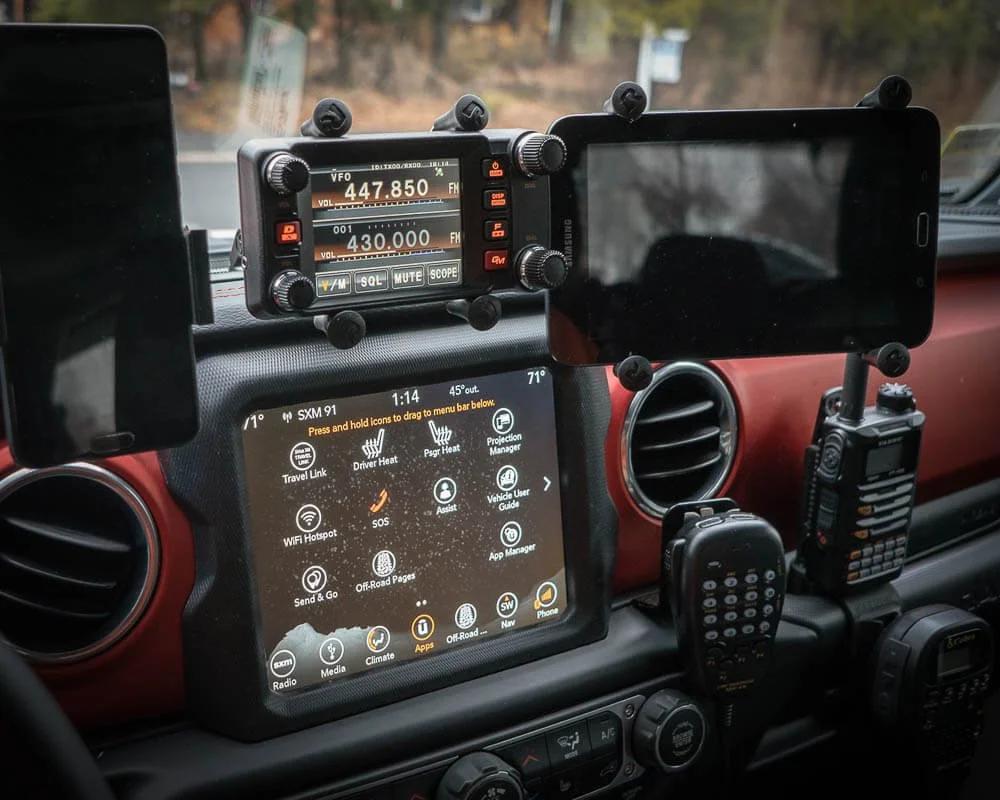
There is no universal best communication device for every overlanding team. The right setup depends on group size, terrain, trip duration, regulatory requirements, and how remote the route will be.
A useful way to narrow the choices is to match each technology with the situation it handles best.
Best for Most Overlanding Groups: GMRS
GMRS is a strong all-around choice for many overlanding groups operating in the United States.
It can support both handheld and vehicle-mounted equipment, making it possible to use one communication system across different situations. A handheld can be carried away from the vehicle, while a mobile radio with an external antenna can serve as the primary vehicle communication system.
For organized groups, the ability to establish shared channels and use compatible equipment makes GMRS particularly practical.
Remember that GMRS licensing and operating rules apply in the United States, and regulations differ internationally.
Best for Simple Short-Range Communication: FRS
FRS is a good choice when simplicity is the priority and vehicles remain relatively close together.
It is particularly suitable for casual camping trips, family outings, and short convoys where users want inexpensive handheld communication without installing equipment in vehicles.
Its limitations become more significant as the distance between vehicles and the difficulty of the terrain increase.
Best for Traditional Vehicle Communication: CB
CB remains a practical option for people who prefer a traditional vehicle-mounted radio system.
It can work well for vehicle-to-vehicle communication when properly installed, particularly for users who already have compatible CB equipment.
Its performance depends heavily on antenna installation and environmental conditions, and it does not offer the same flexibility as some newer radio options.
Best for Advanced Users: Ham Radio
Amateur radio is best suited to overlanders who are willing to obtain the appropriate license and learn how to operate the equipment correctly.
It offers considerably more flexibility than basic personal radio services and can provide access to different frequencies, repeaters, and communication modes.
For someone who simply wants a push-to-talk device for a weekend convoy, that additional capability may be unnecessary. For experienced radio operators and technically inclined travelers, however, it can be extremely valuable.
Best for Remote Emergency Messaging: Satellite Communicator
A satellite communicator is particularly valuable when an overlanding route goes beyond dependable cellular coverage.
Supported devices can provide two-way messaging, location sharing, tracking, and SOS functions through satellite networks.
It is especially useful when the group needs to communicate with someone outside the immediate convoy or needs an emergency communication pathway that does not depend on a nearby radio user.
Best Overall Strategy: Combine Radio + Satellite Communication
For remote overlanding, combining technologies is usually more resilient than choosing one device and expecting it to handle every situation.
Use a terrestrial radio for fast, local communication between vehicles. Keep a smartphone available for cellular communication and offline navigation. Add a satellite communicator when traveling into areas where cellular coverage is unreliable or nonexistent.
This layered approach separates everyday convoy communication from remote and emergency communication.
The result is a communication system that is practical for normal trail driving while still providing another option when the group encounters the limitations of terrestrial networks.
Frequently Asked Questions About Overlanding Radios
What Is the Best Radio for Overlanding?
For many overlanding groups in the United States, GMRS is a practical all-around choice because it supports both handheld and vehicle-mounted equipment. The best option ultimately depends on the group’s terrain, communication distance, experience, and local regulations.
Is GMRS or CB Better for Overlanding?
GMRS is often more flexible for modern overlanding groups because it can be used with handheld and mobile equipment and supports repeater operation under applicable rules. CB remains useful for traditional vehicle communication and may be preferable for users who already have CB equipment.
How Far Can a GMRS Radio Reach While Overlanding?
There is no guaranteed distance. Terrain, antenna position, power, elevation, vegetation, and vehicle separation all affect usable range. Open terrain can provide considerably better communication than mountainous or heavily wooded areas.
Do You Need a License to Use a GMRS Radio?
In the United States, GMRS operation requires an FCC license. Other countries have their own rules, so international overlanders should verify local requirements before transmitting.
Are Handheld or Vehicle-Mounted Radios Better for Overlanding?
Vehicle-mounted radios generally offer greater range potential because they can use an external antenna and vehicle power. Handheld radios are more portable and useful when users leave their vehicles. For many teams, carrying both provides the most flexibility.
Can Overlanding Radios Work Without Cell Service?
Yes. GMRS, FRS, CB, and amateur radios can communicate directly without cellular service when compatible radios are within usable range. Their range is still affected by terrain and other conditions.
Do I Need a Satellite Communicator If I Have a Radio?
For trips into remote areas, a satellite communicator can provide valuable redundancy. A local radio may not reach anyone if the convoy becomes widely separated or terrain blocks the signal, while a satellite device can provide messaging or SOS capability through a satellite network on supported services.
What Is the Best Communication Device for an Overlanding Convoy?
For many convoys, a shared radio system such as GMRS is a practical primary option. Larger or more remote groups can improve redundancy by adding vehicle-mounted radios, handheld backups, and satellite communication.
Can Different Brands of GMRS Radios Communicate With Each Other?
Yes, compatible GMRS radios can communicate across different brands when they operate on the same permitted channels and are configured with compatible settings. The brand itself is less important than frequency/channel compatibility and proper configuration.
What Should I Do If My Overlanding Group Gets Separated?
Try the established primary radio channel first, then the backup channel if one has been designated. Follow the group’s prearranged regrouping procedure rather than driving randomly in search of the other vehicles.
If cellular service is available, use the phone as another communication method. In remote areas, a satellite communicator can provide an additional way to share location or communicate when local radio contact cannot be restored.
How Can I Improve My Radio Range While Overlanding?
Start with the antenna and installation rather than simply increasing transmit power. A suitable external antenna, appropriate mounting position, correct configuration, and a clear line of sight can significantly affect communication performance.
Also remember that terrain can be the limiting factor. A higher-powered radio cannot reliably overcome a mountain or other major physical obstruction.
Read More: Sleeping Arrangements: Vehicle Tents and Setups for Overlanding