
A good night’s sleep can make or break a camping trip. While your sleeping bag or quilt keeps you warm, the surface underneath you plays a major role in how comfortable you actually feel. That is why the choice between a camping cot vs sleeping pad deserves more attention than simply choosing whichever option looks softer.
A camping cot lifts you off the ground and provides a stable, elevated sleeping platform. A sleeping pad, meanwhile, cushions your body while also providing insulation against the cold ground. Modern sleeping pads range from lightweight closed-cell foam models to thick air and self-inflating designs that can provide surprisingly mattress-like comfort.
The better option depends on how and where you camp. A cot can be especially comfortable for car camping, base camps, and campers who prefer sleeping above the ground. A quality sleeping pad is generally more practical for backpacking because it weighs less and packs much smaller. It can also be the better choice in cold conditions because its insulation is measured using an R-value.
For maximum comfort, you do not necessarily have to choose one. Using a sleeping pad on top of a camping cot can combine the benefits of both systems—elevation, cushioning, stability, and insulation.
Camping Cot vs Sleeping Pad: What’s the Difference?
Although both are designed to improve outdoor sleeping comfort, a camping cot and sleeping pad solve different problems.
What Is a Sleeping Pad?
A sleeping pad is a cushioned layer placed between you and the ground. Its two primary functions are comfort and insulation. It cushions pressure points such as your shoulders and hips while reducing heat loss to the ground.
There are three main types:
- Air pads: Inflatable pads that are generally lightweight, compact, and highly adjustable. You can add or release air to change firmness.
- Self-inflating pads: Combine air with open-cell foam to provide cushioning, support, and insulation. They are generally thicker and more comfortable than basic foam pads.
- Closed-cell foam pads: Lightweight, inexpensive, and highly durable, although they are usually firmer and less plush than inflatable options.
For comfort, thickness and dimensions matter, but insulation is equally important. Sleeping pads use R-value to indicate thermal resistance; a higher R-value generally means greater insulation from cold ground. Current camping guidance ranges from low-R-value pads for warm conditions to R-values of 5.5 or higher for very cold conditions.
What Is a Camping Cot?
A camping cot is a portable bed consisting of a fabric sleeping surface stretched over a folding or collapsible frame. Unlike a sleeping pad, it raises your body several inches above the tent floor or campsite surface.
That elevation provides several comfort advantages. You do not have to sleep directly on rocks, roots, or uneven ground, and getting into and out of bed is easier than lowering yourself onto a floor-level pad. The space underneath can also provide useful storage for camping equipment.
The main limitation is that a cot itself does not provide the same ground insulation as a sleeping pad. Because air can circulate underneath an elevated cot, the sleeping surface can become cold in lower temperatures. For cold-weather camping, adding an appropriately insulated sleeping pad is therefore a much better approach than relying on the cot alone.
How Their Comfort Works Differently
The fundamental difference is where the comfort comes from.
A cot provides comfort primarily through elevation, support, stability, and separation from the ground. It can feel more like a traditional bed, particularly for campers who dislike sleeping close to the floor.
A sleeping pad provides comfort through cushioning and insulation. A thick air or self-inflating pad can distribute body pressure and allow you to adjust firmness, while its insulation helps prevent the ground from drawing away body heat.
This distinction explains why neither option is automatically more comfortable for everyone. A camper who values a raised sleeping position may strongly prefer a cot, while a side sleeper who needs substantial cushioning may sleep better on a thick sleeping pad.
For many car campers and overlanders, the most comfortable solution is a cot with a quality sleeping pad on top. The cot provides the elevated platform, while the pad adds cushioning and thermal insulation.
Camping Cot vs Sleeping Pad: Head-to-Head Comfort Comparison
| Comfort Factor | Camping Cot | Sleeping Pad |
|---|---|---|
| Overall comfort | Excellent for elevated, bed-like sleeping | Excellent with a quality thick pad |
| Cushioning | Moderate on its own | Excellent with air/self-inflating models |
| Ground insulation | Limited without a pad | Excellent when properly rated |
| Uneven ground | Excellent | Good, but campsite preparation matters |
| Getting in/out | Easier | Requires getting close to the ground |
| Sleeping position | Stable and relatively firm | Adjustable cushioning and firmness |
| Portability | Bulky and heavier | Generally lighter and more compact |
| Backpacking | Usually impractical | Excellent |
| Car camping | Excellent | Excellent |
| Cold weather | Needs additional insulation | Strong option with suitable R-value |
| Best overall setup | Cot + sleeping pad | Sleeping pad alone or paired with a cot |
Which Feels More Like a Bed?
A camping cot generally wins if your definition of comfort is a raised, stable, bed-like sleeping surface. Its height makes it easier to sit down, stand up, and change sleeping positions without being directly on the tent floor.
However, a cot’s fabric surface may not provide enough pressure relief by itself. Adding a thick sleeping pad can significantly improve the experience.
Which Provides Better Cushioning?
A quality sleeping pad usually has the advantage here. Modern air and self-inflating pads can be several inches thick and allow campers to adjust firmness. This is particularly useful for people who experience pressure around their hips or shoulders. REI’s 2026 testing, for example, found thick self-inflating pads particularly strong for comfort-focused campers and side sleepers.
Basic closed-cell foam pads are different: they are durable and reliable but considerably firmer and generally less comfortable than thicker inflatable designs.
Which Is Better for Warmth?
A sleeping pad has a major advantage because it is specifically designed to insulate against ground temperatures. Its R-value gives you a useful way to compare thermal resistance.
A cot alone does not replace that insulation. In cool or cold weather, placing an insulated sleeping pad on the cot can provide both the elevation of the cot and the thermal protection of the pad.
Which Is Better for Uneven Ground?
A cot can make an uneven campsite feel more manageable because your sleeping surface remains elevated above small rocks, roots, and irregularities.
A sleeping pad still requires a reasonably suitable tent floor. While the pad cushions minor imperfections, sharp rocks or roots should be cleared before setting up camp.
The Comfort Winner Depends on Your Priorities
There is no universal winner in the camping cot vs sleeping pad debate. For elevated sleeping and easy access, the cot has the edge. For cushioning, insulation, portability, and versatility, a quality sleeping pad is usually better.
If maximum comfort is the priority and you are car camping or overlanding, combining the two is often the strongest setup.
Which Is More Comfortable for Different Sleeping Positions?
Your preferred sleeping position can significantly change the answer to the camping cot vs sleeping pad question. What feels comfortable to a back sleeper may feel too firm for a side sleeper, while stomach sleepers often need a more stable surface.
Side Sleepers
Side sleepers usually place more pressure on the hips and shoulders because those areas carry much of the body’s weight. A thin or poorly inflated pad can allow these pressure points to sink too far, creating discomfort during the night.
For side sleeping, a thicker air or self-inflating pad is generally a better choice than a basic foam pad. Look for enough thickness to cushion the hips and shoulders without allowing your body to bottom out. A wider pad can also help if you move around during sleep.
A camping cot can provide a stable, elevated platform, but the cot fabric itself may not offer enough cushioning. For this reason, a cot combined with a comfortable sleeping pad can be particularly effective for side sleepers.
Back Sleepers
Back sleepers often do well with a stable surface that supports the body’s natural alignment. A cot can feel comfortable because its relatively firm surface does not allow the body to sink deeply.
However, a sleeping pad gives you more control over cushioning. An inflatable or self-inflating model can provide enough support while reducing pressure around the lower back and shoulders.
Avoid inflating an air pad excessively just because you want maximum firmness. Too much pressure can make the surface feel rigid rather than supportive. Adjusting the firmness to your body and sleeping position is usually more important than simply choosing the thickest pad.
Stomach Sleepers
Stomach sleepers generally benefit from a relatively stable sleeping surface. A pad that is excessively soft can allow the hips to sink, while an overly firm surface may create pressure around the chest and hips.
A moderately firm air or self-inflating pad can work well. A cot can also provide a stable base, particularly when paired with a thin-to-moderate cushioning layer.
Taller and Larger Campers
Body dimensions should be considered before choosing either system. A sleeping pad that is too short or narrow can leave your feet or shoulders hanging off the usable surface, while a narrow cot may restrict movement.
Look for long or wide versions when available and check the manufacturer’s dimensions and weight capacity rather than assuming every camping cot or sleeping pad will fit comfortably.
Campers Who Have Difficulty Getting Up From the Ground
This is one area where a cot has a clear practical advantage. A raised cot makes sitting down and standing up easier than a floor-level sleeping pad.
For older campers, people with limited mobility, or anyone who simply dislikes getting down on the tent floor, the extra height can be more valuable than additional pad thickness.
Comfort winner: There is no single winner for every sleeper. Side sleepers often benefit from a thick, supportive pad, while campers who prioritize elevation and easy access may prefer a cot. For the broadest combination of support and convenience, a cot with a sleeping pad is often the most versatile option.
Camping Cot vs Sleeping Pad for Different Camping Styles
The best sleep system depends heavily on how you travel. A setup that works perfectly at a drive-in campground may be completely impractical when you have to carry every item several miles.
Car Camping
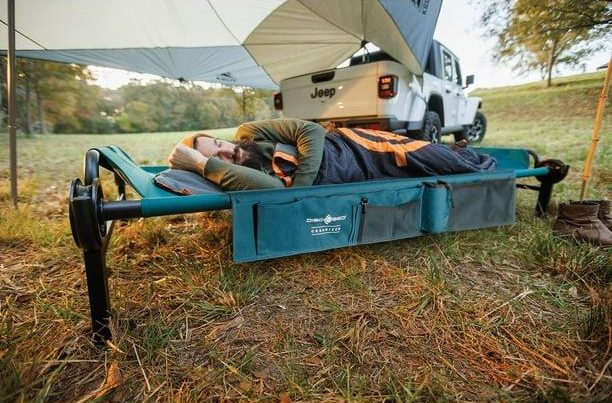
Best choice: Camping cot or cot + sleeping pad
Car camping gives you much more freedom to prioritize comfort because you don’t have to carry your sleeping system on your back.
A camping cot provides an elevated sleeping platform, keeps you away from the tent floor, and makes getting in and out of bed easier. You can also add a sleeping pad, blanket, or other cushioning layer without worrying as much about packed weight.
For maximum comfort, a cot plus an insulated sleeping pad is an excellent car-camping combination.
Backpacking

Best choice: Sleeping pad
When backpacking, every extra pound and every cubic inch of pack space matters. A traditional camping cot is generally too bulky and heavy for most backpacking trips.
Sleeping pads are designed specifically for this situation. Lightweight inflatable pads can pack down remarkably small, while closed-cell foam pads provide an extremely simple and durable option.
For backpacking, prioritize the balance between weight, packed size, comfort, and insulation rather than choosing the thickest pad available.
Overlanding and Base Camping

Best choice: Cot + sleeping pad
Overlanding sits between car camping and traditional backpacking. Because the vehicle carries your equipment, you can afford to bring a larger and more comfortable sleep system.
A cot gets you off the ground and can provide storage space underneath. A sleeping pad adds cushioning and insulation.
This combination is especially useful when you establish a base camp for several nights and sleeping comfort becomes more important than minimizing equipment weight.
Family Camping

Best choice: Cot or sleeping pad depending on space
For family camping, cots can make sleeping arrangements easier, particularly for adults who prefer an elevated bed. They can also make it easier to get children in and out of sleeping areas.
However, multiple cots can consume considerable tent floor space. Sleeping pads are usually easier to arrange side by side and are simpler to transport when several people are camping together.
If tent space is limited, check the sleeping area dimensions before choosing cots.
Cold-Weather Camping

Best choice: Insulated sleeping pad or cot + insulated sleeping pad
Cold-weather comfort depends heavily on insulation. A sleeping pad’s R-value measures its resistance to heat transfer through the pad. Current standardized testing makes R-values more useful for comparing pads across brands.
As a general guide, REI lists pads below R-2 for warm conditions, R-2 to 3.9 for cool conditions, R-4 to 5.4 for cold conditions, and R-5.5 or higher for very cold conditions. Actual requirements also depend on the ground, sleeping bag, clothing, and individual tolerance to cold.
A cot alone should not be treated as a substitute for an insulated sleeping pad. The air beneath an elevated cot can make the sleeping surface feel cold, so adding an appropriate pad is particularly important when temperatures drop.
Summer Camping

Best choice: Camping cot for airflow and sleeping pad for portability
A cot can be very comfortable during warm weather because air can circulate underneath the sleeping surface. This can help reduce the stuffiness associated with sleeping directly against the ground.
A sleeping pad remains a good option when portability matters. For warm summer nights, you generally don’t need the same level of insulation required for winter camping, so a lighter pad can be sufficient.
Camping-style winner: Choose a cot for comfort-focused car camping, a sleeping pad for backpacking, and both for overlanding or base camping where weight and packed size are less restrictive.
Camping Cot vs Sleeping Pad: Weight, Setup, Space, and Durability
Comfort isn’t the only factor to consider. The practical differences in weight, setup, storage, and durability can determine whether a particular sleep system actually works for your trip.
Weight and Packed Size
A sleeping pad generally has a major advantage in portability. Lightweight backpacking pads can weigh around a pound or less, although larger and more heavily insulated models can weigh considerably more.
Camping cots require a frame, legs, hinges, and fabric, so they typically take up more space and add more weight. Some ultralight cots reduce this penalty, but they still generally cannot match a compact sleeping pad for packability.
This makes the decision straightforward for many backpackers: if you have to carry your sleeping system for miles, a sleeping pad is usually the better choice.
For vehicle-based camping, however, the extra weight of a cot may be less important.
Setup and Breakdown
A sleeping pad is generally simple to deploy. Foam pads unfold or unroll, while inflatable pads require inflation. Self-inflating pads expand after opening their valves but may still need additional air to achieve your preferred firmness.
Cots require unfolding or assembling the frame and locking the legs or supports into position. Some models are very quick to set up, while others involve more components.
For frequent overnight moves, the simplicity of a sleeping pad can be a significant advantage.
Tent and Floor Space
A sleeping pad uses only the space occupied by your sleeping body. A cot requires enough floor area for its entire frame and may also require adequate tent height.
Before purchasing a cot, measure the tent’s interior floor dimensions, not just its advertised sleeping capacity. A tent that comfortably fits several sleeping pads may feel crowded once cots are installed.
Cots can also create useful storage space underneath. You may be able to keep shoes, bags, or other equipment beneath the sleeping surface rather than placing everything around the tent.
Durability
Durability depends heavily on the construction of the specific product.
Closed-cell foam pads are particularly reliable because they contain no air chambers or valves and cannot be punctured. Inflatable pads are comfortable and compact but require more care around sharp rocks, branches, and other hazards.
Cots avoid puncture problems but introduce mechanical components such as hinges, joints, legs, and frame connections. A damaged frame or locking mechanism can make the cot unusable.
For either system, campsite preparation matters. Clear sharp objects from underneath your tent, follow the manufacturer’s weight limits, and inspect equipment before trips.
Which Is Easier to Store?
Sleeping pads generally win because they compress or roll into relatively small packages. Cots need enough storage room for their folded frame and may be awkward to fit into small vehicles or closets.
The difference becomes less important for overlanders and car campers who have dedicated gear-storage space.
Practical winner: Choose a sleeping pad for minimum weight and packed size, while a cot is better when vehicle storage, setup space, and comfort matter more than portability. If you have enough room, combining a cot with a sleeping pad offers the most complete sleep system.
Should You Choose a Camping Cot, Sleeping Pad, or Both?
The best choice depends on how you camp, how much space you have, and what you consider comfortable. There is no universal winner in the camping cot vs sleeping pad debate because each solves a different problem.
Choose a Camping Cot If You Want…
A cot is a strong choice if you prefer sleeping above the ground rather than directly on the tent floor.
Choose a cot if you value:
- Easier entry and exit from bed
- A raised, bed-like sleeping position
- A stable sleeping platform
- Separation from damp or uneven ground
- Extra storage space underneath
- Comfortable car camping or base camping
Modern camping-cot testing continues to show that comfort can be excellent, particularly with wider or padded models. However, the tradeoff is usually greater weight and bulk. In recent testing, some of the most comfortable cots were also among the least portable.
A cot can therefore be an excellent choice when your vehicle carries your gear and you don’t need to worry about every extra pound.
Choose a Sleeping Pad If You Want…
A sleeping pad is usually the better choice when portability, insulation, and adaptable cushioning are more important than elevation.
Choose a sleeping pad if you want:
- A lightweight sleep system
- Compact storage
- Backpacking compatibility
- Better insulation from cold ground
- Adjustable cushioning
- A sleeping surface that works in almost any tent
Modern pads have become considerably more comfortable than the thin foam mats commonly associated with traditional camping. Current 2026 testing includes thick self-inflating and air-based designs that provide substantial cushioning while still offering useful insulation.
For backpacking, the sleeping pad is particularly important because it contributes both comfort and warmth without requiring a separate frame.
Choose a Cot + Sleeping Pad If Comfort Is Your Priority
If you don’t have to carry your sleeping system far, using both is often the best overall solution.
The cot provides the elevated platform, while the sleeping pad adds cushioning and insulation. This combination addresses the main weakness of using a cot by itself: the cot’s elevated fabric surface does not provide the same thermal insulation as an insulated sleeping pad.
The approach is already reflected in modern camping gear. Some current sleeping pads are specifically designed to interface with compatible cots, helping prevent the pad from shifting during the night.
This setup works especially well for:
- Car camping
- Overlanding
- Long-term base camps
- Multi-night camping trips
- Campers who prioritize sleep quality over minimum weight
For cold conditions, pay attention to the pad’s R-value rather than assuming that the cot’s height will keep you warm. REI’s current guidance categorizes R-values below 2 as primarily warm-weather insulation, 2–3.9 for cool conditions, 4–5.4 for cold conditions, and 5.5+ for extreme cold.
Is a Camping Cot or Sleeping Pad More Comfortable?
So, which is more comfortable in the wild—a camping cot or sleeping pad?
For most vehicle-based campers, a camping cot with a quality sleeping pad provides the highest overall comfort. The cot gives you elevation, easier access, and a stable platform, while the pad supplies cushioning and insulation.
But if you have to choose only one, the right answer depends on your camping style.
Best for Overall Comfort: Cot + Sleeping Pad
For car camping, overlanding, and established base camps, combining the two is the strongest option. You get the advantages of an elevated bed without giving up the cushioning and thermal protection of a sleeping pad.
Best for a Bed-Like Experience: Camping Cot
If you dislike sleeping directly on the ground or have difficulty getting up from a floor-level sleeping position, a cot can feel substantially more comfortable. A quality cot can provide broad, consistent support and plenty of room to change positions.
Best for Cushioning and Pressure Relief: Sleeping Pad
A thick air or self-inflating pad can provide excellent cushioning, especially for side sleepers. Current testing includes pads designed specifically around comfort, with some models offering several inches of cushioning and high R-values.
Best for Cold-Weather Comfort: Insulated Sleeping Pad
A cot alone isn’t enough to guarantee warmth. For cold camping, an appropriately insulated sleeping pad is essential because it limits heat transfer between your body and the cold environment beneath you.
Best for Backpacking: Sleeping Pad
The sleeping pad wins decisively when portability matters. A cot’s frame adds weight and bulk that most backpackers don’t want to carry, while modern backpacking pads can provide substantial comfort in a relatively compact package.
Best for Car Camping and Overlanding: Cot + Sleeping Pad
When your vehicle carries the equipment, there is little reason to sacrifice sleep quality just to save weight. A cot-and-pad combination gives you an elevated sleeping platform, cushioning, insulation, and easier access.
The bottom line: A camping cot isn’t automatically more comfortable than a sleeping pad, and a sleeping pad isn’t automatically better. A cot excels at elevation, stability, and bed-like comfort, while a sleeping pad excels at cushioning, insulation, versatility, and portability.
If maximum comfort is your priority and you’re not carrying the gear on your back, a camping cot topped with a quality sleeping pad is the most complete setup for sleeping comfortably in the wild. For backpacking and weight-conscious trips, however, a well-insulated sleeping pad remains the smarter choice.
Read More: Goose Gear vs DIY Storage Systems: Best Way to Organize Your Overland Rig?