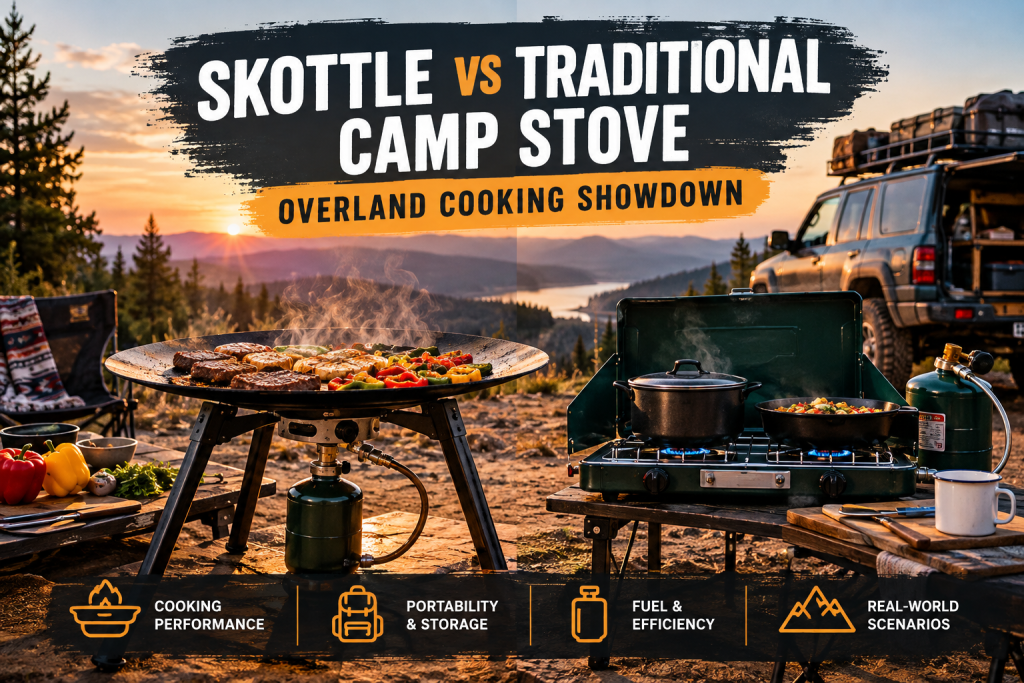
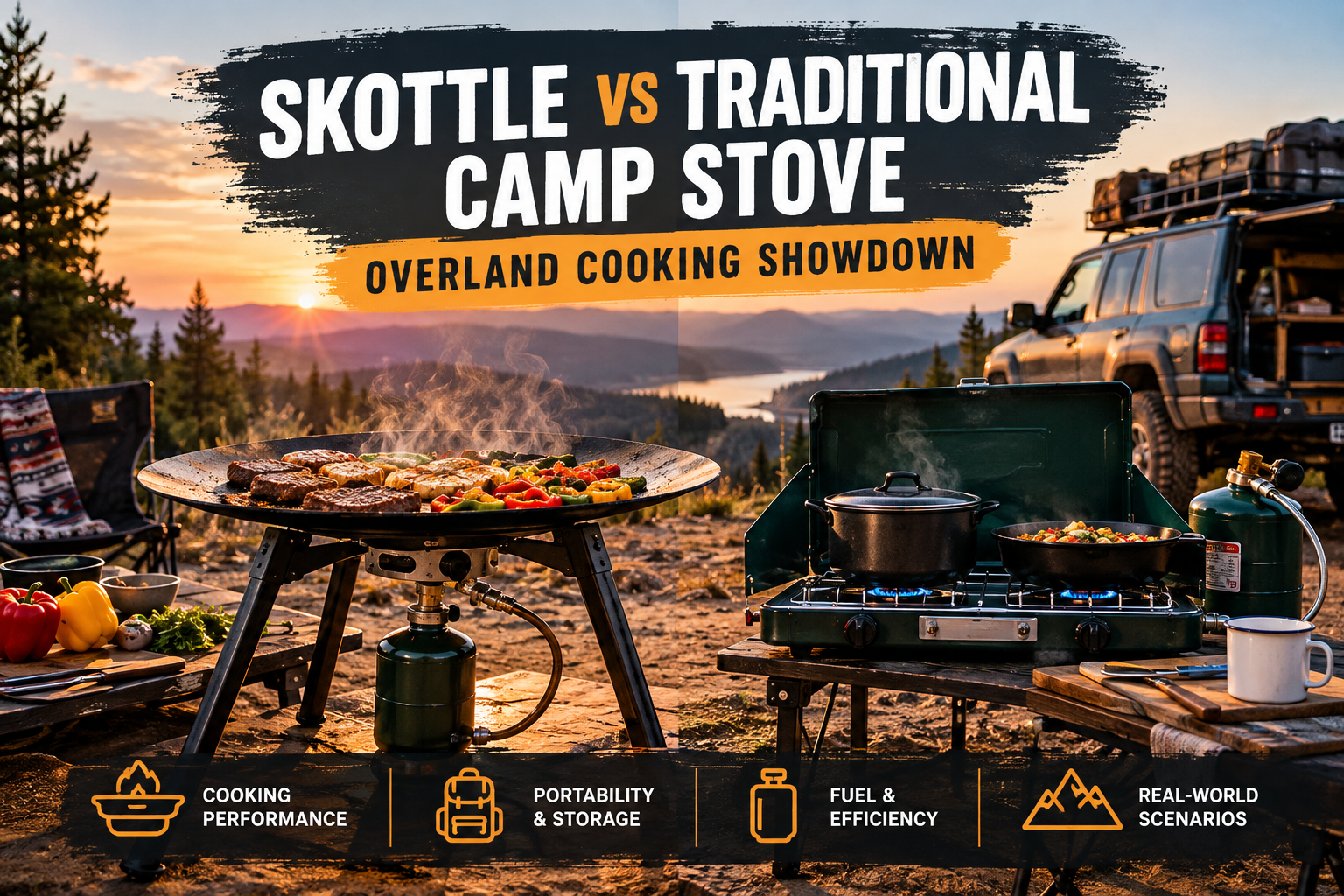
For overlanders, choosing a cooking system is about more than simply getting food hot. The right setup needs to balance cooking performance, portability, fuel use, setup time, cleanup, and available vehicle space. Two popular approaches are a Skottle and a traditional camp stove, especially the familiar two-burner propane stove.
A Skottle takes a very different approach to outdoor cooking. Instead of placing separate pots and pans over individual burners, it uses a large, shallow, wok-like cooking surface over a burner. Modern Skottle systems are designed specifically for vehicle-based camping and can provide a large area for cooking everything from eggs and bacon to stir-fry, steak, vegetables, and fajitas.
A traditional camp stove, by contrast, gives you one or more independently controlled burners. A current two-burner propane stove such as Coleman’s Classic model provides two independently adjustable cooking zones, 20,000 total BTUs, and enough space for 12-inch and 10-inch pans simultaneously.
Neither system is automatically better. The Skottle generally shines when large cooking space, versatility, and outdoor-style cooking are priorities. A traditional stove is usually the more flexible choice when you need pots, pans, boiling water, simmering, and multiple cooking temperatures at once.
The following comparison looks at how they actually differ in day-to-day overland cooking.
Skottle vs Traditional Camp Stove: What’s the Difference?
What Is a Skottle?
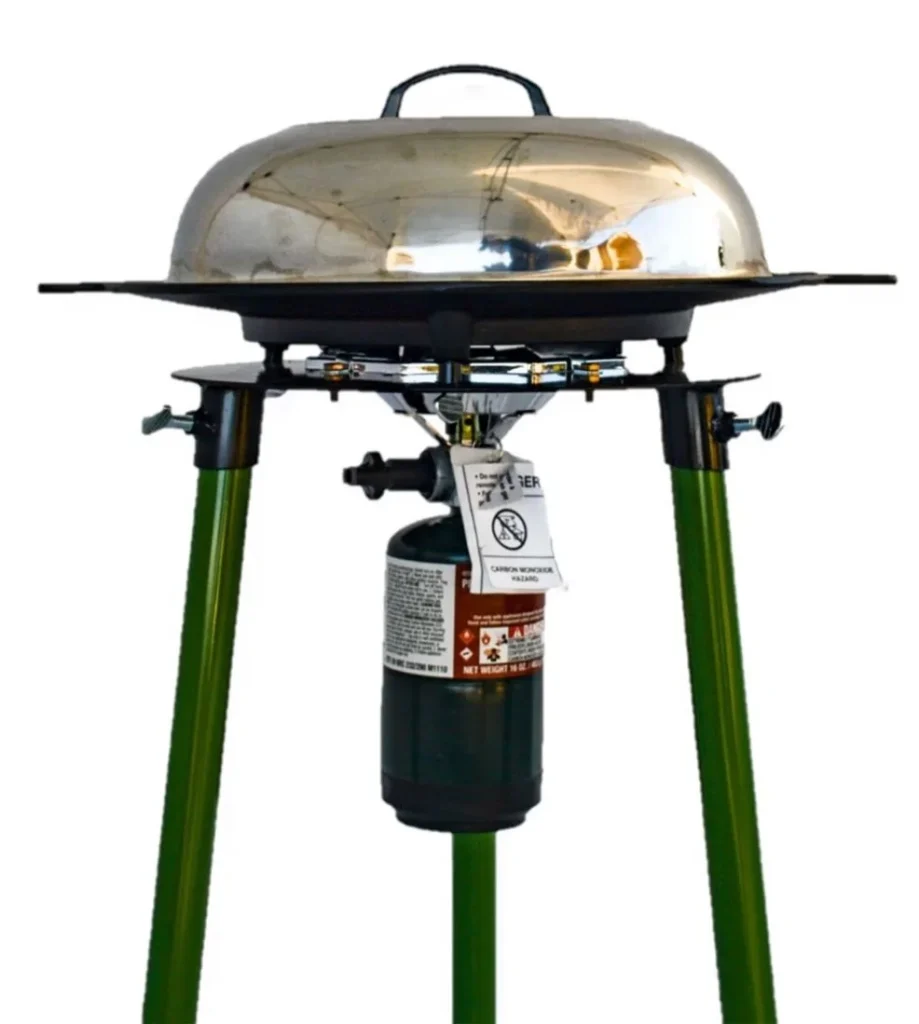
A Skottle is essentially a large, shallow, curved cooking disc inspired by the South African outdoor cooking tradition. Its shape sits somewhere between a wok, griddle, and large skillet. Modern overland versions commonly use a steel or cast-iron cooking surface supported above a propane burner, with dedicated legs or a frame.
The distinctive feature is the large continuous cooking surface. Rather than placing cookware on top of a burner, you generally cook directly on the Skottle itself. The curved surface also creates natural differences in heat across the pan: the center is generally hotter while food can be moved toward the outer area for gentler cooking.
This makes a Skottle particularly useful for foods that benefit from being tossed, moved, or cooked in batches. Eggs, bacon, sausage, potatoes, vegetables, fajitas, stir-fry, burgers, steak, and similar meals can all be prepared directly on the surface.
Skottle designs vary considerably. For example, the Tembo Tusk system uses an 18-inch cooking surface and a 10,000-BTU burner, while smaller modern Skottle-style systems are available for solo travelers or couples.
That distinction matters because “Skottle” doesn’t describe one standardized size or burner output. Weight, diameter, burner power, leg design, and fuel connection can vary significantly between models.
What Is a Traditional Camp Stove?
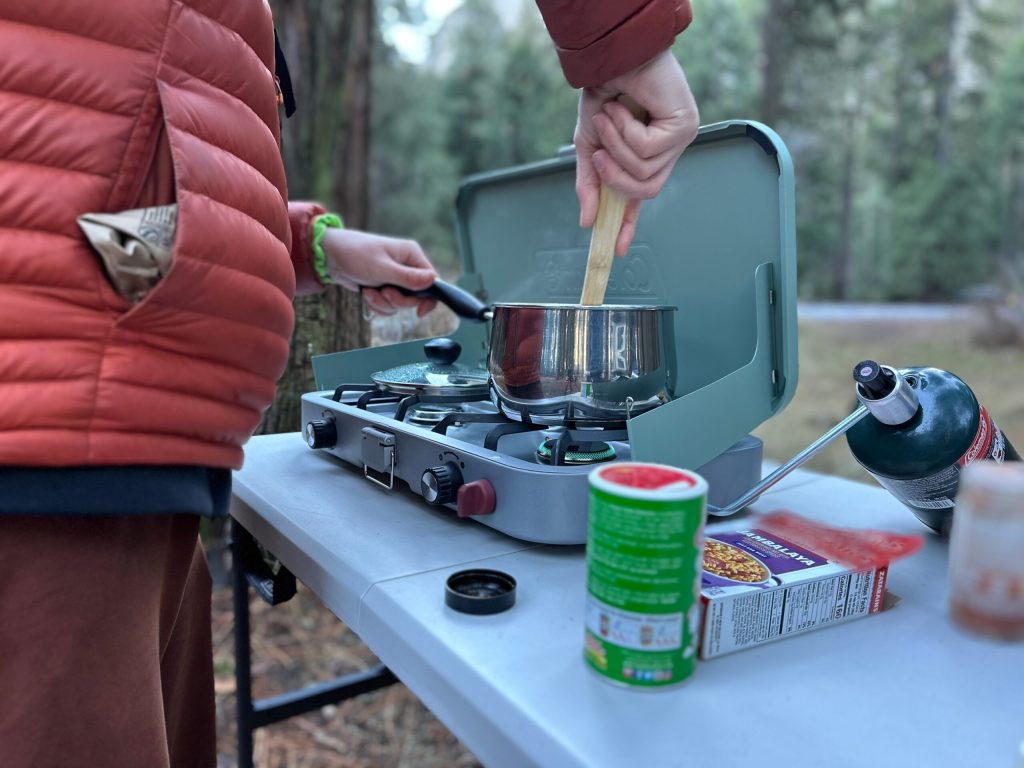
A traditional camp stove is the more conventional outdoor cooking system: one or more burners mounted in a compact stove body, with cookware placed on a grate above the flames.
For overlanding, the most useful version is often a two-burner propane stove. It gives you two separate heat sources, allowing you to use different cookware simultaneously. For example, you can boil water in one pot while frying eggs in a skillet on the other burner.
Modern two-burner stoves can be surprisingly capable. Coleman’s current Classic two-burner propane model produces up to 20,000 BTUs combined, has independently adjustable burners, accommodates 12-inch and 10-inch pans simultaneously, and incorporates wind-blocking panels.
The major advantage is cookware flexibility. You aren’t limited to the cooking surface built into the stove. You can bring a saucepan for coffee, a Dutch oven for stew, a skillet for steak, or a griddle for pancakes and switch between them according to the meal.
This makes a traditional stove feel much more like a miniature outdoor kitchen.
The Biggest Difference at a Glance
The simplest way to understand the difference is this:
A Skottle is primarily a large direct-cooking surface, while a traditional camp stove is a flexible heat source for separate cookware.
| Feature | Skottle | Traditional Camp Stove |
|---|---|---|
| Cooking surface | Large integrated pan | Burner grate |
| Typical burner count | Usually one | One or two+ |
| Direct cooking | Excellent | Limited unless using griddle/pan |
| Multiple heat zones | Natural zones across pan | Separate burner controls |
| Pots and pans | Possible, depending on design | Excellent |
| Stir-fry/fajitas | Excellent | Good with suitable pan |
| Boiling water | Possible with cookware | Excellent |
| Large food batches | Excellent | Good to excellent |
| Breakfast cooking | Excellent | Excellent |
| Simmering separate dishes | Less convenient | Excellent |
| Cookware flexibility | Moderate | Excellent |
| Outdoor cooking experience | Very high | More conventional |
One important point is that BTU ratings alone don’t determine which system cooks better. A burner may have a high advertised output, but actual cooking performance depends on burner design, cookware, wind, heat transfer, and how effectively the cooking surface uses that heat.
For example, the Tembo Tusk Skottle uses a 10,000-BTU burner, while a conventional Coleman two-burner can provide 20,000 BTUs total. Yet the Skottle’s large metal cooking surface can still be highly effective for direct cooking because the food is being cooked directly on the heated surface rather than through a separate pan.
Who Should Consider Each System?
A Skottle makes the most sense for overlanders who:
- Enjoy cooking substantial meals at camp.
- Frequently cook for two or more people.
- Want a large direct-cooking surface.
- Make stir-fries, fajitas, vegetables, burgers, steak, eggs, and similar meals.
- Want to reduce the number of separate pans required.
- Prefer a dedicated outdoor cooking station.
- Don’t mind carrying a somewhat specialized cooking system.
A traditional camp stove is generally better for people who:
- Cook with pots and pans regularly.
- Need two independent cooking temperatures.
- Frequently boil water for coffee, tea, pasta, or dehydrated meals.
- Prepare soups, sauces, stews, and other liquid-heavy foods.
- Want maximum cookware flexibility.
- Already own suitable cookware and want to keep the setup simple.
- Prefer a compact, familiar cooking appliance.
For many overlanders, the decision ultimately comes down to how they cook rather than how much they cook. Someone preparing a large skillet-style dinner every evening may love a Skottle, while someone making rice in one pot and curry in another will probably appreciate a two-burner stove more.
Head-to-Head Cooking Performance
Cooking Surface and Capacity
This is where the Skottle has one of its clearest advantages.
A typical Skottle provides a broad, uninterrupted cooking surface. An 18-inch model, for example, gives you considerably more usable direct-cooking area than the burner grate of a conventional camp stove. The Tembo Tusk system uses an 18-inch Skottle, while smaller 12-inch versions are also available for solo and duo use.
The large surface is particularly useful when cooking foods in batches. You can spread vegetables across one section, move cooked ingredients outward, and keep adding new ingredients without constantly swapping pans.
The curved design is also useful. Food can be pushed toward the outside while the center remains available for higher-heat cooking. With practice, this effectively creates different cooking zones on one surface, although they won’t be as precisely independent as the burners on a two-burner stove.
A traditional camp stove takes a different approach. Its capacity depends heavily on the size and shape of the cookware you bring. A two-burner Coleman, for example, is designed to accommodate a 12-inch and 10-inch pan at the same time.
This can actually be more useful for certain meals. Two pans mean you can cook separate ingredients independently—for example:
- Rice in a saucepan + curry in a skillet
- Pasta in a pot + sauce in another pan
- Coffee water + breakfast
- Soup + grilled vegetables
So, the Skottle generally wins for one large continuous cooking area, while the two-burner stove wins for independent cookware capacity.
Heat Control and Cooking Speed
Heat control is another area where the two systems behave differently.
With a traditional two-burner stove, each burner normally has its own control knob. You can run one burner high while keeping the other at a low simmer. Coleman’s current two-burner model specifically provides independent burner adjustment for two temperature zones.
That makes conventional stoves particularly good for meals requiring different cooking temperatures simultaneously.
A Skottle generally uses one burner underneath the central portion of the cooking surface. Instead of getting two independently controlled burners, you work with the heat gradient across the metal surface. The center tends to be the primary high-heat area, while food moved outward can cook more gently.
This takes a little practice, but it can be extremely effective.
Skottle cooking can also feel surprisingly fast because food is cooked directly on a heated metal surface. Blue Ridge Overland Gear specifically recommends beginning Skottle meals at lower heat because food can cook faster than expected compared with a conventional camp stove or grill.
However, faster isn’t always better. A traditional stove can be easier for controlled low-temperature cooking because you can reduce the flame directly underneath a pot or pan.
For fast direct cooking: Skottle has an advantage.
For precise independent temperature control: traditional two-burner stove has an advantage.
Cooking Different Types of Meals
A Skottle is particularly strong when your meals are built around surface cooking.
Think:
- Bacon and eggs
- Sausage and potatoes
- Fajitas
- Stir-fry
- Burgers
- Steak
- Fried vegetables
- Hash browns
- Quesadillas
- Pancakes
- Sautéed chicken
- Grilled sandwiches
The large surface gives you room to spread ingredients out and move them around as they cook. Skottle manufacturers and experienced users emphasize its ability to handle foods normally prepared in skillets, pans, or grills.
A traditional camp stove is more versatile when the meal requires different types of cookware.
For example, making a curry and rice simultaneously is straightforward: put the rice pot on one burner and the curry pot on the other. The same applies to pasta and sauce, soup and bread, or oatmeal and coffee.
You can also expand the stove’s capabilities with accessories such as a griddle, cast-iron skillet, Dutch oven, or specialty cookware.
Therefore, the Skottle isn’t necessarily more versatile in an absolute sense. It is highly versatile within direct cooking, while the traditional stove is more versatile across different cookware and cooking techniques.
Cooking for Couples vs Groups
For a couple, either system can work extremely well.
A smaller Skottle is especially attractive for two people because it provides plenty of cooking space without requiring multiple pots and pans. The current Adventure Skottle, for example, uses a 12-inch cooking surface and is specifically marketed for solo travelers or couples.
For larger groups, a full-size Skottle becomes even more useful for foods that need to be cooked in batches. You can prepare a large quantity of fajita meat, vegetables, breakfast hash, or stir-fry without working with a small skillet.
But a two-burner stove can be better when a group meal involves multiple dishes at once.
Imagine cooking dinner for six:
- Pot of rice on burner one
- Large skillet of meat on burner two
With a Skottle, both foods would generally need to share the same cooking surface unless you add another cooking vessel or cooking system.
So the practical distinction is:
Skottle: excellent for cooking a large quantity of one meal or a meal that can share one surface.
Two-burner stove: excellent for preparing multiple dishes simultaneously.
Boiling Water and Making Drinks
This is an area where a traditional camp stove usually has the advantage.
Boiling water is simple on a conventional stove because you can place a kettle, saucepan, or pot directly over a burner. This is ideal for coffee, tea, oatmeal, instant meals, pasta, and drinking water.
A Skottle can certainly boil water, but you generally need to place a suitable pot or kettle on the cooking surface. Some Skottle systems explicitly support boiling water and cooking with pots, but the large pan is not inherently designed to replace a dedicated kettle or saucepan.
For a morning routine involving coffee and breakfast, a two-burner stove can also provide a useful workflow: boil water on one burner while cooking eggs or bacon on the other.
With a single-burner Skottle, those jobs share the same heat source.
That doesn’t make the Skottle incapable of boiling water—it simply means boiling is usually more natural and efficient from a workflow perspective on a conventional multi-burner stove.
Cleanup After Cooking
Cleanup is one of the more nuanced comparisons.
A Skottle can reduce the number of cookware items you need to wash because many meals are cooked directly on one surface. Instead of cleaning a frying pan, skillet, and griddle separately, you may only need to clean the Skottle itself.
But the cooking surface requires appropriate care, especially when it is made from carbon steel or cast iron. Depending on the model, you may need to scrape away food residue, wipe or lightly scrub the surface, dry it thoroughly, and maintain its seasoning. Tembo Tusk recommends treating its Skottle similarly to cast iron, including salt or a scrubber for cleaning and re-seasoning when necessary.
A traditional camp stove produces a different cleanup workload. The cookware you use must be washed, but the stove itself may be relatively easy to maintain. For example, Coleman’s current two-burner stove has a removable chrome-plated grate designed to make cleaning easier.
The best choice therefore depends on where you place the cleanup burden.
Skottle: fewer cooking vessels, but the main cooking surface needs proper care.
Traditional stove: easy-to-maintain stove body, but potentially more pots, pans, and utensils to wash.
For overlanders who want to minimize dishes after a long day on the trail, the Skottle’s ability to cook an entire meal on one surface can be a major advantage. For travelers who already carry a compact cookware set and prefer conventional washing, the traditional stove may be simpler.
Overlanding Practicality: Portability, Fuel, Setup, and Storage

When choosing between a Skottle and a traditional camp stove for overlanding, cooking performance is only half the equation. The system also has to fit into a vehicle, survive vibration and weather, work with your preferred fuel supply, and be practical enough that you will actually use it every day.
There is no universal winner here. A Skottle can be an excellent dedicated outdoor kitchen, while a traditional stove can provide a more compact and familiar cooking solution. The best choice depends heavily on your vehicle, trip length, cooking habits, and how much equipment you are willing to carry.
Weight and Packed Size
Weight varies considerably between individual Skottle and camp-stove models, so comparing categories rather than assuming every model weighs the same is important.
A full-size Skottle can be fairly substantial. For example, TemboTusk’s current 18-inch adjustable-leg Skottle kit lists a weight of about 10.9 kg (24 lb), while its larger Ultimate kit is listed at about 13.6 kg (30 lb).
That weight isn’t necessarily a disadvantage for vehicle-based travel, but it becomes more noticeable if you frequently move the cooking system between your vehicle, campsite, picnic table, and storage area.
Traditional camp stoves can be lighter. As one current reference point, the Coleman Classic two-burner propane stove weighs 11.65 lb (5.3 kg) and measures roughly 22.5 × 5 × 14.5 inches according to the manufacturer’s current specifications.
However, don’t compare stove weight alone. A stove may require:
- A frying pan
- Saucepan
- Griddle
- Kettle
- Dutch oven
- Wind protection
- Separate cooking utensils
A Skottle incorporates its primary cooking surface into the system, potentially reducing the number of dedicated pans you need.
Practical takeaway: If minimizing the weight of the cooking appliance itself is important, a traditional stove generally has an advantage. If you are comparing the complete cooking system, the difference can become much smaller depending on what cookware you carry.
Setup and Breakdown Time
Both systems can be quick to deploy, but their setup routines are different.
A traditional two-burner stove generally involves opening the stove, connecting the propane supply, placing cookware on the grate, and lighting the burners. Many models have integrated wind protection, so there may be little additional equipment to assemble. The Coleman Classic, for example, has built-in adjustable WindBlock panels and two independently controlled burners.
A Skottle may require setting up its legs or stand, attaching the burner or fuel connection, positioning the cooking surface, and then lighting it. Some designs are deliberately engineered for fast assembly, and TemboTusk users report being able to assemble the system quickly.
Once both systems are familiar, the actual difference may be small. The bigger distinction is what happens after setup.
With a Skottle, you can often move directly into cooking on the integrated surface. With a traditional stove, you need to select and position the appropriate pot, pan, or griddle.
For a quick roadside breakfast, either can work. For repeated cooking throughout a long trip, however, the Skottle’s dedicated cooking surface can make the routine feel more streamlined.
Fuel Options and Fuel Efficiency
Fuel choice deserves more attention than simply asking which system “uses less.”
Many overlanding Skottles are designed around propane, and conventional propane camp stoves are also widely available. The important consideration is therefore often how the burner connects to your existing fuel setup.
A traditional camp stove can use small disposable propane cylinders or, depending on the model and approved connection system, a larger refillable propane supply. The Coleman Classic, for example, is rated for propane and is specified to operate for up to about one hour with both burners on high using one 16.4-ounce cylinder.
That figure should not be interpreted as normal real-world consumption. Most campers don’t run both burners at maximum output continuously. Simmering, intermittent cooking, and turning the stove off between tasks can dramatically change actual fuel consumption.
The same principle applies to Skottles. A Skottle with a relatively high-output burner isn’t automatically less efficient than a lower-output stove. Fuel consumption depends on:
- Burner output
- Cooking time
- Heat setting
- Wind
- Ambient temperature
- Cookware
- Food quantity
- Lid use
- How efficiently heat reaches the food
A useful way to compare systems is therefore fuel consumed per meal, not simply BTUs advertised on the box.
Also remember that BTU is a measure of heat input, not a direct measurement of cooking efficiency. A burner producing more BTUs can cook faster but may consume more fuel when operated at high power.
For extended remote travel, carrying enough fuel reserve is more important than trying to determine a tiny theoretical efficiency difference between two systems.
Wind, Weather, and Outdoor Conditions
Wind can have a major impact on outdoor cooking.
It can pull heat away from cookware, extend cooking times, increase fuel consumption, and make low-temperature cooking difficult. Strong gusts can also interfere with burner flames.
Traditional camp stoves often have a built-in advantage here because many two-burner designs include folding or adjustable wind panels. The current Coleman Classic, for example, uses WindBlock panels specifically to shield its burners and can adjust those panels around different pan sizes.
A Skottle has a large exposed cooking surface, so wind management becomes particularly important. You can improve performance by positioning the cooking station in a naturally sheltered location or using manufacturer-approved wind protection.
However, never improvise a fully enclosed windscreen around a gas appliance. Restricting ventilation or allowing excessive heat to build around a fuel cylinder or regulator can create a safety hazard. Outdoor gas appliances should be operated according to the manufacturer’s instructions, on a stable surface and in an appropriately ventilated outdoor area.
Rain presents another challenge. A Skottle’s broad surface can be exposed to precipitation, while a traditional stove’s folding lid or wind panels may provide some protection. Neither should be treated as an all-weather appliance, though.
For genuinely bad weather, the goal should be to create a safe, ventilated, sheltered cooking area, rather than trying to make the stove completely weatherproof.
Storage in an Overland Vehicle
Vehicle storage can ultimately determine which system makes more sense.
A traditional two-burner stove typically folds into a relatively flat package. The Coleman Classic, for example, is approximately 22.5 × 5 × 14.5 inches, giving it a rectangular footprint that can be easier to slide into a drawer, cabinet, or gear compartment.
A Skottle’s shape is different. The large circular cooking surface can consume valuable horizontal storage space, particularly when you choose a full-size model.
But the Skottle’s storage requirements can sometimes be simplified by its design. You may not need to carry a separate large skillet or griddle because the Skottle itself serves as the primary cooking surface.
For a vehicle with a dedicated kitchen drawer, this distinction may be minor. For a compact SUV packed with recovery equipment, water, camping gear, clothing, and food, the physical shape of the cooking system can matter considerably.
Before buying, measure your actual storage compartment rather than relying only on advertised packed dimensions. Consider:
- Where will the cooking system live?
- Can the lid or cooking surface be stored separately?
- Where will propane cylinders or tanks be secured?
- Can greasy cookware be isolated from clean gear?
- Will the equipment rattle during rough travel?
- Can you access the stove without unloading half the vehicle?
For overlanding, accessibility matters almost as much as packed size. A cooking system buried beneath recovery gear may technically fit but become frustrating to use.
Which Is Better for Different Overlanding Scenarios?
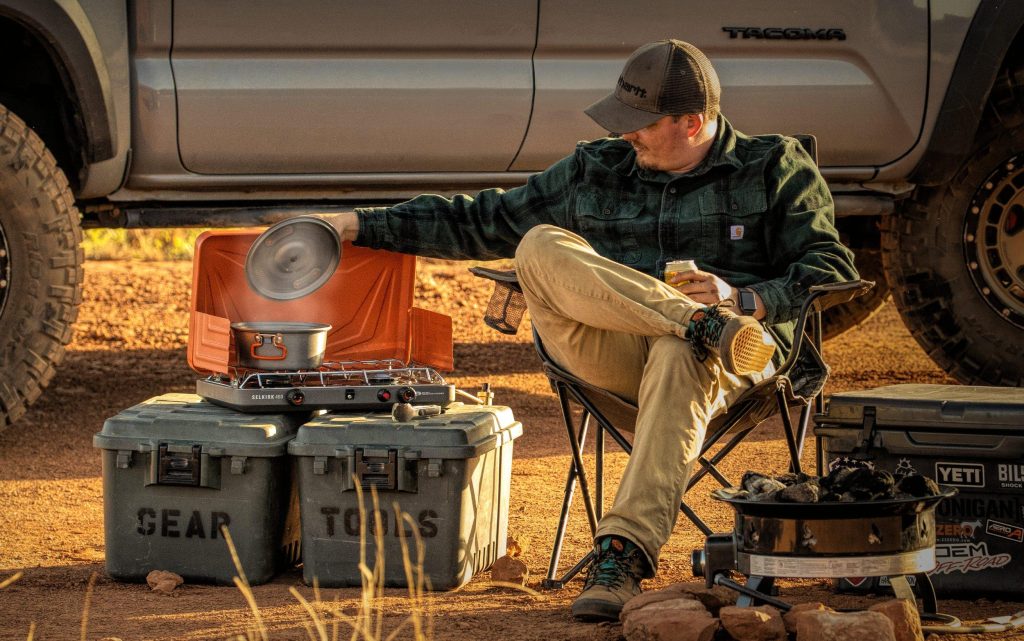
The “better” cooking system changes significantly depending on the type of trip. A solo traveler trying to keep a lightweight vehicle has very different requirements from a family spending several weeks off-grid.
Long-Distance Overlanding
For long-distance overlanding, reliability and versatility generally matter more than maximum cooking surface.
A traditional two-burner stove is a strong choice when your route involves frequent stops, changing weather, and meals that vary from simple breakfasts to one-pot dinners. Two burners allow you to boil water and cook food simultaneously, while conventional cookware is easy to replace if damaged or lost.
A Skottle becomes particularly attractive if cooking is a major part of the travel experience. Its large surface can handle substantial meals and makes it easy to cook fresh ingredients at camp.
For a long trip, think about your complete system:
- Stove or Skottle
- Primary fuel supply
- Backup fuel
- Cooking utensils
- Cleaning supplies
- Spare regulator or connection components where appropriate
- Storage solution
- Wind protection
- Food preparation area
Best overall: Traditional two-burner stove for maximum flexibility; Skottle if outdoor cooking is a major priority.
Solo and Lightweight Overlanding
Solo travelers have less need for a large cooking surface.
A compact one-burner stove can be considerably easier to carry than a full-size Skottle system. Current camp-stove options include compact canister models weighing around 5–6 lb, while full-size Skottle kits can exceed 20 lb.
That doesn’t make a Skottle impractical for solo travel. A smaller Skottle can be a fun and capable solution if you enjoy cooking and have sufficient vehicle storage.
But if the priority is minimum weight, minimum volume, and quick meals, a compact traditional stove usually makes more sense.
Best choice: Compact traditional stove for lightweight travel; small Skottle for solo travelers who prioritize cooking enjoyment.
Gourmet/High-Quality Camp Cooking
This is where the Skottle becomes particularly compelling.
The large cooking surface makes it easy to prepare restaurant-style meals that benefit from high-heat surface cooking. You can sear meat, sauté vegetables, toast bread, cook eggs, and combine ingredients without constantly switching between small pans.
The large surface also encourages a more social style of cooking. Instead of everyone waiting for a single small frying pan, ingredients can be prepared across a larger cooking area.
However, gourmet cooking doesn’t automatically mean Skottle. If your menu involves several sauces, simmering dishes, rice, pasta, soups, and separate side dishes, the two-burner stove can actually be more capable.
Best choice: Skottle for surface-focused gourmet cooking; two-burner stove for multi-component meals requiring several pots and pans.
Fast and Simple Camp Meals
For simple meals, both systems perform well.
A Skottle is excellent for one-pan meals such as:
- Breakfast hash
- Eggs and bacon
- Sausage and vegetables
- Stir-fry
- Fajitas
- Burgers
- Quesadillas
The ingredients can often be cooked on one surface without changing cookware.
A traditional stove is better if “simple” means boil, heat, eat. A pot of water can be heated quickly for coffee, noodles, oatmeal, dehydrated meals, or pasta.
Therefore, your definition of simple matters.
One-pan simple: Skottle.
Boil-and-serve simple: Traditional stove.
Off-Grid and Remote Trips
Remote travel puts more emphasis on fuel management, reliability, repairability, and versatility.
A traditional propane stove offers the advantage of familiar cookware and multiple burners. If one cooking vessel becomes unusable, another can usually replace it. Many common stove components and propane accessories are also widely available.
A Skottle has fewer cooking components in the actual cooking surface, which can be appealing from a simplicity standpoint. A sturdy steel cooking disc can also tolerate considerable use when properly maintained.
For either system, remote travel requires redundancy. Carrying a backup cooking method—such as a small emergency stove appropriate for your fuel strategy—can be more valuable than choosing between two excellent primary systems.
Best choice: Either can work for remote travel, but prioritize a reliable fuel supply, spare compatible components, safe fuel storage, and a backup cooking option.
Which Should You Choose: Skottle or Traditional Camp Stove?

There isn’t one universally superior answer to the Skottle vs traditional camp stove debate.
Instead, choose according to your cooking style.
Choose a Skottle If You Want…
A Skottle is a strong choice if you:
- Enjoy cooking outdoors as part of the overlanding experience.
- Frequently cook for two or more people.
- Prefer one large cooking surface.
- Make stir-fries, fajitas, breakfast hashes, burgers, steaks, and vegetables.
- Want to cook large batches without a small skillet.
- Prefer fewer separate cooking pans.
- Want an outdoor-kitchen feel.
- Have enough vehicle storage for the larger cooking surface.
- Don’t mind maintaining the cooking surface.
A Skottle is especially attractive to overlanders who view camp cooking as an activity rather than simply a way to prepare calories.
Choose a Traditional Camp Stove If You Want…
A conventional camp stove is probably the better choice if you:
- Want maximum cookware flexibility.
- Regularly cook soups, rice, pasta, sauces, and stews.
- Need two independent burners.
- Frequently boil water.
- Want to simmer one dish while cooking another.
- Have limited storage space.
- Want a familiar cooking system.
- Prefer a lighter or more compact appliance.
- Want an easy-to-replace cooking setup.
A two-burner stove is particularly practical for couples and families because two independent burners can dramatically simplify multi-dish meals. The Coleman Classic, for example, supports simultaneous 10- and 12-inch cookware and independently adjustable burners.
Choose a Hybrid Setup If You Want the Best of Both
For serious overlanders, a hybrid approach can make more sense than choosing one system exclusively.
The basic idea is simple:
Use the Skottle for large-surface cooking and the traditional stove for pots, boiling, and precise multi-burner cooking.
For example, you could use:
- Skottle → steak, fajitas, vegetables, breakfast
- Stove burner 1 → rice or pasta
- Stove burner 2 → sauce, soup, or coffee
- Skottle → large group meals
- Stove → quick morning drinks
The downside is obvious: more equipment, more weight, more fuel connections, and more storage requirements.
So a hybrid setup is best suited to larger vehicles, family groups, extended base camps, or overlanders who genuinely cook enough to justify the additional equipment.
For most people, it is better to choose one primary system and add a small backup option rather than carrying two full-size cooking systems unnecessarily.
FAQ — Skottle vs Traditional Camp Stove
Is a Skottle better than a camp stove?
Not universally. A Skottle is better for large-surface cooking, batch meals, and foods such as stir-fry, fajitas, vegetables, burgers, and breakfast hash. A traditional two-burner stove is better for boiling, simmering, and cooking multiple dishes in separate pots or pans.
Can you boil water on a Skottle?
Yes. You can place an appropriate pot or kettle on a Skottle, provided the particular Skottle and cookware are designed to work together. However, a conventional stove is generally more convenient for frequent water boiling because a pot or kettle sits directly over a dedicated burner.
Is a Skottle good for family camping?
Yes. Its large cooking surface can be excellent for family meals and large batches. An 18-inch Skottle, for example, provides considerably more direct cooking area than a small skillet. However, families that regularly cook several separate dishes at the same time may prefer a two-burner stove.
Are Skottles heavy?
Some are. Weight varies by model and whether the kit includes legs, burners, tables, lids, or accessories. A current TemboTusk 18-inch adjustable-leg kit is listed at approximately 24 lb, while its Ultimate kit is around 30 lb.
Smaller Skottle-style systems can weigh considerably less, so check the complete packed weight before buying.
Does a Skottle use more fuel than a camp stove?
Not necessarily. Fuel consumption depends on burner output, cooking time, heat setting, wind, food quantity, and heat transfer. A higher-BTU burner can consume more fuel at maximum output, but faster cooking can offset some of that difference. Compare fuel consumed per meal rather than BTU ratings alone.
Can you cook everything on a Skottle?
You can prepare a remarkably wide range of foods, including meat, eggs, vegetables, pancakes, stir-fries, fajitas, burgers, and many one-pan meals. But it isn’t a perfect substitute for every piece of cookware. Large pots of soup, pasta, rice, or water may be more convenient on a traditional burner.
Is a two-burner stove better for overlanding?
For versatility, often yes. Two independently controlled burners allow you to cook different foods at different temperatures simultaneously. For example, one burner can boil water while the other cooks breakfast. Current two-burner models such as the Coleman Classic provide two independent burners and accommodate two different pan sizes simultaneously.
But if your priority is large-surface cooking rather than multi-pot cooking, a Skottle can be the better overlanding tool.
Can you use a Skottle with propane?
Yes. Many overlanding Skottle systems are designed around propane burners. The exact cylinder, hose, regulator, and connection requirements depend on the specific model, so always follow the manufacturer’s fuel specifications rather than assuming components are interchangeable.
Is a Skottle worth it for solo overlanding?
It can be, but it depends on your priorities. If you enjoy cooking and regularly prepare substantial meals, a smaller Skottle can be an excellent solo setup. If you mainly boil water, heat ready-made food, or prepare simple one-pot meals, a compact one-burner stove will usually save weight and storage space.
What is the best setup for overland cooking?
For most overlanders, the best setup is the one that matches the way they actually cook.
Choose a Skottle if you prioritize large-surface, one-pan outdoor cooking.
Choose a traditional two-burner stove if you want maximum cookware flexibility, boiling capability, and independent heat zones.
Choose a hybrid system if you’re traveling with a larger group, have sufficient vehicle storage, and regularly prepare complex meals.
For a balanced overland kitchen, a two-burner propane stove plus appropriate cookware is the safest all-around recommendation for versatility, while a Skottle is the more specialized choice for people who love large-surface camp cooking. The important thing is not to buy the biggest cooking system available—it is to build a setup that fits your vehicle, fuel strategy, storage capacity, and actual meal routine.
Read More: Camping Cot vs Sleeping Pad: What’s More Comfortable in the Wild?