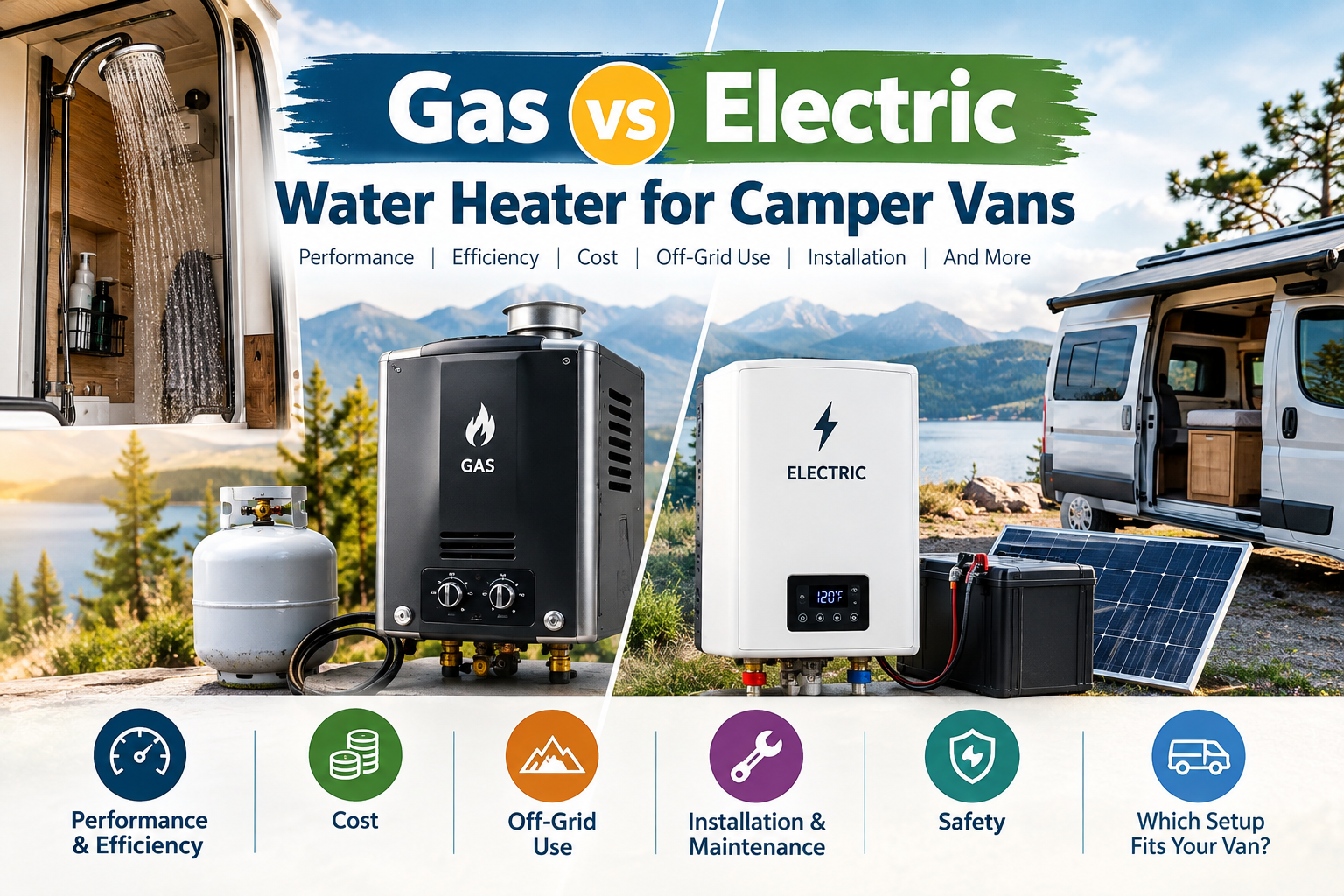
Hot water is one of those camper-van features that quickly becomes essential once you spend more than a few nights on the road. Whether you need a quick shower, want to wash dishes, or simply want reliable hot water during cold-weather travel, the water-heating system can have a noticeable effect on your van’s energy use, storage space, comfort, and overall build.
For camper vans, the two primary heating approaches are gas/propane and electric. Propane water heaters use combustion to transfer heat into the water, while electric models use electrical resistance heating. There are also combination systems that can use both sources, as well as tankless systems that heat water only when a tap or shower demands it.
The important point is that there is no universal solution for every camper van. A van equipped with a large battery bank and regular campground hookups has very different requirements from a compact van designed for extended boondocking. Propane can provide substantial heating output without putting a large continuous load on the battery system, while electric heating is quiet and convenient when shore power is readily available.
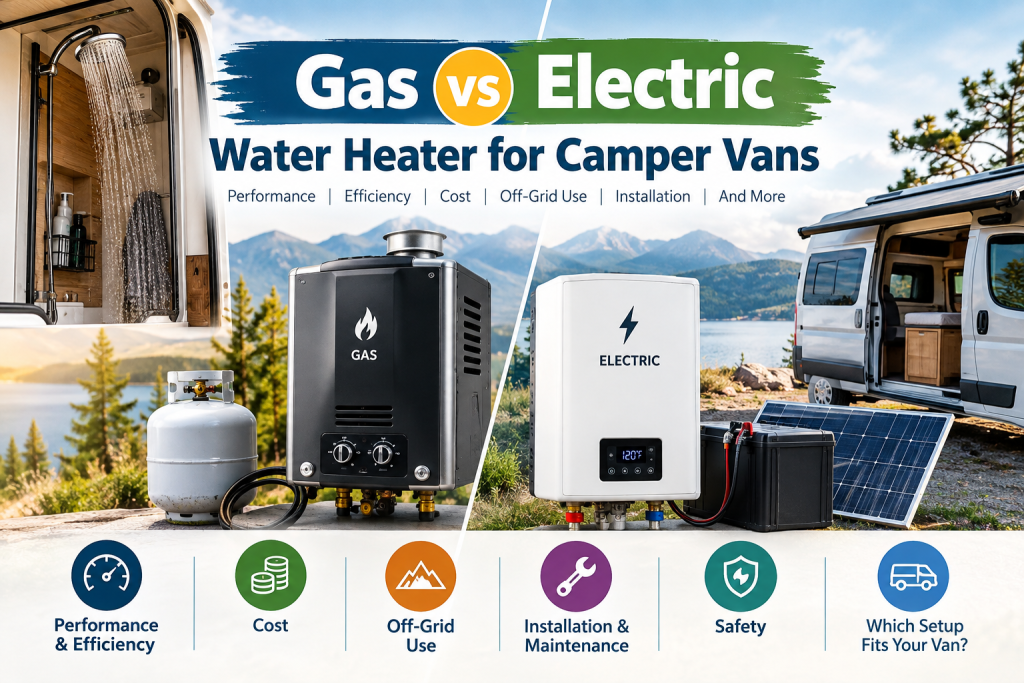
This guide compares gas vs electric water heater camper van setups in terms of how they work, heating performance, efficiency, installation, safety, maintenance, cost, and off-grid practicality.
Gas vs Electric Water Heater for Camper Vans: How They Work
How a Gas/Propane Camper Van Water Heater Works
A propane RV water heater uses LP gas as its primary heat source. In a conventional tank-style system, fresh water enters a storage tank and a propane burner heats the water until it reaches the thermostat’s target temperature. Once the desired temperature is reached, the burner cycles off and later reignites as necessary to maintain the temperature.
Modern RV propane heaters generally use electronic or direct-spark ignition rather than requiring the owner to manually light a pilot. The control system monitors ignition and can shut the heater down if the burner does not operate correctly.
A typical operating sequence is:
- Cold water enters the heater from the van’s plumbing system.
- The control system detects that heating is required.
- The ignition system starts the propane burner.
- The burner transfers heat to the water through the tank or heat exchanger.
- A thermostat or electronic controller monitors water temperature.
- The burner shuts down when the target temperature is reached.
- The system repeats the heating cycle as necessary.
Propane tankless heaters work somewhat differently. Instead of continuously heating stored water, they detect water flow and activate a burner when a hot-water tap is opened. Water passes through a heat exchanger and is heated as it flows through the unit. Modern RV tankless systems can modulate their burner output according to water temperature and flow requirements. For example, Suburban’s current Advantage tankless system uses a microprocessor-controlled burner with an input range of 15,000–60,000 BTU/h.
The major advantage of propane is its high heat output relative to the electrical systems commonly installed in camper vans. This makes it particularly useful when the van is operating away from shore power.
However, propane combustion produces exhaust gases. A properly designed installation therefore requires appropriate combustion-air supply, exhaust ventilation, clearances, and safety controls. Gas appliances should be installed according to the manufacturer’s instructions and applicable RV/gas installation requirements; manufacturers such as Suburban specifically state that their gas appliances should be installed or serviced by qualified technicians.
How an Electric Camper Van Water Heater Works
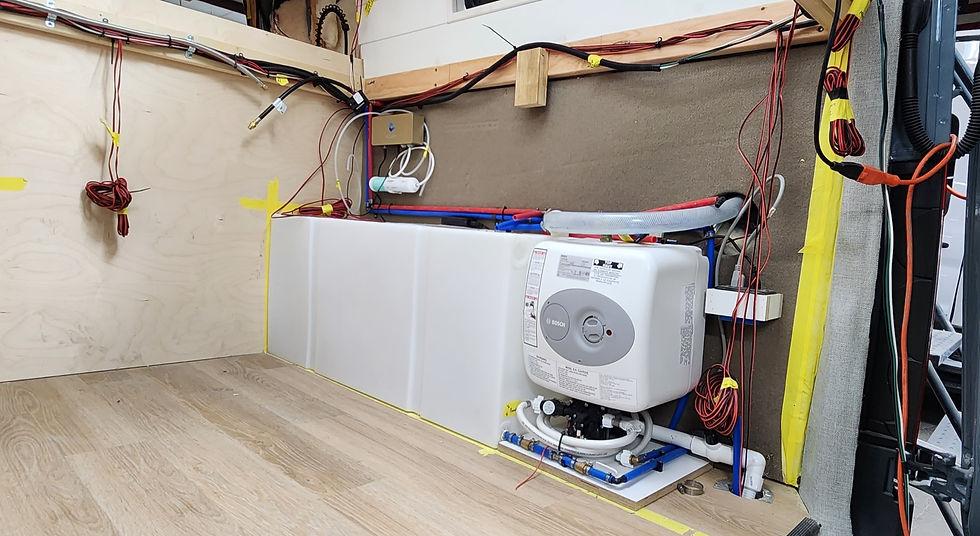
An electric camper-van water heater uses electrical resistance to heat water. Instead of burning fuel, electrical current passes through a heating element, which converts electrical energy into heat.
In a conventional electric tank heater, the basic process is:
- Cold water enters the storage tank.
- A 120V AC heating element transfers heat to the water.
- A thermostat monitors the temperature.
- The element switches on and off to maintain the desired temperature.
- Hot water is delivered to the shower, sink, or other fixture when required.
Some RV electric heaters are designed specifically for shore-power operation. For example, Suburban’s E-Series 120V electric tank heater is designed to operate from 120V AC/15A service and provides a 7-gallon storage capacity in one configuration.
Electric heating has an important advantage inside a camper van: there is no combustion process. A fully electric heater does not need a propane burner or combustion exhaust vent, and some models can therefore be installed inside the vehicle rather than requiring a conventional exterior wall opening. Dometic, for example, describes one of its RV electric water-heater platforms as a 120V system designed for flexible interior installation without an exterior wall cutout.
The main limitation is electrical demand.
A water heater that draws substantial AC power can place a significant load on a camper van’s inverter and battery bank when shore power is unavailable. Converting battery DC power into 120V AC and then using that electricity to produce heat can consume considerably more stored energy than smaller electrical loads such as LED lighting, phones, or refrigeration.
This is why an electric heater that works very well at a campground can become impractical for extended boondocking unless the van has an appropriately sized battery bank, inverter, charging system, and solar array.
Tank vs Tankless Water Heaters
The fuel source is only half of the water-heater decision. You also need to choose between a tank and tankless design.
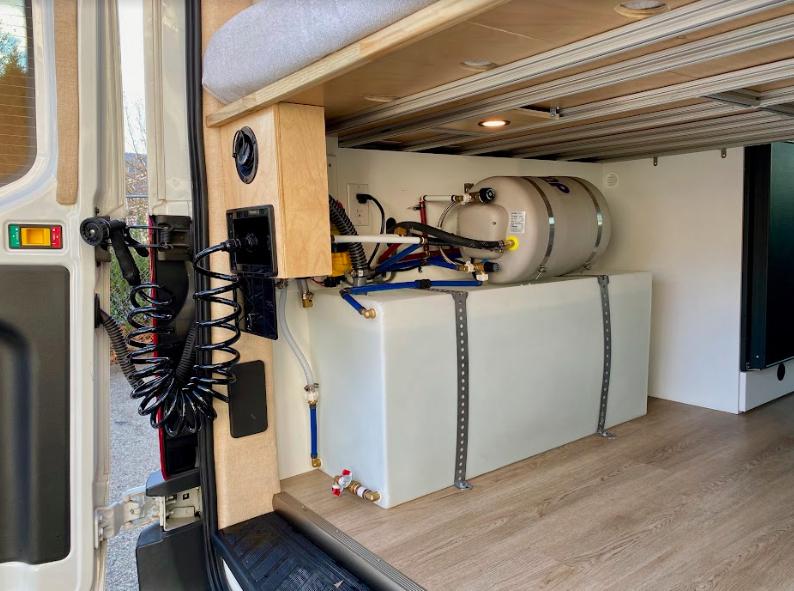
A tank water heater stores a predetermined quantity of hot water. Common RV capacities include approximately 4, 6, 10, 12, and 16 gallons, although the exact choices vary by manufacturer and model.
The biggest benefit is simplicity. The heater can warm water before you need it, so you have a reserve of hot water available for a shower or washing dishes. The disadvantage is limited capacity. Once the stored hot water is used, the heater needs time to recover.
A tankless water heater does not store a large volume of hot water. Instead, it heats water as it passes through the unit. This can provide a continuous supply as long as the water flow, energy source, and heater capacity remain within their operating limits.
Tankless systems can also reduce standby heat loss because they are not continuously maintaining a large tank of hot water. Modern RV tankless heaters may provide precise temperature control and automatic modulation based on incoming water temperature and flow.
However, “tankless” does not automatically mean “unlimited hot water under every condition.” The heater still has a maximum heating capacity and flow rate. If the incoming water is extremely cold or the shower flow is too high for the heater’s capacity, maintaining the desired outlet temperature becomes more difficult.
For example, a current Furrion RV tankless gas heater is rated at 60,000 BTU and 2.4 gallons per minute.
For a camper van, the practical difference can be summarized as:
| Feature | Tank | Tankless |
|---|---|---|
| Hot-water storage | Yes | No/very little |
| Hot-water capacity | Limited by tank size | Continuous within heater capacity |
| Recovery after heavy use | Required | Not normally required |
| Standby heat loss | Yes | Very low |
| Physical design | Generally larger | Generally more compact |
| Long showers | Limited by stored volume | Better suited |
| Complexity | Relatively simple | More electronics and controls |
| Water temperature | Thermostat controlled | Flow/inlet-temperature dependent |
| Off-grid suitability | Depends on fuel | Depends heavily on fuel type |
For occasional camper-van use, a small tank system can be perfectly adequate. For frequent travel or full-time living, a tankless system can provide greater convenience, particularly when multiple people need hot water.
Gas-Electric Combination Water Heaters
A gas-electric combination water heater gives a camper van two ways to heat its water. The same storage tank can contain an electric heating element while also incorporating a propane burner.
This arrangement is particularly useful because the energy source can be matched to the camping environment.
When connected to campground electricity, the owner can use the electric element and preserve propane. When camping away from hookups, the propane burner can provide the heat instead. Some combination models can also operate gas and electric heating simultaneously to increase recovery speed. Dometic’s documentation, for example, confirms that its combination systems can operate both modes at the same time for faster recovery.
This creates a useful operating pattern:
- Shore power available: use electricity.
- Boondocking: use propane.
- Heavy hot-water demand: use both where the system permits simultaneous operation.
- Limited propane: rely on shore power when available.
- Limited electrical capacity: switch to propane.
For many mixed-use camper vans, this flexibility can be more valuable than optimizing the system around only one energy source.
Performance and Efficiency
Heating Speed and Recovery Time
Heating speed depends on more than whether the heater uses gas or electricity. Storage capacity, heating input, incoming water temperature, thermostat settings, insulation, flow rate, and the specific heater design all influence performance.
In general, propane systems can deliver high heat input without requiring a large electrical connection. This is one reason propane has historically been popular in RV water heating. Modern propane tankless systems can provide very high burner input; current RV examples reach approximately 60,000 BTU/h.
Electric tank heaters typically have lower instantaneous heat output than high-output propane burners. They can still provide dependable hot water, but recovery after the tank has been heavily depleted can take longer.
This difference matters most when multiple people are using the shower or when hot water is needed repeatedly over a short period.
Tankless systems change the equation. Because they heat water continuously as it flows, there is no traditional “tank recovery” period after the stored hot water is exhausted. However, the heater must have sufficient capacity to raise the incoming water to the required temperature at the desired flow rate.
Cold weather makes this particularly important. If the incoming water temperature is low, the heater has to provide more heat to achieve the same outlet temperature.
Hot Water Capacity and Shower Performance
For shower performance, there are three important specifications:
- Tank capacity
- Heating input
- Maximum flow rate
A 6-gallon tank does not provide the same shower experience as a tankless system capable of continuously heating several gallons per minute.
With a storage heater, the available hot water decreases as the shower continues. Cold water simultaneously enters the tank to replace the hot water being used, so eventually the outlet temperature falls unless the heater can recover quickly enough.
Tankless systems can provide a much longer shower because they heat incoming water continuously. However, water conservation is still important in a camper van. The water supply may run out long before the heater reaches its maximum capacity.
Flow rate also matters. A high-flow showerhead requires the heater to transfer more heat per minute. A low-flow showerhead reduces both water consumption and the heating demand.
For a small van, this makes a moderate-flow shower combined with good temperature control a practical way to balance comfort, fresh-water capacity, wastewater capacity, and energy consumption.
Energy Efficiency and Fuel Consumption
Gas and electric water heaters measure energy differently, so a simple statement such as “gas is more efficient” or “electric is more efficient” can be misleading.
Electric resistance heating converts electrical energy directly into heat at the point of use. The question for a camper van is therefore not only the heater’s conversion efficiency but where the electricity comes from.
If the van is connected to campground shore power, an electric heater can be very practical because the energy comes directly from the external electrical supply. It avoids consuming propane and avoids running the inverter and battery system for water heating.
When the same electric heater is powered from batteries through an inverter, the overall system has additional losses and can consume a substantial amount of stored electrical energy.
Propane, on the other hand, stores a large amount of usable chemical energy in a relatively compact fuel container and does not require the van’s battery bank to provide the heater’s main heat input. This makes it particularly useful for off-grid water heating. Lippert similarly identifies propane as a practical choice for off-grid camping and electric heating as particularly suitable when hookups are available.
Tankless systems can further reduce standby losses because they do not need to keep a large tank hot between uses.
However, efficiency should always be evaluated as a complete system rather than by the heater alone.
Battery and Solar Impact
This is one of the biggest differences between gas and electric water heating in a camper van.
A propane heater generally uses only a relatively small amount of electricity for controls, ignition, sensors, fans, or pumps, depending on the design. The main thermal energy comes from propane.
An electric heater can require a much larger electrical load. If the van is connected to shore power, that may not be a concern. But when operating from batteries, the heater can become one of the largest electrical loads in the vehicle.
For example, a 1,500-watt AC heating load operating through an inverter represents a very substantial DC power demand from a 12V battery system. The exact battery current depends on inverter efficiency and battery voltage, but the basic point is that heating water electrically can consume stored battery energy rapidly.
Solar power can offset some of this consumption, but solar output varies with weather, season, shading, panel orientation, and available roof area. A camper van should therefore not be designed around the assumption that solar will always provide enough power for electric water heating.
A practical system often looks like this:
Propane heater + modest battery system:
Good fit for frequent boondocking.
Electric heater + large battery/inverter/solar system:
Possible for off-grid use, but requires careful energy planning.
Electric heater + shore power:
Very convenient for campground use.
Gas-electric combination:
Flexible when the van alternates between hookups and off-grid camping.
Noise, Comfort, and Temperature Control
Electric water heating has a clear comfort advantage: there is no combustion burner operating inside or immediately adjacent to the living space, and many electric systems operate very quietly.
Propane systems can produce burner and ignition sounds, and some tankless systems use combustion-air or exhaust fans. These noises are generally modest, but they can be noticeable in a small, quiet camper van.
Temperature stability depends heavily on the heater design.
Traditional tank systems use a thermostat to maintain stored water at a predetermined temperature. This is straightforward but can result in temperature changes as the stored water is depleted.
Modern tankless systems can use sensors and electronic controls to monitor incoming water temperature, flow rate, and outlet temperature. Some systems then modulate burner output to maintain a more consistent temperature.
This can make a modern tankless heater particularly comfortable for showering because the system is actively responding to changing conditions.
Regardless of heater type, temperature should be controlled carefully to avoid scalding. Current RV tankless systems can include over-temperature protection, flame-out protection, pressure relief valves, and other automatic safety features.
Installation, Space, Safety, and Maintenance
Gas Water Heater Installation Requirements
Installing a propane water heater in a camper van is more involved than simply connecting a gas line.
The installation must accommodate:
- Proper propane supply and pressure
- Combustion air
- Exhaust gases
- Required clearances
- Exterior venting
- Electrical connections for ignition and controls
- Water inlet and outlet connections
- Pressure-relief protection
- Secure mounting for vehicle vibration
- Proper sealing around the exterior opening
A propane appliance must be installed so that combustion gases cannot enter the living area. The heater’s intake and exhaust arrangement must follow the manufacturer’s specified design rather than being improvised.
Tankless propane heaters may also require sufficient airflow and a suitable exterior vent assembly. For example, Suburban’s Advantage tankless system uses a dedicated vent arrangement that exhausts combustion gases while bringing combustion air into the appliance.
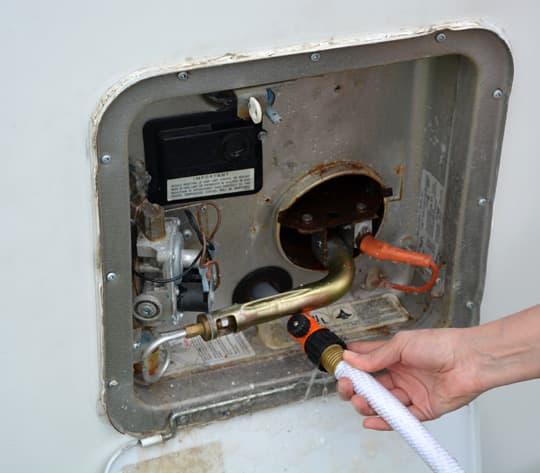
The existing water-heater opening is another important consideration when replacing a factory unit. A retrofit may be straightforward when the replacement heater is designed around a compatible opening, but installing a completely different system can require structural, plumbing, electrical, and exterior-panel modifications. Lippert notes that many current tankless systems are specifically designed to retrofit common RV water-heater openings.
For a custom camper van build, propane installation should be treated as a complete appliance-and-gas-system project rather than a simple DIY plumbing task. Manufacturer instructions and applicable local regulations should always take priority.
Electric Water Heater Installation Requirements
Electric water heaters eliminate many of the installation requirements associated with combustion appliances, but they still need correctly designed plumbing and electrical systems.
The installer needs to consider:
- Available AC voltage
- Circuit capacity
- Breaker and wiring requirements
- Grounding
- Inverter capacity, if used off-grid
- Water connections
- Pressure-relief protection
- Mounting and vibration resistance
- Physical clearance
- Drainage and winterization
- Protection from water leaks near electrical equipment
A 120V electric heater is especially important to size correctly against the van’s electrical system. The heater’s rated wattage should be compared with the inverter’s continuous output and the available shore-power circuit.
For example, if a heater requires more power than the inverter can continuously supply, it may trip the inverter or overload the system. If other appliances are running simultaneously, the combined load must also remain within the system’s limits.
Fully electric RV water heaters can offer significant installation flexibility. Dometic’s current electric platform, for example, is designed for interior installation and does not require an exterior wall cutout, while Suburban’s E-Series includes configurations intended for compact RV installation.
Even without combustion, however, an electric heater should not be installed casually. Water and electricity must be properly separated, wiring must be correctly protected, and the manufacturer’s electrical specifications must be followed.
Ventilation and Carbon Monoxide Safety
Ventilation is one of the most important distinctions between propane and electric water heaters.
A propane heater burns fuel, which means it produces combustion gases. Those gases must be directed safely outside the vehicle. A faulty installation, blocked exhaust, inadequate combustion air, or damaged venting can create serious safety risks.
Carbon monoxide is particularly dangerous because it is colorless and odorless. A camper van therefore needs appropriate carbon-monoxide detection wherever combustion appliances are installed.
The heater’s exterior vent and combustion-air openings should remain unobstructed. Suburban’s maintenance guidance specifically instructs owners to check the water-heater door screen and ensure that foreign material has not accumulated and restricted combustion or ventilation air. It also states that visible soot is a sign of incomplete combustion and requires the appliance to be shut down and inspected.
A good camper-van safety setup should therefore include:
- A properly installed propane appliance
- Correct combustion-air and exhaust routing
- A working carbon-monoxide detector
- A propane leak detector where appropriate
- Adequate ventilation according to the appliance requirements
- Regular inspection of vents and combustion components
- No obstruction around exterior exhaust openings
- Professional inspection if unusual soot, odor, ignition problems, or repeated shutdowns occur
Electric water heaters do not produce combustion gases, so they do not require combustion ventilation or a carbon-monoxide exhaust path. This makes them attractive for compact interior installations.
That does not mean the entire van can ignore ventilation. Cooking appliances, furnaces, generators, and other combustion sources may still require appropriate ventilation and CO protection.
Maintenance and Winterization
Both gas and electric water heaters require maintenance, although the specific tasks differ.
For tank-style propane heaters, maintenance can include:
- Inspecting the burner and combustion area
- Checking for soot
- Checking the exhaust and combustion-air openings
- Inspecting the tank
- Checking the pressure-relief valve
- Flushing sediment
- Inspecting the anode rod on models equipped with one
Suburban recommends periodic inspection for soot and states that its tank water heaters with anode rods should have the rod inspected and replaced when sufficiently consumed; its guidance gives annual replacement as a normal recommendation under typical use.
Electric tank heaters avoid combustion-related maintenance, but they can still accumulate mineral deposits. Depending on the tank construction and manufacturer’s design, maintenance may include flushing, checking connections, inspecting the heating element, and inspecting the pressure-relief system.
Tankless systems have their own maintenance requirements. Mineral-rich water can produce scale inside the heat exchanger, reducing heating performance and potentially causing problems. Current Suburban tankless guidance recommends annual descaling of the heat exchanger.
Winterization is essential for both gas and electric systems.
The energy source does not protect the water system from freezing. Water trapped inside the heater, plumbing, valves, or heat exchanger can expand when frozen and cause expensive damage.
Before storing a camper van in freezing conditions, the heater should be turned off and drained according to its specific instructions. Suburban recommends turning off electrical power, shutting off the gas supply, turning off the water pump, opening hot and cold faucets, and draining the heater.
A bypass system can make winterization easier because it allows the water heater to be isolated from the rest of the plumbing before RV-approved non-toxic antifreeze is introduced into the water system. This can prevent wasting antifreeze by filling the heater tank unnecessarily.
One particularly important rule applies to tank-style heaters:
Never energize an electric heating element when the tank is empty.
Suburban specifically warns that operating the 120V electric portion without water can damage the heating element. Before returning the heater to service, the tank should be filled completely and air removed from the system according to the manufacturer’s instructions.
Tankless units also need freeze protection. Some modern models have built-in freeze-protection systems, but these may require both electrical power and propane to remain available. Suburban, for example, states that certain tankless systems use powered freeze protection and also recommends draining the unit when the RV is being stored for winter.
Therefore, built-in freeze protection should not be treated as a substitute for proper winterization during long-term storage.
Space, Weight, and Storage Considerations
Space is extremely valuable in a camper van, so water-heater dimensions should be considered during the initial build rather than after the cabinetry has already been constructed.
A conventional tank heater needs space for the tank itself, plumbing connections, service access, insulation, and—in the case of propane models—combustion and venting arrangements.
Tankless heaters can reduce the volume dedicated to water heating because they do not need a large storage tank. Suburban’s current Advantage tankless model, for example, measures approximately 19.5 × 12.5 × 12.5 inches and weighs 36 pounds with the vent assembly.
Electric systems can also be compact. Suburban’s 7-gallon E-Series is listed as occupying less than 2 cubic feet, while Dometic’s current electric RV water-heater platform is designed around a lightweight, flexible installation concept.
But the heater itself is not the whole space calculation.
A camper-van designer should also account for:
- Fresh-water tank capacity
- Hot and cold water plumbing
- Shower and faucet lines
- Water pump
- Electrical wiring
- Inverter capacity
- Propane cylinders and regulators, if applicable
- Exterior venting
- Service access
- Drain lines
- Winterization valves
- Insulation
- Storage around the appliance
Weight also matters. A storage water heater carries the weight of the tank plus the water inside it. Water weighs approximately 8.34 lb per US gallon, so a 6-gallon tank contains roughly 50 lb of water before the heater, fittings, and mounting hardware are considered. A 10-gallon tank contains more than 80 lb of water.
That additional mass is carried every time the van travels, even though the hot water may not be needed continuously.
Tankless systems eliminate most of this stored-water weight, although the van still needs a fresh-water supply elsewhere.
For a compact camper van, the best design is therefore not simply the heater with the smallest physical dimensions. The better approach is to evaluate the entire system footprint—heater, fuel, electrical equipment, plumbing, ventilation, service access, and water storage—before deciding which technology fits the build.
Cost, Off-Grid Use, and Practicality
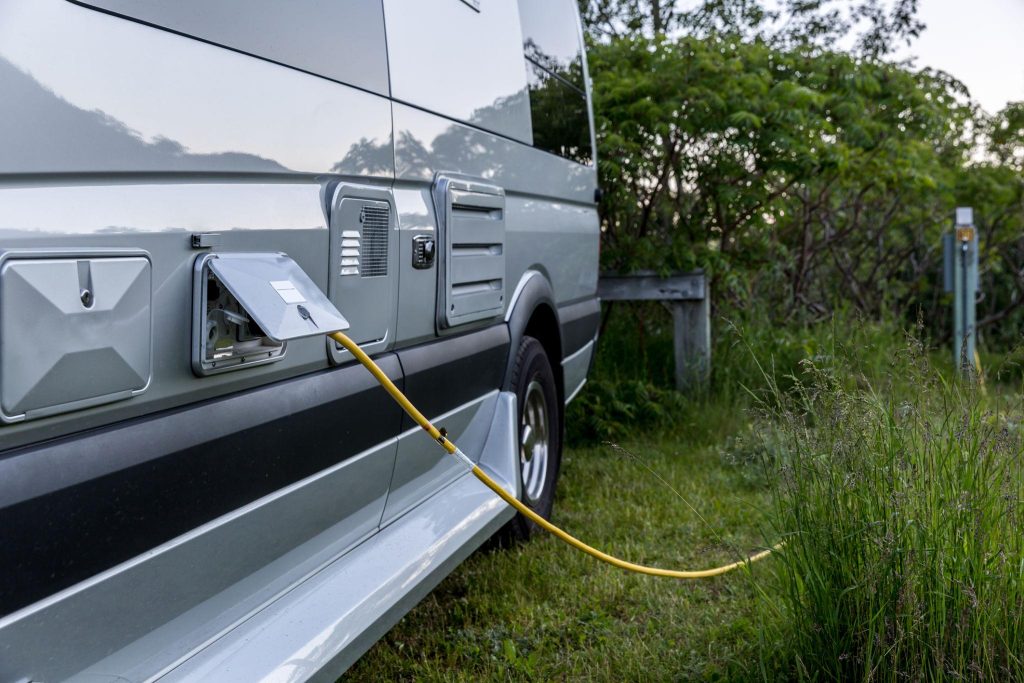
Choosing between a gas and electric water heater for a camper van is ultimately a system-design decision rather than simply an appliance decision. The heater has to work with the van’s propane supply, battery bank, inverter, solar capacity, freshwater system, camping habits, and available hookups.
A propane heater can reduce dependence on the electrical system, making it useful for extended off-grid travel. An electric heater can be particularly convenient at campgrounds where 120V shore power is included. Combination systems can bridge the two use cases by allowing the van to use electricity when plugged in and propane when operating independently. Current RV water-heater offerings from major manufacturers include gas-only, electric-only, and gas-electric systems specifically for these different operating conditions.
Initial Purchase and Installation Cost
The purchase price of a camper-van water heater varies substantially according to capacity, fuel type, tank or tankless design, controls, installation requirements, and brand.
As a current example, Dometic lists a 6-gallon gas-only RV water heater at about $603, while its 6-gallon gas-and-electric model is listed at about $686. Larger gas-electric models are listed at higher prices, with the exact price depending on tank capacity and configuration. These are manufacturer-listed prices and can change, so they should be treated as examples rather than universal market prices.
The appliance price, however, is only part of the installation cost.
A propane system may require:
- Propane tubing and fittings
- Regulator and shutoff components
- Exterior venting
- Combustion-air provisions
- Gas leak testing
- Electrical connections for ignition and controls
- Exterior access door or vent assembly
- Professional installation where required
An electric system generally eliminates the combustion and propane components, but a higher-power model can require substantial electrical infrastructure. Depending on the design, this can include a suitably rated AC circuit, inverter, battery bank, transfer or shore-power equipment, and appropriately sized wiring.
For a custom van conversion, the installation cost can therefore move in opposite directions. A simple electric heater may be straightforward if the van already has suitable shore-power infrastructure, while an off-grid electric system can become expensive if the battery and inverter must be upgraded specifically to operate the heater.
Propane installation can also be relatively straightforward when the van already has a compliant LP-gas system and an existing water-heater opening. Replacement units designed as direct-fit RV upgrades can reduce modification work considerably. Suburban, for example, currently markets a direct-fit replacement designed to avoid cutout, cabinet-depth, and major plumbing modifications in many installations.
Ongoing Operating Costs
Operating cost depends heavily on where the energy comes from.
For an electric water heater connected to campground shore power, the direct energy cost to the van owner may be very low if electricity is included in the campsite fee. The heater simply draws electricity from the campground’s 120V supply.
If the same heater is powered from the van’s battery through an inverter, the economics change. Electricity is no longer effectively “free”; it has to be supplied by the battery and replenished through solar, alternator charging, a generator, or another charging source.
This distinction is particularly important for resistance heating because heating water requires considerably more energy than small loads such as lighting, phone charging, or electronics. A high-wattage heater can therefore consume a meaningful portion of a van’s daily usable battery capacity.
Propane has the opposite operating pattern. The heater’s primary heat energy comes from the LP fuel rather than the battery. The van still needs electricity for controls, ignition, and other components depending on the model, but the major heating load is carried by propane.
A gas-electric combination heater can reduce operating costs or fuel consumption by switching energy sources according to the camping situation. Suburban’s current electric tank systems, for example, explicitly describe shore-power operation as a way to conserve propane.
To compare operating costs accurately, consider:
Electric cost per hot-water session = electricity consumed × electricity price
Propane cost per hot-water session = propane consumed × propane price
But for off-grid travel, also account for the cost and replacement cycle of batteries, solar panels, inverter capacity, and other charging equipment required to support electric heating.
Off-Grid and Boondocking Performance
Boondocking is where the difference between gas and electric water heating becomes especially noticeable.
A propane heater can produce substantial heat without requiring a large continuous battery discharge. Modern RV propane tankless heaters can have high burner inputs; for example, the current Furrion tankless system listed by Lippert provides 60,000 BTU/h of heating capacity and up to 2.4 gallons per minute under specified conditions.
This makes propane particularly compatible with a van designed around:
- Moderate battery capacity
- Limited roof space for solar
- Extended stays away from hookups
- Frequent showers
- Cold-weather travel
- Propane-powered cooking or heating appliances
Electric heating can also work off-grid, but the rest of the electrical system needs to be designed around it.
For example, an electric heater drawing around 1,500 watts through an inverter can become a major load on a 12V battery system. In simplified terms, 1,500W at 12V corresponds to 125A before accounting for inverter losses. Actual battery current will vary with battery voltage and inverter efficiency, but the example illustrates why electric water heating can quickly consume battery capacity.
Solar can replenish some of this energy during daylight, but solar production is variable. Cloud cover, winter conditions, shading, roof orientation, panel area, and other electrical loads all reduce the energy available for water heating.
For that reason, an electric heater is most practical for off-grid use when the van has been deliberately engineered for high electrical consumption, such as a large lithium battery bank, appropriately sized inverter, substantial solar or alternator charging, and sufficient energy-management capacity.
A propane system, by contrast, allows the battery system to remain focused on other loads.
Campground and Shore-Power Use
Campground travel changes the calculation considerably.
When 120V shore power is available, an electric water heater can provide hot water without consuming propane. This can be particularly useful for travelers who spend most nights at established campgrounds.
A current Suburban 7-gallon electric tank heater, for example, is designed to operate from 120V AC/15A service and provides a factory-set water temperature of 135°F. Suburban specifically identifies campground use and propane conservation as applications for the system.
Electric operation can also reduce the need to run a propane burner, which eliminates combustion noise and avoids consuming LP fuel while the van is connected to shore power.
A gas-electric combination system can provide even more flexibility. The van can use electricity when connected to the campground and switch to propane after leaving the campsite.
However, the campground’s electrical service still has limits. A water heater may share the shore-power circuit with:
- Air conditioning
- Refrigerator
- Microwave
- Induction cooktop
- Battery charger
- Coffee maker
- Other electrical appliances
If several high-power appliances operate simultaneously, the available circuit capacity can be exceeded. Therefore, the heater’s wattage needs to be considered as part of the entire electrical load rather than in isolation.
Cold-Weather and Winter Camping
Cold weather places additional demands on a camper-van water-heating system.
The colder the incoming water, the more heat the system must add to reach the desired shower temperature. A tankless heater therefore has to work harder when the water supply is near freezing than when it enters the system at a warmer temperature.
Propane tankless systems can have substantial heating capacity, making them useful for cold-weather operation. Some current models also incorporate freeze-protection features. Furrion’s current tankless system, for example, lists operation and protection features intended for cold conditions.
However, freeze protection should not be confused with complete winterization.
If a camper van will be stored in freezing conditions, water remaining inside the heater, pipes, valves, or heat exchanger can freeze and expand. Dometic’s current maintenance guidance recommends draining RV water heaters before winter storage or whenever freezing conditions are possible.
Electric heaters have another consideration: freeze protection may depend on continuous electrical availability. A system that relies on electricity to maintain a safe temperature cannot necessarily protect itself if the van is disconnected from power and the battery becomes depleted.
For extended winter storage, the safer approach is normally to follow the manufacturer’s specific draining and winterization procedure rather than relying indefinitely on an automatic freeze-protection function.
Cold-weather campers should also protect the rest of the water system, including:
- Freshwater tank
- Water pump
- Hot-water lines
- Cold-water lines
- Faucets
- Shower mixer
- Filters
- Wastewater plumbing
The water heater is only one part of the freeze-risk equation.
Daily Convenience and Long-Term Reliability
For everyday use, convenience depends on how the van is actually used.
Electric systems can be particularly straightforward when the van regularly has shore power. There is no propane burner to ignite, no combustion exhaust system to maintain, and no combustion-air opening associated with the heating process. Dometic’s current electric RV water heater, for example, is designed around a 120V platform and flexible installation, with the manufacturer emphasizing low-maintenance operation.
Propane systems introduce additional components but can provide greater energy independence. Modern systems incorporate electronic ignition, temperature controls, safety shutoffs, and other protection features. Proper installation and maintenance are essential, particularly for the combustion and exhaust system.
Long-term reliability depends more on correct installation, water quality, maintenance, and operating conditions than simply choosing gas or electric.
Hard water can cause mineral buildup in water-heating equipment. Tankless heat exchangers can be particularly sensitive to scale, while tank systems can require periodic flushing and inspection.
For gas systems, maintenance also includes keeping combustion-air and exhaust openings clear. Dometic’s current maintenance instructions specifically call for keeping the vent and combustion-air grill unobstructed and inspecting the burner flame; soot can indicate a combustion or flue problem.
For electric tank systems, the heating element and tank still require appropriate maintenance. Water should also be drained before freezing conditions, and the manufacturer’s instructions should be followed before energizing the heating element after the system has been drained.
The most reliable system is therefore the one that matches the van’s energy infrastructure and is maintained according to the manufacturer’s requirements.
Which Setup Fits Your Van?
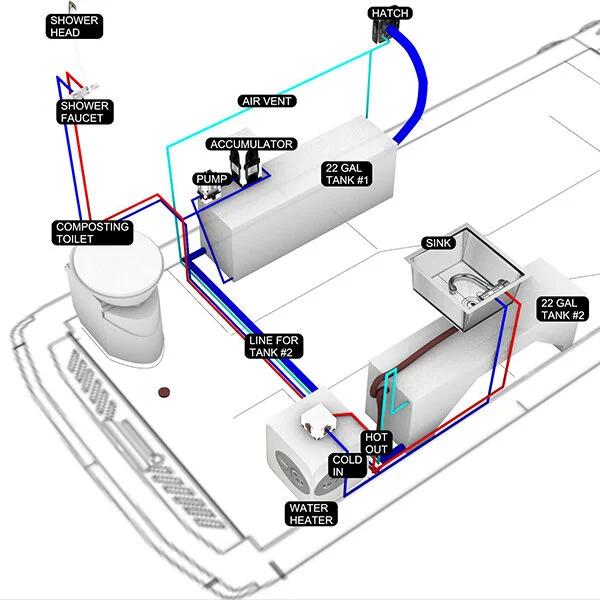
There is no single configuration that fits every camper van. The appropriate setup depends mainly on how often the van operates off-grid, how much electrical capacity it has, whether propane is already part of the build, how much space is available, and how frequently hot water is used.
The following categories make the decision easier.
Best Choice for Off-Grid and Boondocking Vans
For a van that spends long periods away from electrical hookups, the main question is how much energy the water heater takes from the limited onboard electrical system.
A propane water heater generally fits this type of build well because the primary heating energy comes from LP fuel rather than the battery. This leaves more battery capacity for refrigeration, lighting, electronics, ventilation, pumps, and other essential loads.
A propane tankless system can be especially useful when several people need hot water because it does not have the same stored-water limitation as a small tank. A current Furrion RV tankless model, for example, provides up to 2.4 GPM with a 60,000-BTU burner under its specified operating conditions.
An electric system can still be used for boondocking, but it makes more sense when the van has:
- A large battery bank
- A suitably sized inverter
- Significant solar capacity
- Strong alternator or DC charging
- Good energy monitoring
- Relatively low simultaneous electrical loads
For a small electrical system, using battery power to heat water can consume energy that could otherwise support essential appliances.
Best Choice for Campground-Based Van Travel
If the van spends most of its time at campgrounds with electrical hookups, an electric water heater can fit naturally into the energy system.
Shore power allows the heater to operate without draining the house battery or consuming propane. A current Suburban electric model, for example, is specifically designed around 120V AC/15A operation and marketed for campground use.
This setup can be particularly attractive when:
- The van regularly uses shore power
- Propane consumption needs to be minimized
- The electrical system already supports 120V appliances
- Quiet operation is important
- The owner wants a simple flameless water-heating system
A gas-electric combination provides another practical arrangement for travelers who alternate between campgrounds and off-grid locations.
Best Choice for Small Camper Vans
Small camper vans have particularly tight constraints on:
- Floor area
- Cabinet volume
- Battery capacity
- Propane storage
- Water capacity
- Payload
- Ventilation and appliance access
A compact electric heater can be attractive where the van already has reliable shore power. Dometic’s current electric RV water-heater platform, for example, is designed to be lightweight and flexible for RV floorplans, with a 10-pound listed weight for its system.
Tankless designs can also reduce the amount of space dedicated to hot-water storage.
However, the smallest physical heater is not necessarily the best overall solution. A tiny electric heater may require a large inverter and battery system if the owner wants to use it away from shore power.
Conversely, a compact propane tankless heater may reduce electrical requirements but needs propane plumbing, combustion-air provisions, exhaust routing, and appropriate exterior installation.
For a small van, compare the complete system footprint, not just the dimensions printed on the heater’s specification sheet.
Best Choice for Full-Time Van Living
Full-time van living generally creates more demanding hot-water requirements than occasional weekend travel.
A full-time occupant may need hot water for:
- Daily showers
- Dishwashing
- Cooking cleanup
- Hand washing
- General cleaning
- Multiple users
- Frequent cold-weather use
For this type of usage, a tankless propane system can provide a large supply of hot water without requiring a huge electrical heating load.
However, full-time travelers who spend most of their nights at campgrounds may prefer electric operation. In that situation, a gas-electric combination can provide a practical operating strategy: electricity can handle normal campground use, while propane remains available when the van moves away from hookups.
Full-time users should also place greater emphasis on serviceability. A water heater that requires specialized parts or difficult access can become inconvenient when traveling far from a service center.
Before choosing a system, check:
- Replacement-part availability
- Warranty coverage
- Service network
- Manufacturer documentation
- Maintenance requirements
- Water-quality tolerance
- Winterization procedure
- Ease of accessing the heater for repairs
When a Gas-Electric Combination Makes More Sense
A gas-electric combination is particularly useful when the van has a mixed camping pattern.
For example:
At a campground:
Use 120V electricity and preserve propane.
At a remote campsite:
Switch to propane and preserve battery capacity.
During heavy demand:
Use both heating modes if the specific heater supports simultaneous operation.
This flexibility is one of the strongest arguments for combination systems.
Current RV combination products are designed specifically around this concept. Dometic offers gas-and-electric water heaters in several tank capacities, while Suburban’s electric systems can also be used as a supplemental heating source alongside compatible propane/tankless systems.
The tradeoff is greater system complexity and potentially higher purchase cost compared with a single-energy heater.
For a van that alternates regularly between campground stays and boondocking, however, having two energy sources can simplify day-to-day energy management.
Final Decision Checklist
Before purchasing a water heater, evaluate the entire camper-van system rather than choosing based solely on heater price.
Use this checklist:
| Question | What to consider |
|---|---|
| Where will you camp most? | Campgrounds, boondocking, or a mixture |
| Do you have shore power? | Frequency and available circuit capacity |
| How large is your battery? | Usable kWh/Ah, not just nominal capacity |
| How much solar do you have? | Roof space, seasonal output, shading |
| Do you already use propane? | Cooking, furnace, refrigerator, or other appliances |
| How much hot water do you need? | One person, couple, family, daily showers |
| Tank or tankless? | Stored capacity versus continuous heating |
| How much space is available? | Heater plus service clearance and plumbing |
| What is the van’s payload? | Heater, water, propane, batteries, and equipment |
| How cold will you camp? | Incoming-water temperature and freeze protection |
| How will you winterize? | Drainage, bypass, antifreeze, and storage |
| What maintenance is required? | Descaling, flushing, burner inspection, anode replacement |
| Is professional installation required? | Especially important for propane systems |
| Are replacement parts available? | Important for long-term and remote travel |
| What happens without shore power? | Determine whether electric heating remains practical |
| What happens if propane runs out? | Important for gas-only systems |
| What happens if the battery is low? | Important for electric and freeze-protection systems |
A useful way to make the final decision is to identify the van’s primary energy scenario.
If the van is predominantly off-grid and has a modest electrical system, propane heating can reduce pressure on the batteries. If the van spends most of its time connected to campground electricity, electric heating can make good use of shore power. If the van regularly switches between the two environments, a gas-electric combination provides two energy sources and greater operating flexibility.
The most important consideration is therefore not simply gas vs electric, but whether the water heater works efficiently with the van’s complete system—fuel storage, battery capacity, solar/charging capability, water capacity, available space, camping style, climate, and maintenance requirements.
Read More: Skottle vs Traditional Camp Stove: Overland Cooking Showdown