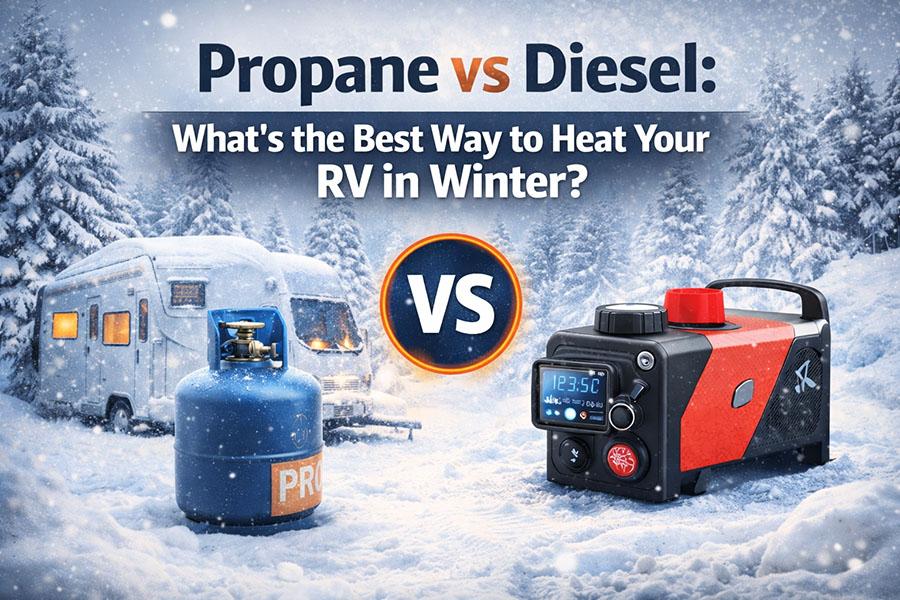
Choosing the right heater can make a major difference when you spend winter nights in an RV. Freezing temperatures, long heating cycles, limited battery capacity, condensation, and fuel availability all become more important once the weather turns cold. Two of the most common fuel-based options are diesel air heaters and propane heating systems.
A diesel heater burns diesel fuel in a sealed combustion chamber and transfers the resulting heat to air that is circulated inside the RV. The combustion exhaust is routed outside, while a small 12V electrical system powers the fan, fuel pump, controls, and ignition. Modern diesel air heaters are available in different sizes; for example, Webasto’s Air Top 2000 STC produces 0.9–2.0 kW (about 3,100–7,000 BTU/h), while larger Air Top Evo models reach 4–5.5 kW.
An RV propane furnace works differently. It burns propane in a sealed combustion area, uses a heat exchanger to transfer heat to interior air, and sends combustion gases outside through an exhaust system. A blower then distributes the heated air through ducts around the RV. Current Suburban RV furnaces, for example, are available from roughly 20,000 to 40,000 BTU/h and use 12V electrical power for the blower and controls.
The comparison is therefore not simply about which fuel is cheaper. A diesel heater can provide efficient, low-power space heating and can be attractive for boondocking or small camper vans. A propane furnace can deliver higher heat output and use an RV’s existing propane infrastructure, making it particularly practical for larger RVs with ducted heating.
There is also an important distinction between a built-in propane furnace and a portable propane heater. Portable heaters may be convenient as supplemental heat, but they should not automatically be treated as replacements for a properly installed RV furnace. The U.S. Consumer Product Safety Commission specifically warns against using portable fuel-burning heaters while sleeping in enclosed campers or vehicles unless the equipment is specifically designed and approved for that enclosed-space application and its instructions are followed.
For a winter RV setup, the better choice depends on several factors: RV size, insulation, expected outdoor temperatures, camping altitude, battery capacity, fuel availability, desired heat distribution, noise tolerance, and whether the heater will be the primary system or a backup.
How Each Heating System Works
How a Diesel RV Heater Works
A diesel RV heater is essentially a small, self-contained combustion heater. Unlike a vehicle engine, it does not need to idle the engine to create heat. Instead, the heater meters a small amount of diesel into a combustion chamber, burns it, and transfers the resulting heat through a heat exchanger.
The basic process is:
- The heater draws in combustion air from outside.
- A metering pump supplies diesel fuel to the combustion chamber.
- The fuel is ignited.
- Combustion heats a metal heat exchanger.
- An interior fan moves RV air across the heat exchanger.
- The warmed air is discharged into the living space.
- Combustion exhaust is routed outside the RV.
The key advantage is that the combustion process and interior air are separated. The air you breathe is not supposed to pass through the combustion chamber. Instead, interior air receives heat indirectly through the heat exchanger.
Modern diesel air heaters can modulate their output rather than simply operating continuously at maximum power. The Webasto Air Top 2000 STC, for example, has a continuously variable output between 0.9 and 2.0 kW and can use either recirculated or fresh air depending on the application.
Electrical consumption is relatively modest compared with electric resistance heating. A current Air Top 2000 STC specification lists approximately 14–29 watts of electrical consumption during operation, although startup can have different power requirements.
Fuel consumption is also low relative to the amount of heat produced. The same 2 kW-class Webasto model is rated at approximately 0.12–0.24 L/h of fuel consumption depending on operating output.
This combination of liquid fuel and modest electrical demand makes diesel air heaters particularly interesting for off-grid winter camping. A properly sized system can maintain a small camper’s interior temperature without relying on shore power or running a generator continuously.
However, installation quality matters. The heater needs correctly routed combustion air, exhaust, fuel lines, electrical connections, and hot-air ducting. Exhaust gases must never be allowed to enter the RV. The manufacturer’s installation requirements should therefore be followed rather than treating the heater as a simple plug-in appliance.
How an RV Propane Furnace Works
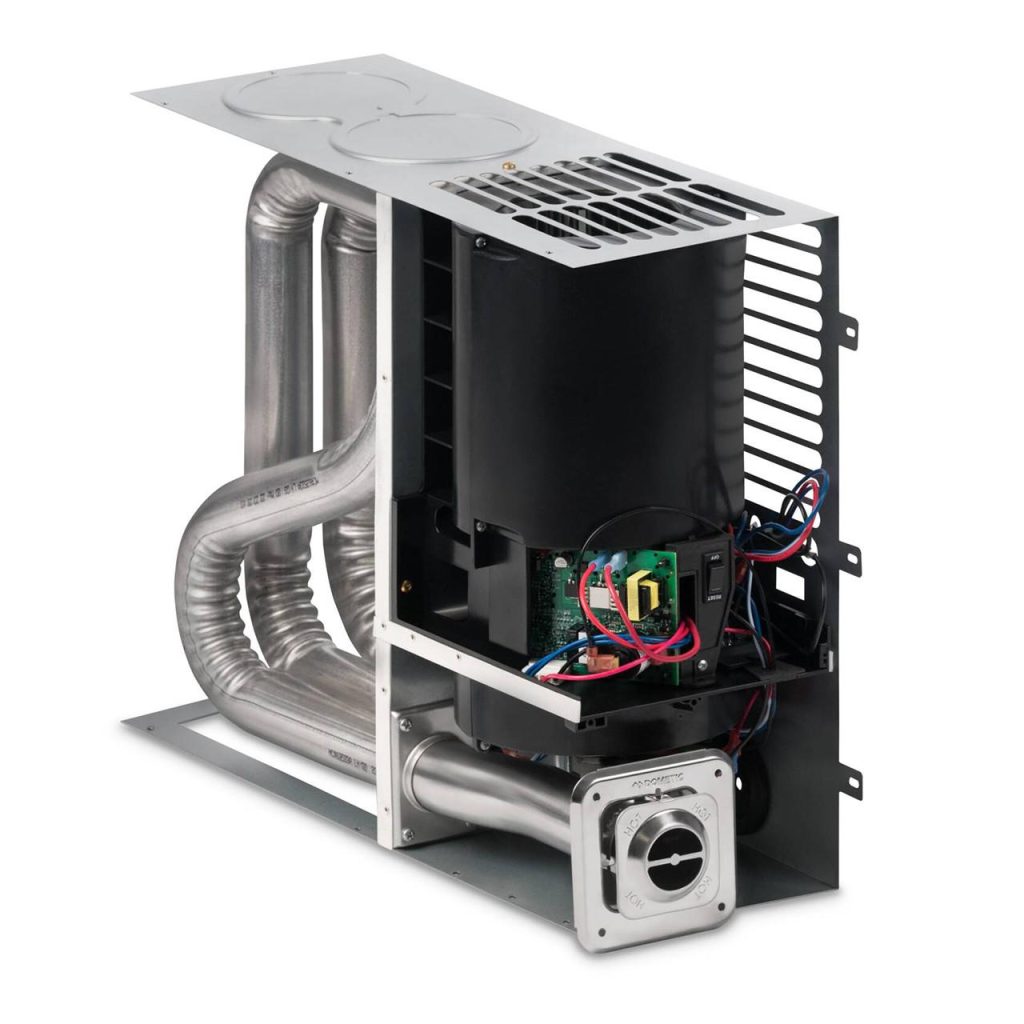
A traditional RV propane furnace is a ducted forced-air heating system. Propane is burned in a combustion chamber, but the combustion gases remain separated from the interior air by a heat exchanger.
The basic heating cycle works like this:
- The thermostat detects that the RV temperature is below the set point.
- The furnace blower starts.
- The ignition system starts the propane burner.
- Propane combustion heats the heat exchanger.
- The blower moves interior air across the heated exchanger.
- Warm air travels through ducts to different parts of the RV.
- Combustion gases leave through the exterior exhaust.
- Once the thermostat reaches the desired temperature, the burner shuts down.
The ducted design is one of the biggest differences between a typical RV propane furnace and many diesel air-heater installations. A propane furnace can send heated air through multiple ducts, allowing one furnace to warm the main living area, bedroom, bathroom, or other zones.
Current Suburban SF-Q furnaces, for example, are available in 20,000–40,000 BTU/h capacities and use sealed forced-draft combustion. A 20,000-BTU/h model is listed at 5.1 amps on 12V power.
That higher heat-output range is useful for larger RVs or extremely cold conditions where a small 2 kW diesel heater may not provide enough capacity.
A propane furnace does not run solely on propane, however. Its blower, ignition, thermostat, and control electronics require electricity. This means a propane furnace can still consume a meaningful amount of battery power during extended off-grid winter camping.
The major benefit is that propane furnaces are already integrated into many RVs. If the RV was designed with a propane furnace, the ductwork, thermostat, exterior venting, return-air system, and propane plumbing may already be installed. Replacing or maintaining the existing furnace can therefore be easier than installing an entirely new heating system.
Portable Propane Heater vs RV Propane Furnace
A portable propane heater is not the same thing as a built-in RV propane furnace.
A typical RV furnace uses sealed combustion and exhausts combustion products outside. A portable radiant or catalytic propane heater may instead release the heat directly into the living space. Some models are specifically certified for certain enclosed-space applications and incorporate safety features such as an oxygen-depletion sensor and tip-over shutoff. For example, some current Mr. Heater models are designed for specific enclosed-space uses and include ODS and tip-over protection.
However, certification and intended use are critical. A heater being marketed for camping does not mean every model is appropriate for use inside an RV while sleeping.
The CPSC warns that people die every year from carbon monoxide poisoning associated with portable camping heaters, lanterns, and stoves used inside tents, campers, and vehicles. It specifically advises against using portable heaters while sleeping in enclosed campers and vehicles.
There is another difference: portable propane heaters generally do not provide the same whole-RV heat distribution as a ducted furnace. They heat the area around the appliance, often through radiant or localized convection heat. A bedroom behind a closed door may remain significantly colder than the area immediately around the heater.
Portable heaters can therefore be useful as supplemental or emergency heating when the exact model is approved for the intended indoor application and all manufacturer instructions are followed. They should not automatically be considered a direct replacement for a properly installed RV furnace.
What Makes the Two Systems Different in Winter?
The biggest difference between diesel and propane RV heating is the combination of fuel type, heat output, electrical demand, installation, and heat distribution.
A diesel air heater is often compact and efficient for its size. It can provide continuous low-level heat while using relatively little fuel and electrical power. This is particularly useful in small camper vans, converted vehicles, and off-grid setups where battery capacity is limited.
A propane furnace generally has a larger available heat-output range and is better suited to the ducted heating architecture found in many motorhomes and travel trailers. A 20,000-BTU/h furnace produces roughly 5.9 kW of heat input, before accounting for the furnace’s actual delivered efficiency, while many compact diesel heaters are in the 2 kW class.
The difference becomes particularly noticeable during severe cold. A small diesel heater may maintain a well-insulated camper effectively but struggle to recover the interior temperature after the door has been opened repeatedly in freezing weather. A properly sized propane furnace can have considerably more heating capacity.
On the other hand, maximum BTU rating should not be used alone to determine which system is better. Oversizing a heater can cause short cycling, uncomfortable temperature swings, inefficient operation, and poor air distribution. The heater should be matched to the RV’s size, insulation, climate, and expected heat loss.
Fuel Efficiency, Running Cost, and Battery Use
Diesel Fuel Consumption
Diesel heaters are known for relatively low liquid-fuel consumption, especially when operated at their lower output levels.
For example, Webasto lists the Air Top 2000 STC at approximately 0.12–0.24 L/h of diesel across its 0.9–2.0 kW operating range. That means a theoretical 10-hour operating period could consume approximately 1.2–2.4 liters if the heater operated continuously at those respective rates. Actual daily consumption can be substantially lower than a simple maximum-runtime calculation because the heater normally cycles or modulates according to the heat requirement.
Larger diesel heaters naturally consume more. Webasto’s Air Top Evo 40, for example, has a published fuel consumption range of approximately 0.18–0.43 L/h, with a temporary boost rate of about 0.49 L/h. The Air Top Evo 55 is listed at approximately 0.18–0.61 L/h, with a temporary boost rate of about 0.67 L/h.
This illustrates why fuel consumption should always be compared at a similar heat output. Comparing a 2 kW diesel heater with a 5 kW propane furnace solely by liters or gallons per hour would not provide a meaningful efficiency comparison.
Another advantage of diesel is that a relatively small onboard fuel supply can provide many hours of heating. A diesel heater can also draw from a dedicated auxiliary tank or, depending on the installation and manufacturer requirements, an appropriate vehicle fuel source.
Propane Consumption in Cold Weather
Propane consumption varies considerably because an RV furnace does not necessarily operate continuously. Its thermostat cycles the burner according to interior temperature, insulation, outdoor temperature, wind, and heat loss.
A useful way to estimate propane consumption is to start with the furnace’s BTU input rating. Propane contains approximately 91,500 BTU per U.S. gallon of liquid propane, although the exact energy content varies with composition and conditions.
For example, a 20,000-BTU/h furnace operating continuously at its rated input would theoretically consume about:
20,000 ÷ 91,500 ≈ 0.22 gallons of propane per hour
At continuous full input, that is roughly 5.2 gallons over 24 hours. But this is a theoretical full-fire calculation, not a typical daily consumption figure.
If the furnace operates 30% of the time because the RV is well insulated and the outdoor temperature is moderate, the equivalent full-input consumption would be approximately 1.6 gallons per day. In severe winter weather, the duty cycle can be much higher.
Propane cylinder size also matters. A commonly used 20-lb propane cylinder contains about 4.7 gallons of propane when filled to the normal safe fill level. A larger ASME RV tank provides substantially more capacity.
Cold weather can create another issue: propane vaporization. As temperatures fall, a propane cylinder’s ability to vaporize liquid propane decreases. A nearly empty or undersized cylinder can therefore struggle to supply enough vapor during periods of very high demand, particularly in extremely cold weather.
This does not mean propane furnaces stop working in ordinary winter conditions. Properly sized RV propane systems are designed for cold-weather use. But tank capacity, regulator condition, cylinder exposure, and fuel level become increasingly important as temperatures drop.
Which Uses More Electricity?
Neither system is electrically independent, but the electrical demand can differ substantially by model.
A diesel air heater typically uses electricity for its fan, fuel pump, controller, and ignition/startup sequence. Once running at a stable output, its electrical demand can be relatively low. Webasto lists the Air Top 2000 STC at approximately 14–29 watts during operation.
A propane RV furnace also needs electricity because its blower must circulate air and its ignition/control system must operate. A current Suburban SF-Q 20,000-BTU/h furnace is listed at 5.1 amps on a 12V system, which corresponds to approximately 61 watts while drawing that rated current.
The actual battery consumption depends on how long the equipment operates and how frequently the burner or heater cycles.
For example, if a 12V heater averaged 2 amps for 10 hours:
2 A × 10 h = 20 Ah
If a furnace averaged 5 amps for the same 10-hour period:
5 A × 10 h = 50 Ah
These are simplified examples rather than universal consumption figures. Startup, shutdown, fan speed, thermostat cycling, battery voltage, and specific equipment all affect real-world consumption.
This is one area where diesel heaters can be attractive for boondocking: a small diesel air heater can provide useful continuous heat without placing the same blower load on the house battery as some larger RV furnaces.
Calculating Winter Heating Cost
The most useful way to compare diesel and propane operating costs is to calculate the cost per unit of delivered heat rather than simply comparing fuel prices.
A basic calculation is:
Heating cost = fuel consumed × local fuel price
For diesel:
Daily diesel cost = liters used per day × diesel price per liter
For propane:
Daily propane cost = gallons or liters used per day × propane price per unit
However, the calculation becomes more useful when you account for heater output and runtime.
Suppose a diesel heater consumes 0.20 L/h while providing approximately 2 kW of heat. At a diesel price of $1.00/L, running continuously for 10 hours would cost about:
0.20 × 10 × $1.00 = $2.00
A hypothetical propane furnace with a 20,000-BTU/h input that runs continuously for 10 hours would consume approximately 2.19 gallons based on the simplified 91,500-BTU/gallon calculation. At $3.00/gallon, that would be:
2.19 × $3.00 ≈ $6.57
But these numbers should not be presented as a universal diesel-versus-propane cost winner. Fuel prices vary significantly by country and region, and heaters differ in efficiency, output, and cycling behavior.
A better real-world comparison is to record actual fuel consumption over several winter nights at similar outdoor temperatures. This captures the effect of insulation, wind, thermostat settings, heater sizing, and RV heat loss.
Battery charging also has a cost if you rely on a generator or shore power to replace energy used by the heating system. For boondockers, however, the bigger issue may be battery capacity rather than the monetary cost of electricity.
Fuel Availability and Storage
Fuel availability can be just as important as fuel efficiency during a long winter trip.
Propane is deeply integrated into the RV industry. Many motorhomes, travel trailers, and camper systems already have propane tanks or cylinders for furnaces, refrigerators, water heaters, and cooking appliances. That makes propane convenient when traveling through areas with established RV propane services.
Diesel has a different advantage: diesel fuel is widely available at conventional fuel stations and is also commonly carried by diesel-powered tow vehicles and motorhomes. A diesel heater may therefore allow the heating fuel to come from a fuel source already present on the vehicle.
Storage requirements differ as well. Propane must be stored in approved cylinders or tanks and handled according to applicable regulations. Diesel can be stored in approved fuel tanks or containers, but spills, fuel quality, and cold-weather fuel behavior must be considered.
For winter travel in remote areas, it is worth planning fuel stops before the trip rather than assuming every destination will have convenient propane refilling or diesel access.
Winter Performance: Heat Output, Cold Temperatures, Altitude, and Comfort
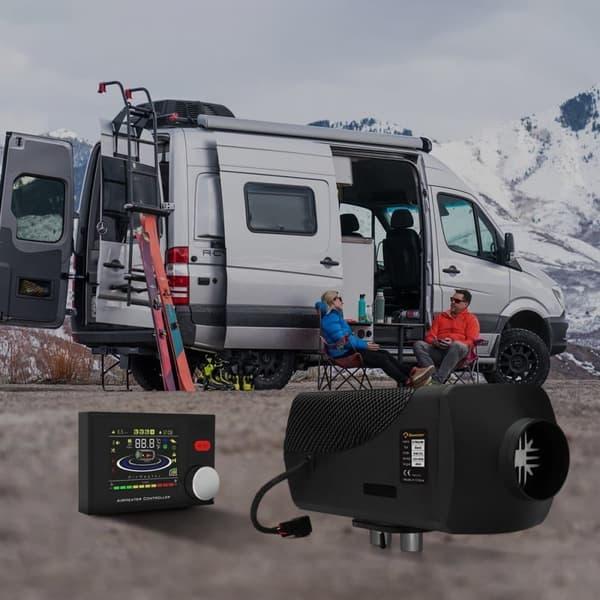
Heating Performance in Freezing Weather
Both diesel and propane can provide reliable winter heating when the equipment is correctly sized, installed, and maintained. The important question is whether the heater can replace the heat the RV loses to the outdoor environment.
An RV’s heat loss increases as the temperature difference between inside and outside increases. For example, maintaining 20°C inside when it is 0°C outside requires considerably less heating than maintaining the same indoor temperature when it is −20°C outside.
Insulation, window area, floor insulation, roof construction, slide-outs, door seals, and air leakage can therefore matter as much as the fuel type.
A compact 2 kW diesel heater can be very effective in a well-insulated camper van or small RV. Webasto’s Air Top 2000 STC, for example, provides up to 2 kW and is specifically designed for compact vehicle heating applications.
Larger RVs may require substantially more capacity. Webasto offers diesel air heaters in 4 and 5.5 kW classes, while Suburban’s current RV propane furnace range extends from about 20,000 to 40,000 BTU/h.
The important point is to size the heater according to the RV’s heat-loss requirement rather than selecting the largest available model.
An oversized heater can also be problematic. If it rapidly heats a small space and repeatedly shuts down, the resulting short cycling can reduce comfort and may be less desirable than a properly sized heater that can operate steadily at a lower output.
Heat Distribution Inside an RV
Heat distribution is one of the biggest practical differences between heating systems.
A typical RV propane furnace is connected to ductwork. Warm air can therefore be directed toward different areas of the RV. This is useful in larger floorplans where the sleeping area, kitchen, bathroom, and living area may otherwise develop different temperatures.
A diesel air heater can also be ducted, but many compact installations use one or a few strategically positioned outlets. The final result depends heavily on installation design.
For example, placing a diesel heater outlet close to the floor can help distribute warm air through the living space as warm air naturally rises. Positioning outlets strategically can also reduce cold spots around beds or seating areas.
Airflow restrictions are important. Long, narrow, sharply bent, or undersized ducts can increase resistance and reduce useful airflow. Heater manufacturers specify limits for duct length, diameter, outlet configuration, and installation geometry, and those requirements should be followed.
The return-air arrangement matters too. A heater that recirculates warm interior air can gradually maintain the RV temperature efficiently, while a fresh-air configuration can introduce outside air and change the ventilation and humidity balance.
For larger RVs, a properly designed ducted propane furnace can have an advantage because the heating system was often engineered as part of the vehicle’s original climate-control layout.
High-Altitude RV Camping
Altitude can affect combustion heaters because the air contains less oxygen as elevation increases.
A fuel heater must maintain an appropriate fuel-to-air mixture to burn efficiently. At high elevations, a system without appropriate altitude compensation can experience incomplete combustion, reduced output, increased soot, or other operating problems.
This is particularly important for diesel heaters because many RV users install them specifically for off-grid mountain camping.
Modern diesel heaters can address this with altitude compensation. For example, Webasto’s Air Top Evo 40/55 systems include automatic altitude adjustment to 2,200 meters, with certain variants capable of operation at substantially higher elevations. The Air Top Pro 25 is advertised with altitude capability up to 5,500 meters.
Not every heater has the same capability. Therefore, an RV traveler who regularly camps at high elevations should check the exact heater model’s altitude rating rather than assuming all diesel heaters behave the same way.
Portable propane heaters also have altitude limitations. For example, some current Mr. Heater portable models list maximum operating elevations around 7,000 feet.
High-altitude operation also increases the importance of carbon-monoxide protection. The CPSC specifically warns that carbon-monoxide poisoning from portable camping equipment is especially important to consider at high altitudes.
If winter camping involves mountains, always follow the heater manufacturer’s altitude requirements and use a properly functioning carbon monoxide alarm inside the RV.
Humidity and Condensation
Winter condensation is often misunderstood when comparing RV heaters.
A properly vented diesel heater or propane furnace separates combustion exhaust from the interior air. Because the water vapor produced by combustion is exhausted outside rather than released into the RV, these systems do not add combustion moisture directly to the living space.
Portable unvented propane heaters are different. When propane burns inside the RV, the combustion process produces water vapor along with heat. That moisture can contribute to condensation on windows, walls, ceilings, and cold surfaces.
This can become a serious winter comfort and moisture-management problem because RVs have many surfaces that can become cold overnight.
Condensation can also come from normal human activity: breathing, cooking, showering, wet clothing, and melting snow brought into the RV all add moisture.
A vented diesel heater or propane furnace therefore has an advantage over an unvented fuel heater when moisture control is a priority. However, heating alone does not eliminate condensation. Proper ventilation, insulation, thermal curtains, moisture management, and minimizing unnecessary indoor humidity remain important.
Noise and Sleeping Comfort
Noise can make a surprisingly large difference when heating an RV overnight.
A diesel air heater contains several moving and mechanical components, including a combustion fan and fuel metering pump. The fan can create airflow noise, while the metering pump can produce a characteristic clicking sound if it is not properly isolated.
Modern diesel heaters are designed to reduce operating noise. Webasto, for example, specifically describes several current air-heater models as quiet or optimized for low-noise operation, with variable output and blower control intended to improve comfort.
A propane furnace also produces blower noise. Because the furnace may use a relatively powerful fan to push air through several ducts, airflow noise can become noticeable when the system starts.
The perceived noise depends heavily on installation. A diesel heater mounted directly against a thin interior panel can transmit vibration into the RV structure. A properly isolated fuel pump and heater mounting system can substantially reduce this effect.
Similarly, propane furnace noise can vary depending on duct design, return-air restrictions, blower condition, and where the furnace is mounted.
For sleeping, the best system is not necessarily the one with the lowest published noise figure. A heater that can maintain temperature at a low continuous output may be less disruptive than a larger system that repeatedly turns on at high power.
In practical terms, a small, properly installed diesel heater can be very quiet once it settles into low-power operation, while a propane furnace may produce more noticeable fan noise during each heating cycle. But individual models and installations vary, so published specifications and real-world installation quality should be considered before making a final choice.
Installation, Maintenance, and Winter Safety
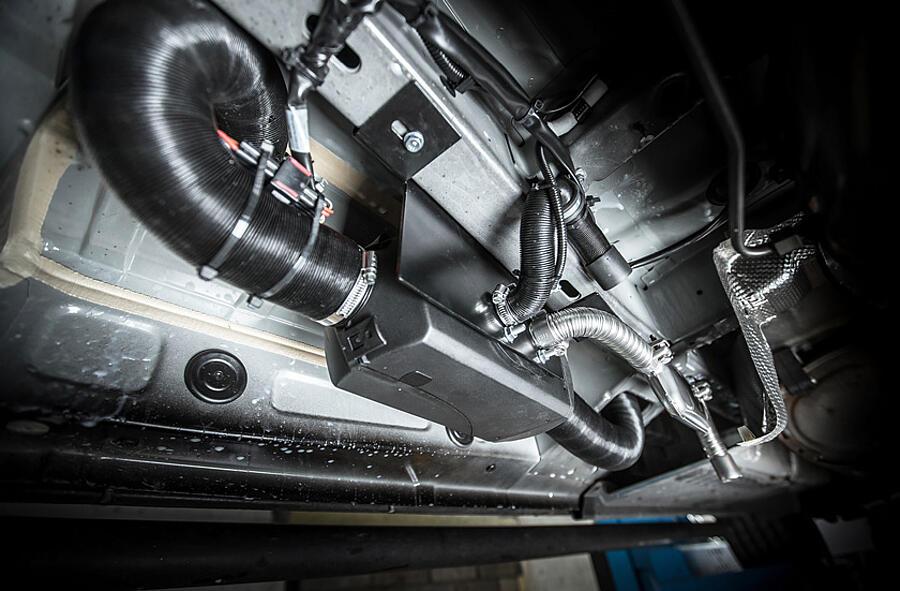
Diesel Heater Installation Requirements
Installing a diesel air heater is more involved than simply mounting the heater and connecting a fuel line. Because the system produces combustion gases and high temperatures, the combustion-air intake, exhaust, fuel supply, electrical system, and hot-air ducting all need to be installed according to the manufacturer’s specifications.
A typical diesel RV heater requires several main connections:
- A 12V or 24V electrical supply, depending on the model
- A diesel fuel supply and metering pump
- A combustion-air intake
- An exhaust pipe routed outside the RV
- A heated-air outlet
- A return-air or fresh-air intake, depending on the installation
- A suitable control or thermostat
For example, the Webasto Air Top 2000 STC is designed for vehicle installation and can be installed in different locations, including underfloor or onboard, depending on the application. The manufacturer provides dedicated RV installation versions with installation materials and controls.
The most important part of the installation is separating combustion gases from the RV’s interior. The exhaust must be routed completely outside, and the heater’s mounting arrangement must maintain the required seal. Webasto specifically warns that exhaust gases must be routed only to the outside and that the heater’s base seal must be correctly fitted.
The exhaust pipe also becomes extremely hot during operation. It should therefore be positioned away from combustible materials, fuel lines, wiring, insulation, and other components that could be damaged by heat. The manufacturer’s specified clearances and heat shielding should always be followed.
Fuel-line routing is another important consideration. The line should be securely supported, protected from abrasion, and kept away from hot components. The metering pump should be installed in the orientation specified by the heater manufacturer because pump positioning can affect reliable fuel delivery and noise.
Electrical installation deserves equal attention. A diesel heater can draw relatively little power once operating, but startup and shutdown can involve additional electrical demand. The wiring should therefore be correctly sized and protected with the manufacturer’s specified fuse or circuit protection.
Airflow is also critical. The hot-air outlet should not be blocked by furniture, bedding, clothing, or storage items. Webasto warns that restricted or contaminated hot-air lines can cause overheating and trigger the heater’s safety shutdown.
For a permanent RV installation, following the exact installation manual for the specific heater is much more important than relying on a generic installation diagram. If you are unfamiliar with fuel systems, combustion appliances, or vehicle electrical work, professional installation is the safer approach.
Propane Furnace Installation Requirements
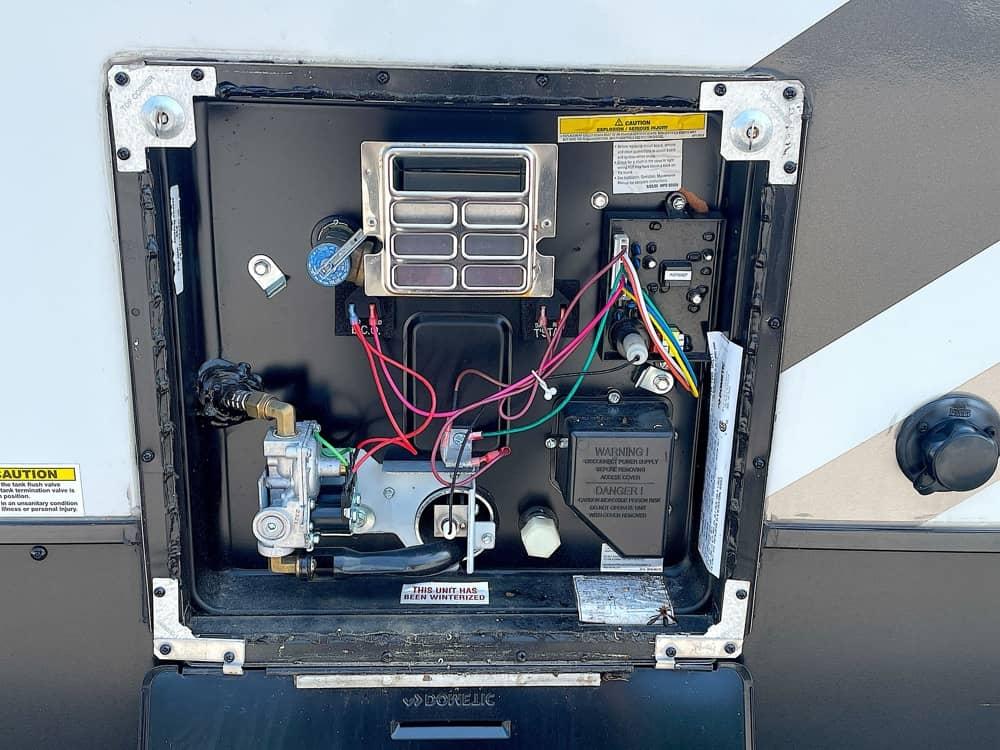
A built-in RV propane furnace is a more integrated system than a typical portable heater. It normally requires a propane supply, 12V electrical connection, combustion-air intake, exhaust vent, return-air opening, and heated-air ductwork.
Modern RV furnaces are generally designed as sealed forced-draft systems. For example, Suburban’s current SF-Q series uses sealed forced-draft combustion, automatic direct-spark ignition, and ducted warm-air distribution. The range covers approximately 20,000 to 40,000 BTU/h depending on the model.
The installation therefore needs to accomplish several things at the same time:
- Deliver propane at the correct pressure.
- Provide adequate combustion air.
- Keep combustion gases separated from the interior.
- Exhaust those gases safely outside.
- Provide sufficient return air to the furnace.
- Distribute heated air through correctly sized ducts.
- Supply the required 12V electrical power.
- Maintain the manufacturer’s specified clearances.
Return-air airflow is particularly important. Blocking the furnace’s return-air opening can restrict circulation and cause operating problems. Similarly, covering the exterior furnace vent can interfere with combustion or exhaust.
The furnace also needs to be positioned so that its exterior vent cannot accidentally become blocked by an open RV door, storage compartment, snow, mud, or other obstruction. Suburban’s operating guidance specifically instructs owners to keep furnace venting clear and warns that soot on the vent can indicate incomplete combustion and unsafe operation.
Propane connections are another area where professional installation is strongly recommended. Suburban states that its gas appliances should be installed and serviced by qualified service technicians.
This is particularly important because a propane leak can create both fire and explosion hazards. Never improvise propane connections or substitute fittings that are not approved for the system.
Carbon Monoxide and Combustion Safety
Carbon monoxide (CO) is one of the most important safety issues when using any combustion-based heating system inside or around an RV.
Carbon monoxide is colorless and odorless, so people cannot reliably detect it without an alarm. It can be produced when carbon-based fuels such as propane or diesel do not burn completely.
A correctly installed diesel heater or propane furnace is designed to keep combustion gases separate from the RV’s interior air. That separation must never be compromised.
The basic safety rules are straightforward:
- Install a suitable CO alarm in the RV.
- Test the alarm regularly.
- Replace batteries or the complete alarm according to its instructions.
- Never block a heater’s exhaust or combustion-air intake.
- Inspect exterior vents before operating the heater.
- Never modify the exhaust system in an unapproved way.
- Never operate a heater if you suspect exhaust gases are entering the RV.
- Never ignore a CO alarm.
- Follow the heater manufacturer’s installation and maintenance instructions.
The CPSC specifically recommends CO alarms for motorhomes and recreational vehicles and states that the Recreation Vehicle Industry Association requires CO alarms in motorhomes and trailers. It also emphasizes that alarms are an additional layer of protection rather than a replacement for proper appliance installation and maintenance.
Portable fuel-burning heaters require additional caution. A portable heater should only be operated inside an enclosed RV if that specific appliance is designed and approved for that type of enclosed-space use and the manufacturer’s instructions explicitly permit it. The CPSC warns against using portable fuel-burning camping equipment inside vehicles or other enclosed spaces unless it is specifically designed for that application.
Propane smell is another warning sign. If you smell propane, do not turn on the furnace or other electrical equipment to investigate. Shut off the propane supply if it is safe to do so, extinguish flames, ventilate the area, leave the RV if necessary, and have the system inspected by a qualified professional. Suburban likewise instructs users never to operate its furnace when propane gas is present.
Winter conditions make these precautions even more important because snow, ice, mud, or packed debris can partially obstruct exterior vents. Check the exhaust and intake before starting the heater after heavy snowfall or when camping on muddy or snowy ground.
Maintenance Differences
Both systems require maintenance, but the maintenance tasks are somewhat different.
A diesel heater’s combustion chamber, burner, fuel system, exhaust, air intake, fan, and electrical connections all need to remain in good condition. Diesel heaters can develop soot or carbon deposits, particularly if they are repeatedly operated at low output or are not allowed to reach proper operating conditions.
For that reason, the heater should be operated according to the manufacturer’s recommendations rather than treated as a completely maintenance-free appliance.
Important diesel-heater maintenance items include:
- Inspecting the exhaust system
- Checking the combustion-air intake
- Inspecting fuel lines and connections
- Checking electrical connections
- Keeping air filters or intake passages clean where applicable
- Inspecting hot-air ducts
- Watching for unusual smoke or exhaust behavior
- Listening for changes in fan or fuel-pump noise
- Servicing the burner or combustion chamber at the manufacturer’s recommended interval
Modern diesel heaters can include built-in diagnostics. Webasto describes the Air Top 2000 STC as designed for straightforward maintenance, service, and diagnostics.
Propane furnaces require a different maintenance routine. The exterior intake and exhaust vents should remain unobstructed, the return-air opening should remain clear, and the furnace should be inspected for signs of incomplete combustion.
Soot is particularly important. Suburban identifies soot on the furnace vent as a visual warning that combustion may be incomplete and recommends shutting the furnace down and contacting a dealer or qualified service person if soot is present.
Other propane-furnace maintenance checks include:
- Inspecting propane connections
- Checking the regulator and gas supply system
- Inspecting exterior vents
- Keeping return-air openings clear
- Checking ductwork
- Inspecting the furnace compartment
- Watching for unusual ignition behavior
- Checking for unusual odors or operating noises
- Having the furnace professionally serviced when required
The safest maintenance approach for either system is to use the manufacturer’s service schedule. Fuel-burning appliances should not be disassembled or adjusted without the appropriate knowledge, tools, and service information. The CPSC specifically advises against servicing fuel-burning appliances without the necessary expertise.
Common Installation Mistakes to Avoid
Many heating problems are caused not by the heater itself but by poor installation.
One common mistake with diesel heaters is installing the exhaust too close to an opening through which exhaust could re-enter the RV. Windows, doors, roof vents, and other air openings should be considered when determining exhaust placement.
Another mistake is allowing the exhaust pipe to contact combustible materials. Diesel heater exhaust components can become extremely hot, so the correct clearances and heat protection specified by the manufacturer must be maintained.
Poor fuel-line routing is another problem. Lines that are unsupported, sharply bent, exposed to abrasion, or routed close to hot exhaust components can eventually cause fuel-system problems.
Incorrect electrical wiring is also common. Undersized wiring can create voltage drop, especially during startup. Loose electrical connections can create intermittent operation or overheating.
For propane furnaces, common problems include inadequate return-air openings, restricted ducts, blocked exterior vents, incorrect propane connections, and improper combustion-air or exhaust arrangements.
Another mistake is covering or modifying vents to prevent cold air from entering. The exterior furnace vent is part of the combustion and exhaust system and should not be blocked.
Oversizing is also worth mentioning. Installing the biggest heater available is not automatically the best solution. A heater should be sized according to the RV’s heat-loss requirement. An oversized heater may cycle frequently instead of maintaining a stable temperature.
Finally, do not copy an installation simply because another RV owner has done it successfully. Different heater models have different requirements for duct diameter, exhaust length, fuel-pump position, combustion-air routing, electrical supply, and altitude operation. Always use the installation instructions for the exact heater model.
Which One Fits Your Winter Camping Style?
Choose a Diesel Heater If You…
A diesel heater can make sense if your winter camping style prioritizes low fuel consumption, compact installation, and extended off-grid operation.
A diesel system may be particularly suitable if you:
- Camp primarily in a camper van, truck camper, or small RV.
- Already carry diesel fuel for the vehicle.
- Spend long periods boondocking without shore power.
- Want a heater that can operate with relatively low electrical consumption.
- Prefer steady, controllable air heating.
- Frequently camp in cold environments where a dedicated heating system is needed.
- Want an independent heater rather than relying entirely on the RV’s propane system.
- Regularly travel in areas where diesel is easier to obtain than propane service.
- Need a compact heating solution.
Compact diesel air heaters are available in low-output configurations. Webasto’s Air Top 2000 STC, for example, provides 0.9–2.0 kW of heating output and is designed for vehicle applications, while larger Air Top Evo models reach 4–5.5 kW for larger vehicles.
Diesel can also be attractive for people who spend several consecutive nights off-grid. Instead of depending on propane cylinders alone, the heating system can draw from an appropriate diesel fuel supply.
However, diesel is not automatically the right choice for every RV. If the vehicle already has a properly designed ducted propane furnace, replacing it solely to obtain a diesel heater may not make economic or practical sense.
Choose a Propane Furnace If You…
A propane furnace can be particularly practical when the RV already has a factory-installed propane heating system.
It may fit your setup if you:
- Own a travel trailer, fifth wheel, or larger motorhome.
- Already use propane for cooking, water heating, or other appliances.
- Need high heat output.
- Want warm air distributed through multiple RV ducts.
- Prefer to use the RV’s existing heating infrastructure.
- Regularly camp in locations with convenient propane refilling.
- Want the heating system integrated into the RV’s thermostat and ductwork.
- Need to heat multiple areas rather than just one small living space.
Current Suburban SF-Q furnaces, for example, are available from 20,000 to 40,000 BTU/h and are designed specifically for ducted heating in mid-size and large RVs.
For a large RV in severe winter weather, the ability to distribute heat through multiple ducts can be more important than simply choosing the fuel with the lowest consumption.
Propane also has an established RV ecosystem. If your furnace, refrigerator, water heater, and cooking equipment already depend on propane, keeping a propane furnace can simplify your overall fuel system.
Diesel vs Propane for Different RV Winter Scenarios
There is no single winner for every winter camping situation. The practical choice changes according to the RV, weather, camping style, and available infrastructure.
| Winter RV scenario | Diesel heater | Propane furnace |
|---|---|---|
| Small camper van | Very suitable, especially with a correctly sized compact unit | Suitable if an existing system is installed |
| Large motorhome | Larger diesel systems can work, but sizing and ducting are important | Well suited to ducted factory systems |
| Extended boondocking | Low electrical demand can be useful | Works well but furnace blower can consume significant battery power |
| RV with existing propane infrastructure | May require additional installation | Convenient because the infrastructure already exists |
| RV with limited interior space | Compact diesel units can be attractive | Depends on furnace size and existing installation |
| Very cold winter camping | Requires correctly sized heater | High-output furnaces can provide substantial heating capacity |
| Mountain camping | Choose a diesel model with appropriate altitude capability | Verify the furnace and propane system’s altitude suitability |
| Multiple-room heating | Possible with proper ducting | Naturally suited to ducted distribution |
| Supplemental heating | Useful when properly installed | Built-in furnace can provide primary heating |
| Fuel convenience | Diesel stations are widespread | Propane is convenient where RV refill services are available |
Altitude deserves special attention. Some modern diesel heaters include automatic altitude compensation. Webasto’s Air Top Evo 40/55, for example, has standard altitude adjustment to 2,200 meters, with a higher-altitude variant available up to 5,500 meters.
The exact capability depends on the model, so high-altitude travelers should check the manufacturer’s specifications before choosing a heater.
For larger RVs, heat distribution may be the deciding factor. A properly installed ducted propane furnace can deliver warm air to several parts of the RV, whereas a basic single-outlet diesel heater may primarily heat the space around its outlet.
For small, well-insulated campers, the situation can be different. A compact diesel heater may provide enough heat while using relatively little fuel and electrical power.
Can You Use Both Diesel and Propane Heating?
Yes. Some RV owners use both systems to create a primary-and-backup heating arrangement.
For example, a diesel heater can serve as the primary overnight heater in a camper van while the existing propane furnace remains available for rapid warm-up or emergency backup.
A dual-system setup can provide several benefits:
- Redundancy if one heater fails.
- More heating capacity during extreme cold.
- Lower reliance on a single fuel source.
- Greater flexibility when boondocking.
- Faster recovery after opening doors or windows.
- A backup system if fuel or electrical conditions change.
However, installing two combustion heaters creates additional installation and maintenance requirements. Each system needs its own correctly designed combustion-air and exhaust arrangement.
The exhaust systems should never be improvised or combined unless the manufacturer specifically permits the arrangement.
It is also important to think about electrical capacity. Running both systems simultaneously can increase battery demand, especially if the propane furnace blower and diesel heater are both operating.
A sensible dual-heater arrangement is therefore not simply “install both and run them together.” The systems should be properly sized and installed, and the owner should understand how much fuel and battery capacity each one requires.
For example, a diesel heater could maintain a stable interior temperature overnight while the propane furnace remains available when the RV needs a large burst of heat. The exact strategy depends on the RV’s insulation, heater capacity, thermostat arrangement, and weather.
Final Winter Heating Checklist
Before heading into freezing weather, inspect the complete heating system rather than checking only whether the heater turns on.
Heating system
- Confirm that the heater is correctly sized for the RV.
- Test the heater before the trip.
- Check that warm air is reaching all important areas.
- Confirm that vents and ducts are unobstructed.
- Make sure return-air openings are clear.
Diesel heater
- Inspect the fuel lines and connections.
- Check the combustion-air intake.
- Inspect the exhaust pipe and mounting.
- Check electrical connections and fusing.
- Make sure the hot-air outlet is unobstructed.
- Follow the manufacturer’s shutdown procedure.
- Confirm altitude capability if traveling to high elevations.
Webasto specifically warns against incorrectly interrupting the heater’s shutdown cycle because the fan continues running after the heater is switched off. The system should be allowed to complete its prescribed after-run period.
Propane furnace
- Check the propane supply before leaving.
- Inspect the exterior furnace vent.
- Remove snow, ice, mud, or debris from the vent.
- Keep the return-air opening clear.
- Check ducts for restrictions.
- Watch for soot around the exhaust.
- Never operate the furnace if you smell propane.
- Have suspected combustion or ignition problems inspected professionally.
Suburban specifically recommends keeping furnace venting unobstructed and treating soot, erratic cycling, or delayed ignition as reasons to shut the furnace down and seek qualified service.
Carbon monoxide and ventilation
- Test the RV’s CO alarm.
- Replace batteries when required.
- Confirm that the alarm is not obstructed.
- Check the heater’s exhaust before every extended heating period.
- Never operate an unapproved unvented fuel-burning appliance while sleeping.
- Know what to do if the CO alarm sounds.
CPSC recommends CO alarms in recreational vehicles and emphasizes that correct installation, operation, inspection, and maintenance remain essential even when an alarm is installed.
Cold-weather preparation
- Carry enough fuel for the expected weather plus a reserve.
- Do not rely on a nearly empty propane cylinder in severe cold.
- Protect exposed plumbing and water systems from freezing.
- Check battery capacity before extended off-grid heating.
- Keep exterior heater vents clear of snow and ice.
- Carry an appropriate backup heating plan for remote trips.
- Test the entire heating system before the weather becomes severe.
Ultimately, the diesel heater vs propane heater RV decision comes down to how the entire heating system fits the vehicle. A compact diesel heater can be an efficient and practical solution for smaller, off-grid campers, while a properly sized propane furnace can provide high-capacity, distributed heating in larger RVs. In either case, correct installation, unobstructed combustion and exhaust pathways, regular maintenance, and working carbon monoxide protection are more important than simply choosing one fuel over the other.
Read More: Softshell Tent vs Ground Tent: Which is More Comfortable?