When choosing an enclosed camping space for an overlanding or vehicle-based camping setup, an awning room and a rooftop-tent annex can appear to serve the same purpose. Both create an enclosed area for changing clothes, storing equipment, escaping insects, and getting additional protection from the weather. However, their designs are fundamentally different.
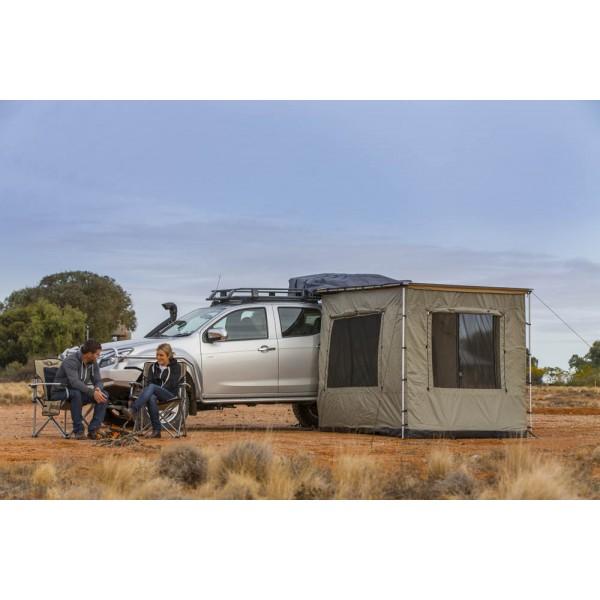
The ARB Deluxe Awning Room is designed as an enclosure that attaches to a compatible ARB vehicle awning. It turns the covered area beside the vehicle into a room with a waterproof floor, solid outer panels, mesh ventilation, privacy, and weather protection. Because it uses the awning as its structural starting point, the room is essentially an extension of the vehicle’s ground-level living space.
The Smittybilt Gen2 Tent Annex takes a different approach. It attaches underneath a compatible Smittybilt Gen2 Overlander rooftop tent using heavy-duty zippers. Instead of extending a ground-level awning, it creates an enclosed room beneath the elevated rooftop sleeping platform. The annex can therefore complement a rooftop tent by providing a separate lower-level space for changing, gear storage, relaxing, or sleeping.
This difference affects almost every aspect of functionality, including floor area, access, privacy, ventilation, setup, compatibility, and how the space can be used at camp.
The ARB Deluxe Awning Room is available for different ARB awning widths, including 2000 × 2500 mm, 2500 × 2500 mm, and a 3000 × 2500 mm version. The standard 2500 × 2500 mm configuration provides approximately 6.25 square meters of enclosed floor area. The Smittybilt Gen2 Standard Annex has a listed floor area of approximately 70 × 80 inches, while the XL version is substantially larger.
So, although both products are marketed as additional camping space, they are not direct equivalents in terms of installation or overall camping system. The ARB is primarily an awning-based ground shelter, while the Smittybilt is specifically an accessory for a rooftop-tent system.
ARB Awning Room vs Smittybilt Tent Annex: Key Differences at a Glance
What Is the ARB Deluxe Awning Room?
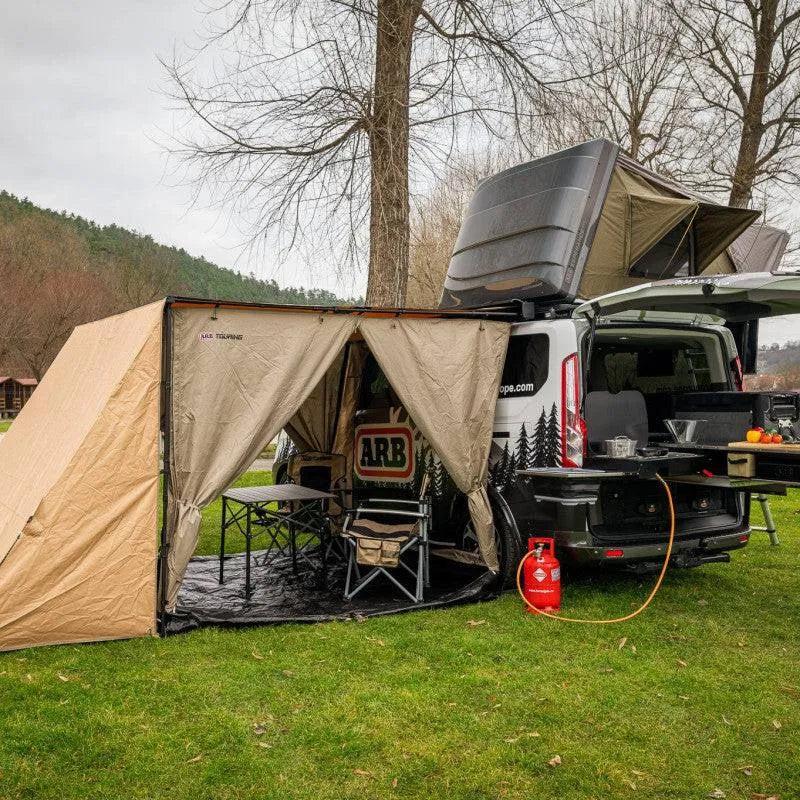
The ARB Deluxe Awning Room is an enclosed room designed to attach to a compatible ARB awning. It is available in configurations matched to ARB awnings measuring 2000 × 2500 mm, 2500 × 2500 mm, and, in the current product range, 3000 × 2500 mm.
Its main purpose is to transform an open awning into a more complete camping room. Instead of leaving the sides exposed, the Deluxe Awning Room adds walls, mesh panels, privacy, and an integrated waterproof floor. The room can therefore be used for dining, relaxing, changing clothes, storing equipment, or creating additional sleeping space.
The construction uses 300D Oxford polyester exterior material, while the enclosure incorporates insect-resistant mesh panels. The solid outer panels can be rolled up to expose the mesh, allowing the same room to function as a more open shelter during warm weather.
One particularly useful feature is the separate ceiling and ventilated mesh roof. This helps create airflow above the occupants instead of making the room feel like a completely sealed box. Cable-access ports and internal storage pockets are also incorporated for practical campsite use.
The ARB room weighs around 8 kg for the 2000 × 2500 mm and 2500 × 2500 mm versions, while the 3000 × 2500 mm version is listed at approximately 9.5 kg. It is therefore a dedicated enclosure rather than a standalone tent; the appropriate ARB awning is required for the system to function.
What Is the Smittybilt Gen2 Tent Annex?
The Smittybilt Gen2 Tent Annex is designed specifically for the Smittybilt Gen2 Overlander rooftop tent range. Rather than attaching to a vehicle-side awning, it connects directly to the underside of the rooftop tent with rugged, heavy-duty zippers.
This creates an enclosed area underneath the elevated rooftop sleeping platform. The space can be used as a changing room, gear area, privacy room, sleeping area, or general campsite living space.
The Gen2 Standard Annex is designed specifically for the Gen2 Overlander Standard Tent, while the Gen2 XL Annex is designed for the Gen2 Overlander XL Tent. This makes compatibility more restrictive than the ARB room because the annex is not a general-purpose enclosure that can simply be attached to any rooftop tent.
The Standard Annex has listed dimensions of approximately 70 inches wide by 80 inches long, with an 85-inch height. It includes a heavy-duty removable zippered floor that helps keep mud and insects out. The side door and windows can be rolled up, exposing mosquito netting underneath for ventilation while maintaining insect protection.
An inner door flap also provides access toward the vehicle, depending on the rooftop-tent installation.
The major advantage of this design is integration. When the Smittybilt rooftop tent is already part of the camping setup, the annex adds usable ground-level space without requiring a separate awning-room structure.
Core Design and Functionality Comparison
The biggest difference between the two products is where they get their structural support.
The ARB Deluxe Awning Room depends on an ARB awning. The awning creates the overhead covered area, and the room enclosure attaches around it. This makes the system particularly useful for campers who spend considerable time beside the vehicle and want a large ground-level living area.
The Smittybilt Annex depends on a Smittybilt Gen2 Overlander rooftop tent. The rooftop tent forms the upper structure, while the annex hangs down to create an enclosed room underneath.
This produces two different camping layouts.
With the ARB setup, the room is essentially an extension of the vehicle’s side awning. You can enter directly from ground level and arrange chairs, tables, cooking equipment, storage bins, or other camping gear inside.
With the Smittybilt setup, the annex becomes the lower section of a rooftop-tent camping system. It is especially useful when the rooftop tent already provides the primary sleeping area and the camper wants additional privacy or living space underneath.
The ARB system also offers considerable flexibility in how much of the enclosure remains open. Its solid outer panels can be rolled up to expose the mesh, allowing campers to change the balance between privacy, airflow, and weather protection.
The Smittybilt annex similarly combines solid fabric with mesh openings, but its primary design objective is integration with the rooftop tent rather than maximizing the footprint of a vehicle-side awning.
Another important distinction is floor configuration. The ARB Deluxe Room has an integrated waterproof floor, creating a defined ground-level room. The Smittybilt Annex also has a removable zippered floor, but its dimensions are tied directly to the corresponding rooftop tent.
Standard vs XL Smittybilt Annex
Smittybilt offers the Gen2 Tent Annex in Standard and XL versions, and the correct version must correspond to the matching Gen2 Overlander rooftop tent.
The Gen2 Standard Annex is designed for the Gen2 Overlander Standard Tent. Its listed floor dimensions are approximately 70 × 80 inches, providing around 38.9 square feet of floor area. The enclosure has an approximately 85-inch height, giving enough vertical space for changing clothes and standing use for many campers.
The Gen2 XL Annex is designed for the Gen2 Overlander XL Tent. The larger XL rooftop tent uses a much larger footprint than the Standard model, and the corresponding annex provides a larger enclosed area. Smittybilt’s published product information identifies the XL annex as the dedicated accessory for the Gen2 Overlander XL rather than a universal annex.
The choice between Standard and XL therefore should not be treated simply as a choice between two differently sized floor shelters. It is primarily a compatibility decision based on the rooftop tent already installed on the vehicle.
For campers who already own the Standard Gen2 Overlander, the Standard Annex is the appropriate match. Owners of the Gen2 XL Overlander need the XL Annex.
Space, Comfort, Privacy, and Weather Protection
Usable Floor Space
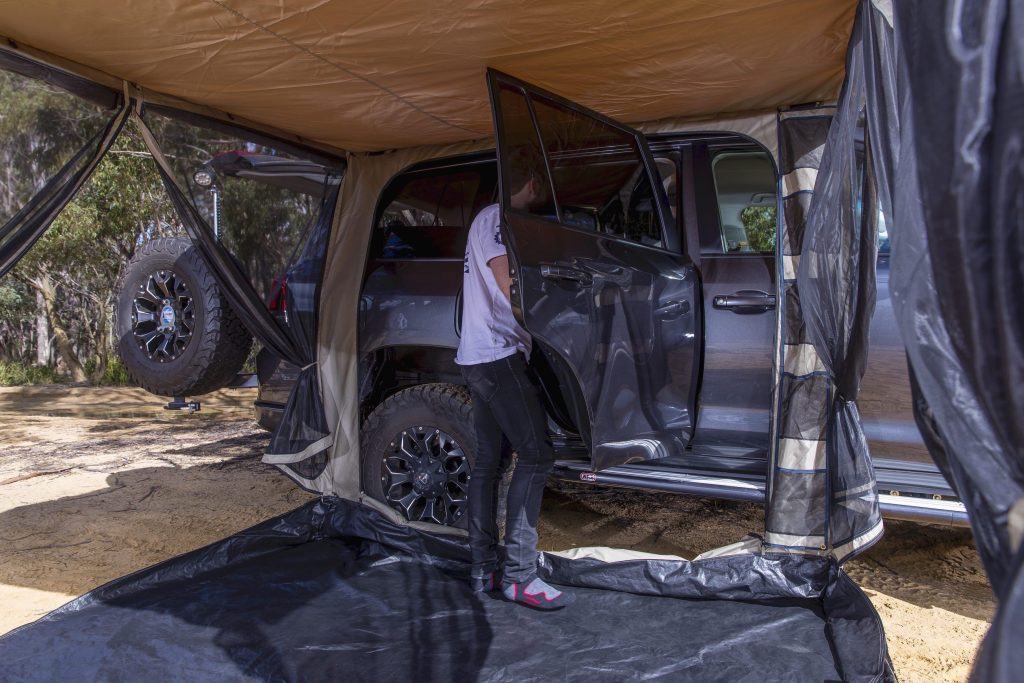
Floor area is one of the clearest differences between an awning room and a rooftop-tent annex.
The ARB Deluxe Awning Room is designed around the dimensions of the supporting awning. The 2000 × 2500 mm version provides approximately 5 square meters of floor area, while the 2500 × 2500 mm version provides approximately 6.25 square meters. The 3000 × 2500 mm version increases the available area to approximately 7.5 square meters.
That is substantial ground-level space for a camping enclosure. Depending on the campsite layout, the room can accommodate camping chairs, a small table, storage boxes, clothing, cooking-related equipment, or sleeping arrangements.
The Smittybilt Standard Annex has a smaller listed floor footprint of approximately 70 × 80 inches, or about 38.9 square feet. Its purpose is therefore more closely connected to supporting the rooftop tent rather than creating a large standalone living room.
The XL version increases the available space considerably and is more appropriate for campers who need additional room underneath the larger XL rooftop tent.
However, raw floor-area measurements do not tell the entire story. The ARB room’s space is generally arranged as a broad ground-level rectangle beside the vehicle. The Smittybilt annex occupies the area underneath the rooftop tent, so the vehicle, ladder, rooftop-tent structure, and access arrangement can influence how much of the floor is practically usable.
For dining, lounging, gear organization, or spending several hours inside during bad weather, the larger ARB configurations can provide a particularly useful footprint. For changing clothes, storing gear, or creating a lower-level extension to a rooftop-tent campsite, the Smittybilt annex can be more directly suited to the job.
Standing Height and Interior Comfort
Interior height is another important consideration because an enclosure can have plenty of floor area but still feel uncomfortable if occupants cannot stand naturally.
ARB lists its Deluxe Awning Room as accommodating awning heights from approximately 75 to 82.5 inches from the ground. This means the actual interior experience depends partly on how high the compatible awning is mounted and adjusted on the vehicle.
At the upper end of that range, the room offers roughly 6 feet 10.5 inches of height. For many adults, this is sufficient for standing, changing clothes, moving around, and using the room without constantly crouching.
The Smittybilt Standard Annex has an approximately 85-inch listed height, equivalent to about 7 feet 1 inch. This gives the annex a generous vertical dimension, although the exact practical experience can depend on the rooftop-tent installation and how the annex is tensioned.
The two products therefore provide useful standing height, but their interior feel is different. The ARB room generally feels like a conventional ground-level camping room because the entire enclosure is built around a broad awning footprint. The Smittybilt annex feels more like a lower-level extension underneath an elevated sleeping platform.
Ventilation also affects comfort. The ARB room uses a ventilated mesh roof and mesh wall sections, while the Smittybilt annex uses roll-up windows and doors with mosquito netting underneath. Both approaches allow campers to open the enclosure considerably during warm weather.
Privacy and Enclosure
Both products are designed to provide substantially more privacy than an open awning.
The ARB Deluxe Awning Room uses solid exterior wall panels that can be closed when privacy is required. These panels can also be rolled up to expose the underlying mesh panels. This creates three useful modes: a more enclosed configuration for privacy and poor weather, a mesh configuration for airflow and insect protection, and a more open configuration when maximum visibility and ventilation are desired.
This makes the ARB particularly useful at busy campgrounds, roadside camps, or family campsites where changing clothes or storing personal equipment inside an open awning would not provide sufficient privacy.
The Smittybilt Annex also provides a private enclosed room beneath the rooftop tent. Its side door and windows can be rolled up, with mosquito netting underneath. This makes it possible to maintain ventilation without completely exposing the interior.
The annex also benefits from its relationship with the rooftop tent. Since the sleeping platform is already elevated above the ground, the lower annex can serve as a separate private zone while the rooftop tent remains dedicated to sleeping.
For changing clothes and personal privacy, both systems are substantially more functional than an ordinary open awning. The practical difference is that the ARB creates a larger conventional room beside the vehicle, while the Smittybilt creates a dedicated lower-level room beneath the rooftop tent.
Rain, Wind, and Cold-Weather Protection
Both systems provide protection from rain and wind, but neither should be treated as a substitute for a fully engineered four-season tent in severe conditions.
The ARB Deluxe Awning Room has solid 300D Oxford polyester exterior walls and a heavy-duty waterproof floor. The integrated floor helps prevent water and muddy ground from entering around the bottom of the enclosure. The separate roof and enclosed wall system also provide a considerable improvement over an uncovered awning during rain.
The Smittybilt Annex uses polyurethane-impregnated polyester construction and includes a heavy-duty removable zippered floor. The floor helps prevent mud and insects from entering and creates a more controlled interior environment.
In both cases, correct tensioning, guying, staking, and awning or rooftop-tent setup are important. Wind resistance is not determined by fabric alone. A large enclosed room can catch significant wind, so securing the supporting structure properly is essential in exposed campsites.
For cold weather, the solid panels of both products can reduce direct wind exposure, but neither enclosure should be considered an insulated living room. They do not have the insulated wall construction or dedicated heating system of a winter-rated shelter.
The ARB’s enclosed floor and solid panels can make the area noticeably more comfortable than an exposed awning, while the Smittybilt annex benefits from being directly connected to the rooftop-tent system. However, ventilation should not be completely sacrificed for warmth, particularly when occupants are cooking or using any combustion-based equipment nearby.
Insect and Ventilation Protection
In warm and humid camping environments, insect protection can be just as important as rain protection.
The ARB Deluxe Awning Room is specifically designed to work both as a fully enclosed room and as a mosquito/insect shelter. Its fine mesh wall panels allow airflow while helping keep insects outside. The solid external panels can be rolled up when weather protection and privacy are less important.
The ventilated mesh roof is another useful feature because it allows cross-flow ventilation near the upper portion of the room. This can help reduce the stuffiness that commonly develops inside enclosed shelters during hot weather.
The Smittybilt Gen2 Annex also provides insect protection through mosquito netting beneath the roll-up side doors and windows. The removable floor additionally helps reduce access for insects and mud from ground level.
The important practical advantage of both designs is that campers do not have to choose between completely open conditions and a completely sealed room. Mesh allows ventilation while maintaining a physical barrier against many insects.
For very hot conditions, however, no fabric enclosure can eliminate heat buildup if the solid panels remain closed. Opening the mesh sections, positioning the vehicle and awning for airflow, and keeping cooking heat outside the enclosure are important for maintaining a comfortable interior temperature.
Overall, the ARB system emphasizes a broad, ground-level enclosed living area with configurable solid and mesh walls, while the Smittybilt system focuses on adding a private, insect-protected lower room to a compatible rooftop tent. The better configuration depends largely on whether the camper’s priority is a spacious awning-based living area or an integrated rooftop-tent camping system.
Setup, Teardown, Portability, and Everyday Usability
ARB Awning Room Setup Process
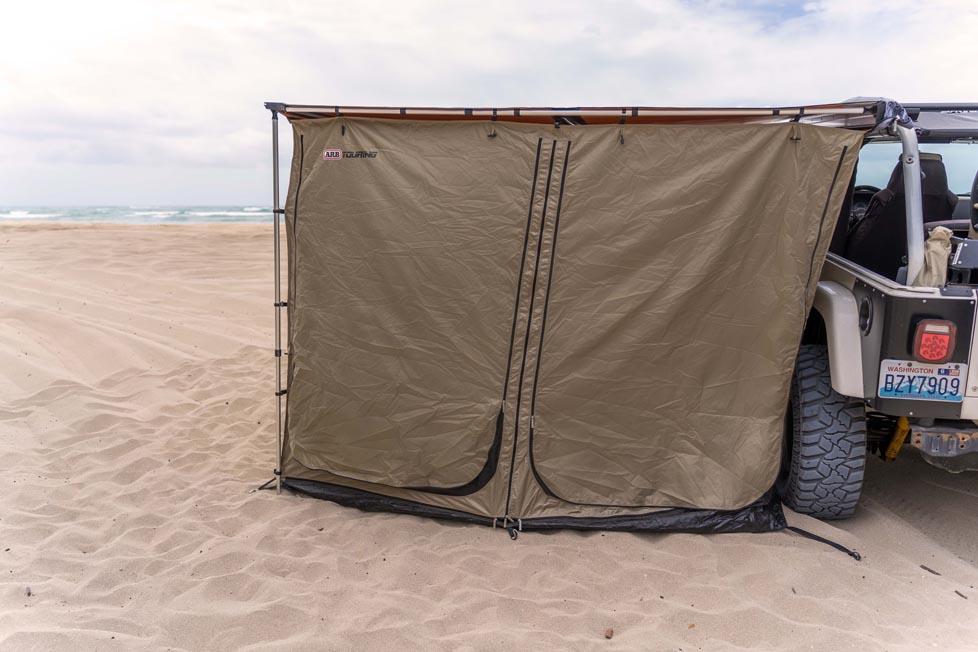
The ARB Deluxe Awning Room is designed to turn a compatible ARB awning into an enclosed camping area without requiring a separate freestanding tent. The supporting awning is deployed first, after which the room enclosure is attached around the awning structure using its integrated attachment system. ARB describes the room as quick and straightforward to set up and specifically designed to attach to its existing awnings.
A typical setup sequence is:
- Park the vehicle and position it appropriately for the awning.
- Deploy the compatible ARB awning and establish the desired height.
- Secure the awning and supporting poles before attaching the room.
- Attach the room’s upper sections to the awning structure.
- Zip the side and vehicle-side sections into position.
- Lay out and secure the integrated waterproof floor.
- Stake and tension the enclosure where required.
- Adjust the solid wall panels, mesh panels, doors, and ventilation openings according to the weather.
One advantage of this arrangement is that the room does not require a completely independent tent frame. The existing awning supplies the primary overhead structure, while the room provides the walls, floor, and enclosed living area.
The ARB Deluxe Room also allows campers to adjust the enclosure after setup. Its solid external panels can be rolled upward to expose the internal mesh panels. The main wall panels incorporate two-way zipper-operated solid and mesh access sections, so the room can be adapted as weather conditions change.
For a warm evening, for example, the solid panels can be opened while the mesh remains closed to maintain ventilation and insect protection. During rain or when privacy is needed, the solid panels can be closed again.
Teardown is essentially the reverse process: remove stakes and tensioning, open the enclosure, detach the room from the awning, fold the fabric and floor, and return the room to its storage bag. It is important to dry the fabric before long-term storage whenever it has been packed wet.
Smittybilt Tent Annex Setup Process
The Smittybilt Gen2 Tent Annex follows a different setup procedure because it is an accessory for the Smittybilt Gen2 Overlander rooftop tent rather than a vehicle-side awning enclosure.
The Standard Annex is specifically designed for the Gen2 Overlander Standard Tent, part number 2583, while the XL Annex is specifically designed for the Gen2 Overlander XL Tent, part number 2683. Smittybilt states that the annex attaches to the rooftop tent using rugged, heavy-duty zippers.
The general setup sequence is:
- Deploy the compatible Gen2 rooftop tent.
- Locate the annex attachment area underneath the rooftop tent.
- Connect the annex to the rooftop tent using its heavy-duty zipper system.
- Extend and position the annex fabric around the lower camping area.
- Install and tension the removable floor.
- Secure the lower sections and tie-down points as necessary.
- Adjust the side door and windows according to weather and ventilation requirements.
- Close or open the underlying mosquito netting depending on insect and airflow requirements.
The major benefit is that the annex does not require a completely separate ground-level shelter. It becomes an extension of the existing rooftop-tent system.
Smittybilt specifically describes the annex as attaching easily and in minutes, while the manufacturer also provides dedicated installation instructions for both the Standard and XL versions.
The removable floor is another practical feature. It can be zipped into place when campers want a more complete enclosed room and removed when they want easier cleaning, storage, or a different campsite configuration.
Setup and Teardown Time
Neither product should require the same amount of work as pitching a conventional standalone tent with multiple poles and a separate rainfly. Both are designed around structures that already exist on the vehicle.
The ARB room has an advantage when the camper already uses an ARB awning as part of the daily vehicle setup. Once the awning is deployed, the room is essentially an enclosure added around it. ARB specifically markets the Deluxe Awning Room as quick and easy to set up.
The Smittybilt annex can also be deployed quickly because the rooftop tent provides its supporting structure. Smittybilt states that the annex attaches to the tent with rugged zippers and can be attached in minutes.
However, the total campsite setup time depends on what is already installed and what else needs to be deployed.
For an ARB user, the sequence is generally:
vehicle → awning → room
For a Smittybilt rooftop-tent user, it is generally:
vehicle → rooftop tent → annex
This means neither product should be judged solely by the time required to attach the enclosure itself. A camper who already deploys an awning may find the ARB room naturally fits into the routine, while someone already using a Gen2 Overlander rooftop tent can add the Smittybilt annex without introducing another independent shelter system.
Teardown follows the same principle. Both are relatively straightforward, but fabric should be allowed to dry before being packed away for extended periods. Packing wet fabric can encourage mildew and unpleasant odors regardless of which system is used.
Portability and Packed Storage
Portability is somewhat different from the simple question of weight.
The ARB 2500 × 2500 mm Deluxe Awning Room is listed at approximately 8 kg, while the 2000 × 2500 mm version is also listed at approximately 8 kg. The 3000 × 2500 mm version is listed separately by ARB and provides the larger enclosure footprint.
The room therefore adds a meaningful amount of fabric and floor material to the vehicle’s camping equipment, but it does not require carrying a separate rigid tent frame.
The Smittybilt annex is similarly fabric-based and designed as an accessory to the rooftop tent. Its storage requirements are therefore substantially different from carrying a freestanding tent. The annex can remain with the rooftop-tent system and be deployed when additional enclosed space is needed.
For overlanders who frequently move from one campsite to another, packed size matters because every additional bag competes for roof-rack, cargo-area, or vehicle storage space.
The ARB room can be attractive for campers who already carry an ARB awning and want one additional enclosure rather than a second standalone shelter. The Smittybilt annex is particularly logical for rooftop-tent owners because it complements equipment that is already part of the vehicle.
Everyday Practicality
The biggest everyday-use difference is the type of space each product creates.
The ARB room is better understood as a vehicle-side living room. Its larger rectangular footprint on compatible awnings can be useful for:
- Sitting and relaxing
- Eating meals
- Changing clothes
- Storing camping equipment
- Escaping mosquitoes
- Creating temporary sleeping space
- Providing privacy at crowded campsites
- Staying under cover during rain
The integrated waterproof floor also creates a more defined room environment.
The Smittybilt annex is more closely integrated into a rooftop-tent campsite. Its intended uses include changing, clothing storage, additional sleeping space, privacy, and general gear storage. Smittybilt specifically lists these uses for the product.
This distinction becomes particularly important for short overnight stops.
If the camper simply needs somewhere to change clothes or store equipment, the annex can be a convenient extension of the rooftop tent. If the objective is to create a relatively large ground-level living space for spending several hours during bad weather, the larger ARB awning-room configurations can offer a different type of usability.
Compatibility, Durability, Maintenance, and Long-Term Value
Vehicle and Awning Compatibility
Compatibility is one of the most important considerations before buying either product.
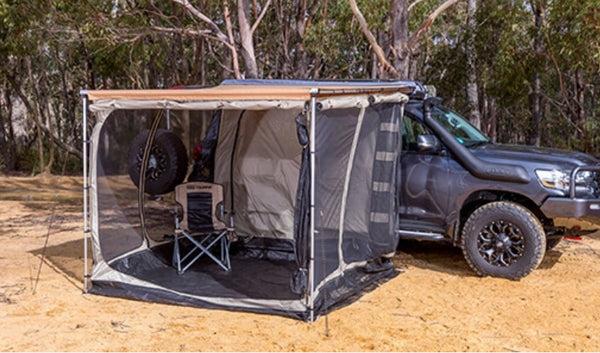
The ARB Deluxe Awning Room is designed around compatible ARB awnings. ARB currently lists versions corresponding to its 2000, 2500, and 3000 mm awning configurations, with the specific room selected according to the awning size.
This means an owner should check the exact awning model and dimensions before purchasing the room rather than assuming every ARB room fits every awning.
The room also depends on the awning being mounted securely to the vehicle. The room itself is not a replacement for the awning structure.
The Smittybilt Gen2 Annex is even more restrictive in terms of compatibility. The Standard Annex works only with the Smittybilt Gen2 Overlander Standard Tent, part number 2583. The XL Annex works only with the Gen2 Overlander XL Tent, part number 2683.
Therefore, the Smittybilt annex should not be treated as a universal rooftop-tent accessory. A different-brand rooftop tent or a different Smittybilt tent generation may not provide the attachment interface required by the annex.
Before purchasing either system, checking the exact model number is more reliable than judging compatibility from appearance or dimensions alone.
Rooftop Tent Compatibility
The two products take opposite approaches to rooftop tents.
The ARB Deluxe Awning Room does not depend on a rooftop tent. It can function independently as an enclosed ground-level room as long as the compatible ARB awning is installed.
That makes it suitable for a vehicle-based camping system where the primary sleeping arrangement might be a ground tent, vehicle sleeping platform, camper setup, or another arrangement.
The Smittybilt Gen2 Annex is fundamentally different. Its compatibility is directly tied to the Gen2 Overlander rooftop tent. Smittybilt explicitly states that the Standard Annex works with the Gen2 Overlander Standard Tent and the XL Annex works with the Gen2 Overlander XL Tent.
This creates a simple compatibility rule:
ARB room: match the room to the appropriate ARB awning.
Smittybilt annex: match the annex to the corresponding Gen2 Overlander rooftop tent.
If a camper has not yet purchased either the awning or rooftop tent, the supporting system should therefore be selected first. The enclosure should then be chosen according to that system’s exact specifications.
Materials and Construction
The ARB Deluxe Awning Room uses 300D Oxford polyester for its exterior walls. ARB also specifies a durable waterproof floor, separate ceiling, mesh panels, internal storage pockets, and cable-access provisions.
The construction is intended to balance weather protection with ventilation. Solid external panels can be rolled up to expose mesh panels, allowing the same room to operate in different weather conditions.
The Smittybilt Gen2 Annex is constructed from polyurethane-impregnated polyester. Its heavy-duty zippered removable floor is intended to help keep mud and bugs out, while the side door and windows incorporate mosquito netting for ventilation and insect protection.
The broader Gen2 Overlander rooftop-tent platform uses heavy-duty ripstop polyester and polyurethane-impregnated fabric, aluminum components, stainless-steel hinges, and other reinforced components. However, the annex itself should be evaluated separately from the rooftop tent because the two products have different functions and construction requirements.
In practical terms, both products use synthetic outdoor fabrics designed for repeated camping exposure. Their long-term life will still depend heavily on UV exposure, moisture management, correct setup, zipper care, and how carefully the fabric is packed.
Maintenance and Cleaning
Routine maintenance is relatively simple for both products, but consistent care can significantly extend the useful life of any fabric shelter.
After a dusty or muddy trip, allow the enclosure to dry completely before storage. Loose dirt can generally be removed with a soft brush or gentle cleaning method, while heavier contamination should be handled according to the manufacturer’s care instructions.
The waterproof floor deserves particular attention because it is the part most exposed to wet ground, mud, sand, food debris, and other campsite contamination.
For the ARB room, inspect the following regularly:
- Zippers and zipper tracks
- Mesh panels
- Awning-room attachment points
- Waterproof floor
- Stitching and seams
- Guy points and attachment areas
- Fabric for UV damage
- Mold or mildew after wet storage
The Smittybilt annex should receive similar attention, particularly around the heavy-duty zippers connecting it to the rooftop tent. The removable floor should also be cleaned and dried before storage.
Avoid aggressive detergents, harsh scrubbing, or unnecessary chemical treatments on outdoor fabrics because they can affect coatings and waterproofing. When cleaning, the objective should be to remove dirt without damaging the fabric, seams, mesh, or protective coatings.
Most importantly, never store either enclosure wet for an extended period. Even high-quality outdoor polyester can develop mildew and odors when repeatedly packed while damp.
Durability and Warranty
ARB currently lists a 3-year warranty for its Deluxe Awning Room. The manufacturer also positions the room as a durable enclosure designed for weather, insects, privacy, and repeated camping use.
Smittybilt lists a 2-year warranty for both the Gen2 Standard Annex and Gen2 XL Annex. Its product pages also identify polyurethane-impregnated polyester construction and heavy-duty attachment features.
Smittybilt’s current warranty policy states that its soft goods are generally covered by a 1-year limited warranty unless a product has a specific warranty, while its Gen2 Overlander rooftop tents receive dedicated 2-year coverage. The individual Gen2 annex product pages specifically list a 2-year warranty.
Warranty length, however, should not be confused with expected service life. Fabric shelters can last considerably longer than their warranty periods when they are properly maintained, but UV exposure, abrasion, storms, incorrect installation, mold, and misuse can shorten their useful life.
Smittybilt also states that warranty coverage does not extend to damage caused by misuse, abuse, improper installation, accidents, or external causes.
For long-term value, therefore, the purchase should be evaluated on more than warranty duration. Compatibility, frequency of use, setup convenience, available space, fabric quality, maintenance requirements, and whether the enclosure fits the rest of the camping system can have a greater effect on practical value.
Which Setup Fits Your Camping Style?
Choose the ARB Awning Room If You Want…
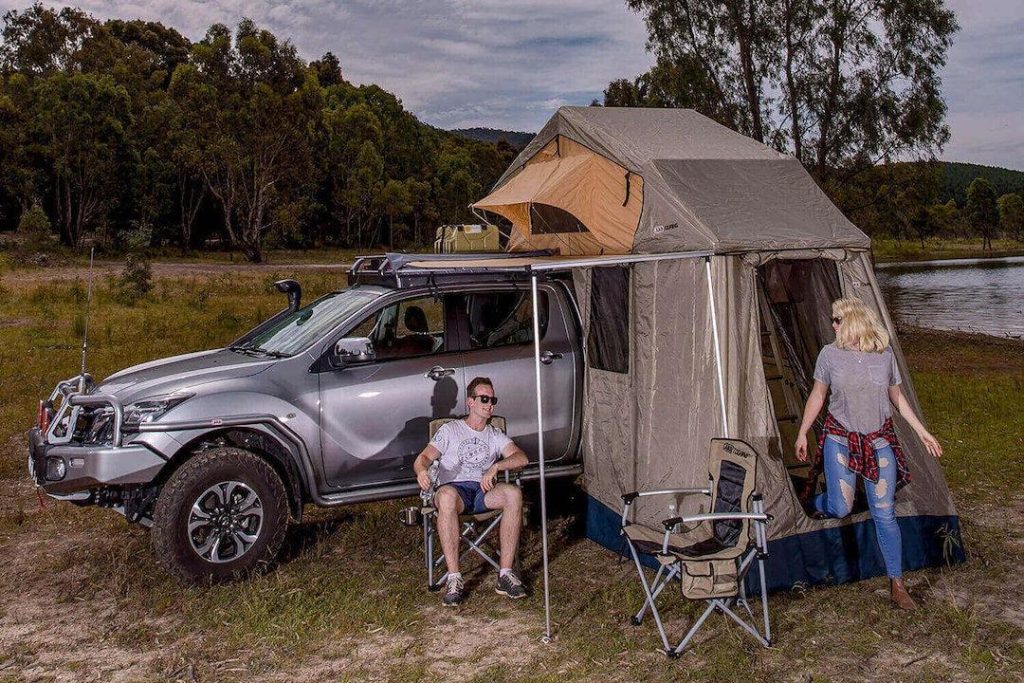
The ARB Deluxe Awning Room makes the most sense for a camping setup built around a vehicle-side awning.
It is particularly suited to campers who want:
- A larger ground-level enclosed area
- A room for sitting, dining, changing, or relaxing
- An integrated waterproof floor
- Flexible solid-panel and mesh configurations
- Strong insect protection
- A privacy area beside the vehicle
- An enclosure that does not depend on a rooftop tent
- Multiple size options based on the compatible ARB awning
The room’s ability to transition between a more enclosed shelter and a ventilated mosquito room is particularly useful in changing weather. ARB specifically designed the product for both enclosed-room and mosquito-net functionality.
It can therefore fit a broad range of vehicle-based camping styles rather than being limited to rooftop-tent users.
For longer stays at one campsite, the additional ground-level living space can also become more valuable because campers have more time to benefit from the enclosure.
Choose the Smittybilt Tent Annex If You Want…
The Smittybilt Gen2 Tent Annex is most naturally suited to someone who already uses, or intends to use, a compatible Smittybilt Gen2 Overlander rooftop tent.
It is particularly useful if you want:
- A dedicated lower-level room beneath the rooftop tent
- A private changing area
- Additional gear-storage space
- A place for sleeping or relaxing below the rooftop tent
- Integrated mosquito protection
- A removable floor
- A quick attachment system using heavy-duty zippers
- A camping system centered around a rooftop tent
The Standard and XL versions also allow the enclosure to match the size of the corresponding rooftop tent. Smittybilt specifically limits the Standard Annex to the Gen2 Standard Tent and the XL Annex to the Gen2 XL Tent.
This makes the annex less flexible as a standalone accessory, but highly integrated when used with the correct rooftop-tent system.
ARB Awning Room vs Smittybilt Tent Annex for Different Camping Scenarios
Different camping situations can make the practical differences much more obvious.
| Camping scenario | ARB Deluxe Awning Room | Smittybilt Gen2 Tent Annex |
|---|---|---|
| Long campsite stays | Large enclosed ground-level space can be useful | Useful as an extension to the rooftop tent |
| Quick overnight stops | Adds an extra setup stage after deploying the awning | Convenient if the rooftop tent is already deployed |
| Changing clothes | Provides dedicated privacy | Particularly well suited to this purpose |
| Gear storage | Broad ground-level room can accommodate substantial gear | Useful enclosed storage beneath the rooftop tent |
| Family/group camping | Larger ARB configurations provide more ground-level living area | XL version provides more room than Standard |
| Rooftop-tent camping | Not dependent on a rooftop tent | Designed specifically for compatible Gen2 rooftop tents |
| Hot/humid weather | Mesh configuration provides ventilation and insect protection | Roll-up openings and mosquito netting provide ventilation |
| Rainy weather | Waterproof floor and enclosed walls provide covered living space | Zippered floor and enclosed lower room provide protection |
| Privacy at crowded campsites | Solid wall panels provide privacy | Enclosed lower room provides privacy |
| Ground-level living | Strong fit for this purpose | More specifically tied to rooftop-tent use |
| Non-rooftop-tent camping | Can work with the appropriate ARB awning | Not the intended use |
| Rooftop-tent-centered setup | Requires a separate awning-based arrangement | Directly integrates with compatible Gen2 tent |
The important point is that neither product has exactly the same job.
The ARB room expands the awning side of the campsite.
The Smittybilt annex expands the rooftop-tent side of the campsite.
That distinction can be more useful when choosing between them than simply comparing dimensions or fabric specifications.
Can You Use Both an Awning Room and Tent Annex?
A camper can theoretically use both types of enclosure in the same overall vehicle-based camping setup if the vehicle has the appropriate compatible equipment and sufficient mounting/storage capacity.
However, they should not be viewed as components that directly connect to one another. The ARB Deluxe Awning Room is designed around a compatible ARB awning, while the Smittybilt Gen2 Annex is designed around a compatible Smittybilt Gen2 Overlander rooftop tent.
A vehicle could therefore have:
Rooftop tent → Smittybilt annex
and separately:
Vehicle-side ARB awning → ARB awning room
This could create two distinct enclosed zones at a large campsite. One might serve as a sleeping area or private rooftop-tent access zone, while the other could function as a larger ground-level living, dining, changing, or gear-storage area.
The trade-offs are additional weight, storage requirements, setup time, and equipment cost. For minimalist overlanding, carrying both may be unnecessary. For extended base-camp-style trips, however, having separate sleeping and living zones can be useful.
Compatibility must also be checked independently for each system. Owning one manufacturer’s enclosure does not make it compatible with the other manufacturer’s supporting structure.
Final Functionality Comparison
The ARB Deluxe Awning Room and Smittybilt Gen2 Tent Annex are best understood as two different approaches to creating extra enclosed camping space.
The ARB Deluxe Awning Room is an awning-based ground-level enclosure. It offers multiple compatible sizes, an integrated waterproof floor, solid and mesh wall configurations, insect protection, privacy, and a broad area that can be used for dining, relaxing, changing, gear storage, or additional sleeping space. ARB currently backs the Deluxe Awning Room with a 3-year warranty.
The Smittybilt Gen2 Tent Annex is a rooftop-tent accessory. It attaches directly to the corresponding Gen2 Overlander Standard or XL tent, adds a private lower-level room, uses a removable zippered floor, and provides roll-up openings with mosquito netting. Both current Gen2 annex versions carry a 2-year warranty according to Smittybilt’s product pages.
The practical distinction can therefore be summarized as:
- ARB Awning Room: an enclosed extension of a vehicle awning.
- Smittybilt Tent Annex: an enclosed extension of a compatible rooftop tent.
- ARB: more independent of the sleeping system and oriented toward ground-level living.
- Smittybilt: more integrated with a rooftop-tent-centered camping setup.
- ARB: available in several awning-matched sizes.
- Smittybilt: available in Standard and XL versions matched to specific Gen2 tents.
- Both: provide privacy, weather protection, insect protection, ventilation, and additional usable campsite space.
Ultimately, functionality depends on the rest of the camping system rather than on the enclosure alone. A camper using an ARB awning as the primary outdoor living area will naturally use the ARB room differently from a rooftop-tent owner who wants a private room beneath the sleeping platform. Looking at the supporting equipment, campsite duration, desired floor area, setup routine, and intended use will give a more meaningful comparison than choosing solely from the product names or advertised features.
Read More: Tire Deflators vs Air Compressor: What’s More Useful for Overlanding?