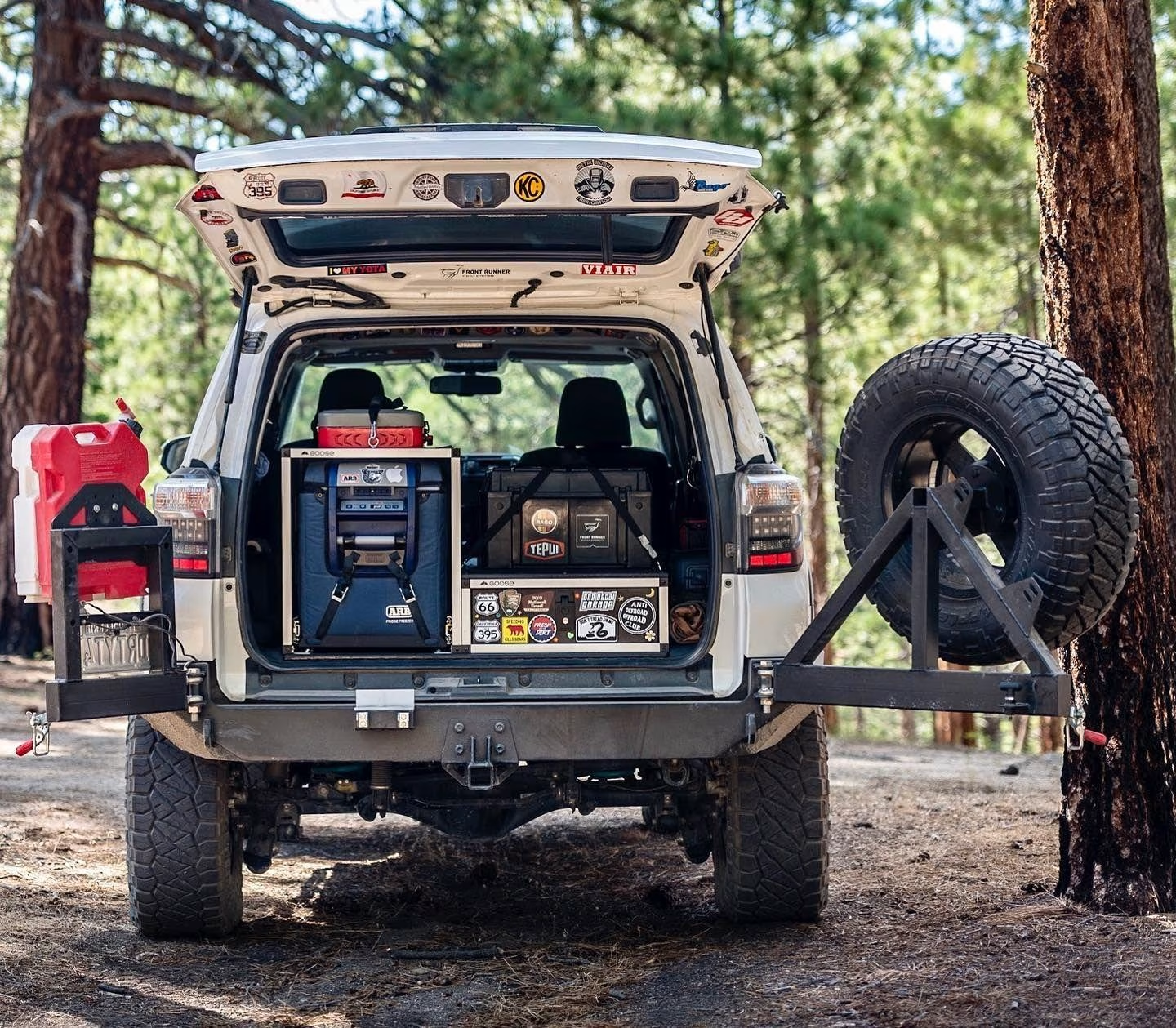
A well-organized storage system can make an overland trip considerably easier. Recovery equipment, cooking gear, tools, food, clothing, electrical equipment, and spare parts all compete for limited cargo space, and simply throwing everything into plastic bins can make frequently needed items difficult to reach. A dedicated drawer or platform system can turn that same cargo area into a more predictable, accessible setup.
That leaves many overlanders with a fundamental choice: buy a purpose-built system such as Goose Gear, or build a DIY storage system yourself?
Goose Gear takes a modular, vehicle-specific approach. Its current systems include plate platforms, drawer modules, fridge slides, and kitchen modules designed to work together. Depending on the vehicle and configuration, the company’s plates can provide pre-drilled mounting points and bolt-in installation, while its drawer modules use Baltic birch construction, full-extension drawer guides, and locking compression latches.
DIY storage takes the opposite approach. You determine the dimensions, materials, drawer hardware, mounting method, and layout yourself. A DIY system can be as simple as a plywood platform with storage boxes or as sophisticated as a custom drawer-and-kitchen system incorporating a refrigerator, water storage, electrical equipment, and sleeping platform.
Neither approach is automatically better. The right choice depends on your budget, vehicle, fabrication skills, available cargo capacity, trip frequency, desired customization, and how permanent you want the installation to be.
Goose Gear vs DIY Storage Systems: What’s the Difference?
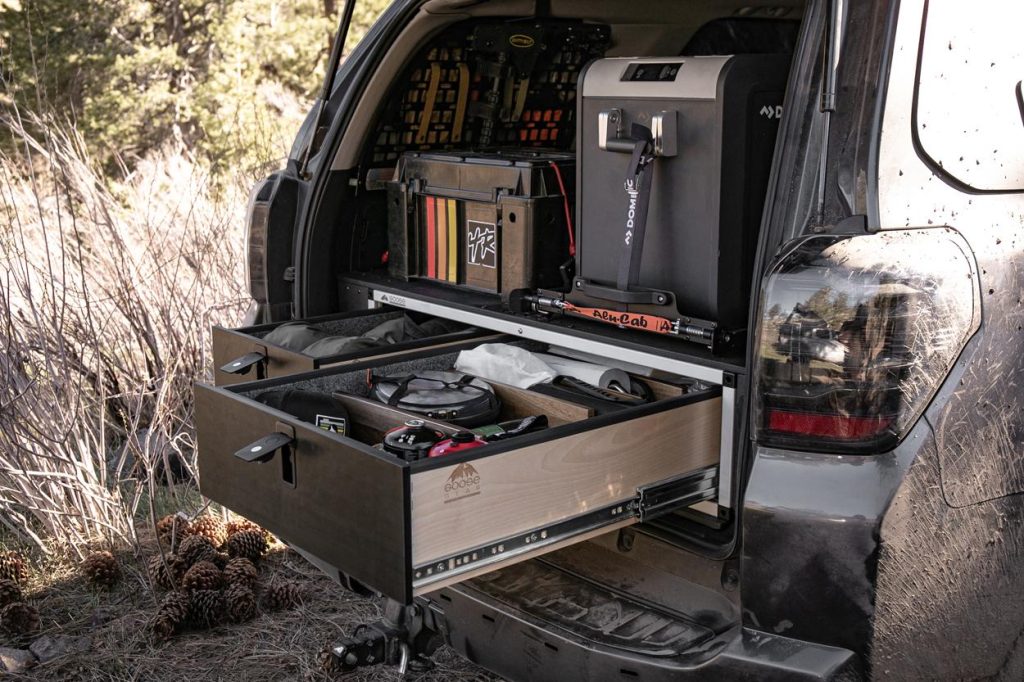
The biggest difference between Goose Gear and DIY storage isn’t simply that one is commercial and the other is homemade. They represent two different approaches to organizing an overland vehicle.
Goose Gear provides a pre-engineered ecosystem designed around specific vehicles and compatible modules. DIY gives you complete control over the design, but you also take responsibility for measuring, fabrication, hardware selection, mounting, finishing, and troubleshooting.
What Is Goose Gear?
Goose Gear is an American manufacturer specializing in modular vehicle storage and camping systems. Its current Explore Series is designed for SUVs, pickup trucks, and camper applications and includes components such as rear plates, drawer modules, CampKitchen systems, IceBox modules, and refrigerator slides.
The Plate System is essentially the foundation. Depending on the vehicle, it can create a flat, secure surface for cargo while providing a mounting platform for additional modules. Goose Gear says its plate systems are built from industrial-grade plywood and coated for durability and wear resistance. Many applications are designed for no-drill installation, although some vehicle-specific plates can require minor drilling.
The modular approach is one of Goose Gear’s major advantages. Instead of designing an entire storage system from scratch, an owner can combine components according to the vehicle and intended use. For example, a setup might include:
- A rear plate system
- One or more drawer modules
- A refrigerator slide
- A CampKitchen
- Additional storage boxes
- Tie-down or anchor points
- A sleeping or cargo platform
Its current drawer modules are made with Baltic birch drawer boxes, 11-ply dovetail construction, full-extension 350-pound-rated drawer guides, and locking compression latches. Goose Gear also uses its MaxLite extrusion in these systems, which it describes as 26% lighter while maintaining high strength.
The system is therefore aimed at people who want organized storage without designing and fabricating every component themselves.
What Is a DIY Overland Storage System?
A DIY overland storage system is any storage solution designed and built by the vehicle owner or another independent fabricator rather than purchased as a complete commercial system.
There is no single DIY design. It could be:
- A basic plywood cargo platform
- Removable plastic storage boxes
- Wooden drawers
- Aluminum extrusion cabinets
- A custom fridge slide
- A drawer-and-sleeping-platform combination
- A full custom kitchen and storage system
Plywood is popular because it is relatively accessible to work with, while aluminum extrusion can provide a modular framework that is easier to modify later. Drawer slides, hinges, latches, fasteners, carpet or protective coatings, and tie-down hardware can then be selected according to the intended application.
The major advantage is complete design freedom. You can build storage around your exact refrigerator, water containers, tools, recovery equipment, electrical components, or sleeping arrangement instead of adapting your gear to a predetermined commercial module.
The downside is that the builder becomes responsible for everything. Poor measurements, inadequate drawer slides, weak mounting points, excessive material thickness, or insufficient vibration resistance can turn an apparently inexpensive project into a heavier and less reliable system.
DIY can still be remarkably capable. Recent overlanding community builds have included modular drawer systems made from Baltic birch with high-load slides and removable components designed to be installed or removed with basic hand tools.
Why Storage Organization Matters for Overlanding
Storage organization becomes more important as an overland trip becomes longer and the amount of equipment increases.
A poorly organized cargo area can create several problems. Gear can shift on rough roads, smaller items can disappear underneath larger equipment, and frequently needed tools may end up buried at the bottom of a cargo box.
A properly designed system can help you:
Access important equipment faster. Recovery straps, tire-repair tools, first-aid supplies, lighting, and other frequently used equipment should be easy to locate.
Separate different types of gear. Cooking equipment can have its own drawer, while tools, recovery equipment, clothing, food, and electrical accessories can each have dedicated locations.
Use vertical and horizontal space efficiently. Drawers can occupy otherwise wasted lower cargo space while leaving a usable surface above them.
Keep equipment secured. Proper anchor points and latches reduce the chance of cargo moving around during off-road travel.
Create repeatable packing. Once every item has a designated location, packing before a trip and checking gear after a trip becomes much easier.
Goose Gear’s system is specifically designed around this principle. Its rear plates can serve as the foundation for drawers and kitchen modules, while its drawer tops also provide locations for securing additional gear.
However, organization does not require expensive drawers. A thoughtfully designed DIY platform with labeled bins can provide excellent organization at considerably lower cost.
Goose Gear vs DIY at a Glance
| Factor | Goose Gear | DIY Storage |
|---|---|---|
| Upfront cost | Generally higher | Potentially much lower |
| Customization | High within available modules | Virtually unlimited |
| Vehicle fit | Excellent for supported vehicles | Depends on your measurements |
| Installation | Usually faster | Requires fabrication and fitting |
| Build time | Minimal compared with DIY | Can range from hours to weeks |
| Finish | Professional and consistent | Depends on builder |
| Hardware | Engineered, integrated components | You choose the hardware |
| Weight optimization | Designed with weight in mind | Completely dependent on design |
| Repair/modification | Modular replacement or upgrades | Easy to modify if designed accordingly |
| Expansion | Strong within Goose Gear ecosystem | Depends on original design |
| Best for | Convenience and polished builds | Budget and maximum customization |
One important point is that DIY isn’t automatically cheaper and Goose Gear isn’t automatically heavier. A DIY system built from thick plywood and oversized hardware can become surprisingly heavy, while Goose Gear specifically designs its drawer modules around minimizing weight and uses its MaxLite extrusion in several current components.
Goose Gear vs DIY Storage Systems: Head-to-Head Comparison
Cost and Budget
Cost is often the first reason people consider DIY.
Goose Gear is a premium system, and the total price can increase substantially once you combine a plate system with drawers, fridge slides, kitchen modules, and accessories. Current Goose Gear listings, for example, show Solo refrigerator slides starting around $539, while CampKitchen modules are listed around $1,945 and IceBox modules around $1,345, depending on configuration.
These prices are for individual components rather than a complete vehicle build, so a full system can represent a significant investment.
DIY can reduce the cash cost because you can choose less expensive materials and build only what you need. A simple plywood platform and removable storage bins may cost a fraction of a complete commercial drawer system.
However, compare total project cost, not just material prices. DIY expenses can include:
- Plywood or aluminum
- Drawer slides
- Fasteners
- Latches
- Hinges
- Carpet or protective coating
- Aluminum extrusion
- Cutting tools
- Finishing materials
- Replacement materials after mistakes
- Your own labor
The last item is easy to ignore. If a DIY system takes several weekends to design and build, the financial advantage becomes smaller if your time is valuable.
Community experience illustrates this variability: one earlier 4Runner DIY build reported roughly $500 in material cost, while another builder noted that a custom drawer project became expensive because quality drawer slides alone represented a substantial portion of the budget.
Bottom line: DIY has the greater potential for savings, but only if you control material, hardware, and labor costs.
Customization and Vehicle Fit
This is where DIY has its clearest advantage.
A commercial system has to offer repeatable dimensions for specific vehicle applications. Goose Gear solves this by developing vehicle-specific plates and compatible modules. For example, its current 6th-generation 4Runner rear plate specifies usable dimensions and compatible drawer configurations, allowing owners to select modules designed to fit the platform.
That makes the system much easier to plan.
DIY, on the other hand, can be designed around almost anything. You can account for:
- Wheel-well shape
- Existing factory storage
- Rear seats
- Sleeping platforms
- Water tanks
- Auxiliary batteries
- Fridges
- Inverters
- Air compressors
- Recovery equipment
- Unusual vehicle modifications
This can be particularly valuable when your vehicle is heavily modified or doesn’t have a commercial storage ecosystem available.
The tradeoff is precision. Your measurements have to be correct, and you need to account for door clearances, seat movement, tailgate operation, electrical wiring, ventilation, and access to factory components.
Winner for maximum customization: DIY.
Winner for predictable vehicle-specific fit: Goose Gear.
Installation and Build Time
Goose Gear has a major advantage in installation time because much of the design and fabrication work has already been completed.
Many Goose Gear plate applications are designed around bolt-in or no-drill installation, although requirements vary by vehicle. The company’s current 6th-generation 4Runner rear plate, for example, is described as 100% bolt-in and reversible, while other systems such as certain truck-bed plates may require minor drilling.
Once the plate is installed, compatible modules are designed to attach to that foundation.
A DIY project can take considerably longer. Even a relatively simple drawer system may require:
- Measuring the vehicle.
- Creating a design.
- Purchasing materials.
- Cutting panels.
- Building the boxes.
- Installing drawer slides.
- Adding latches.
- Creating mounting points.
- Testing fitment.
- Finishing and protecting the materials.
- Removing and correcting anything that doesn’t fit.
The time difference matters if you have a trip approaching.
For someone who wants to organize a vehicle quickly, Goose Gear is usually the easier path. For someone who enjoys fabrication, DIY can turn the installation itself into part of the project.
Durability on Rough Trails
Off-road storage has to deal with vibration, impacts, dust, moisture, repeated opening and closing, and the weight of equipment moving inside drawers.
Goose Gear addresses this with purpose-built construction and hardware. Its drawer modules use dovetail-finished Baltic birch boxes, 350-pound-rated full-extension drawer guides, and locking compression latches. The company also coats its plate surfaces for durability and wear resistance.
That doesn’t mean a DIY system cannot be equally durable. It means the builder has to make the engineering decisions.
For a DIY system, pay particular attention to:
- Drawer-slide load rating
- Fastener size and placement
- Mounting points
- Panel thickness
- Joint construction
- Latch strength
- Vibration resistance
- Water exposure
- Edge protection
- Cargo retention
A common DIY mistake is designing around static weight rather than dynamic off-road loads. A drawer holding 100 pounds of equipment isn’t experiencing only 100 pounds of force when the vehicle hits a rough section of trail.
The best DIY systems therefore borrow principles from commercial products: strong joints, quality slides, positive latching, secure mounting, and weight-conscious construction.
For predictable out-of-the-box durability, Goose Gear has the advantage. For a skilled builder willing to engineer carefully, DIY can also be highly durable.
Weight and Available Cargo Space
Weight deserves more attention than it usually receives in an overland build.
A storage system is useful, but the storage structure itself consumes payload capacity. Add drawers, platforms, fridge slides, water, recovery equipment, tools, food, camping equipment, passengers, and other modifications, and the total can rise quickly.
Community discussions frequently point out that drawer systems can become significant “dead weight” and reduce available payload.
Goose Gear explicitly emphasizes minimizing weight in its current drawer designs. Its drawer modules use MaxLite extrusion and 11-ply Baltic birch boxes, while the company lists specific product weights for some vehicle-specific systems. For example, its current 6th-generation 4Runner rear plate weighs 38 pounds.
DIY gives you more control over this equation. You can use thinner panels where appropriate, eliminate unnecessary surfaces, shorten drawer depths, or use aluminum extrusion instead of a fully enclosed plywood structure.
But DIY can also go in the opposite direction. Overbuilding with ¾-inch plywood everywhere, oversized slides, multiple layers of reinforcement, and heavy hardware can produce a system that weighs much more than expected.
Cargo space is another tradeoff. A tall drawer system may dramatically improve organization but reduce vertical room for bulky equipment. A low platform preserves more usable height but may provide less drawer capacity.
The best storage system isn’t necessarily the one with the most compartments; it’s the one that gives you the most useful storage per pound and per cubic inch.
Accessibility and Organization
This is where drawers can transform an overland vehicle.
With ordinary cargo bins, accessing one item may require removing several others. A drawer allows the entire storage area to move toward you, making smaller items easier to see and reach.
Goose Gear’s drawer modules use full-extension guides, allowing the drawer to extend outward rather than forcing you to reach deep inside the vehicle. Its current drawer designs also include locking compression latches and top surfaces intended for additional gear storage.
Its kitchen modules take the same concept further. The CampKitchen combines refrigerator and stove storage, with independently or jointly operated slides depending on configuration.
DIY can duplicate this functionality, but the quality depends on the hardware and design. A properly built DIY drawer can provide excellent access, while a poorly designed drawer may bind, sag, rattle, or become difficult to open under load.
There is also an important question of what should actually be in drawers.
Frequently accessed items—tools, recovery equipment, cooking utensils, clothing, food and electrical accessories—benefit from organized drawers. Large lightweight objects may be better stored in removable bins or bags.
For many overlanders, the most efficient approach isn’t “drawers everywhere.” It is a combination of drawers + bins + open platform space, selected according to the type and frequency of access.
Which Storage System Is Better for Different Overlanding Needs?
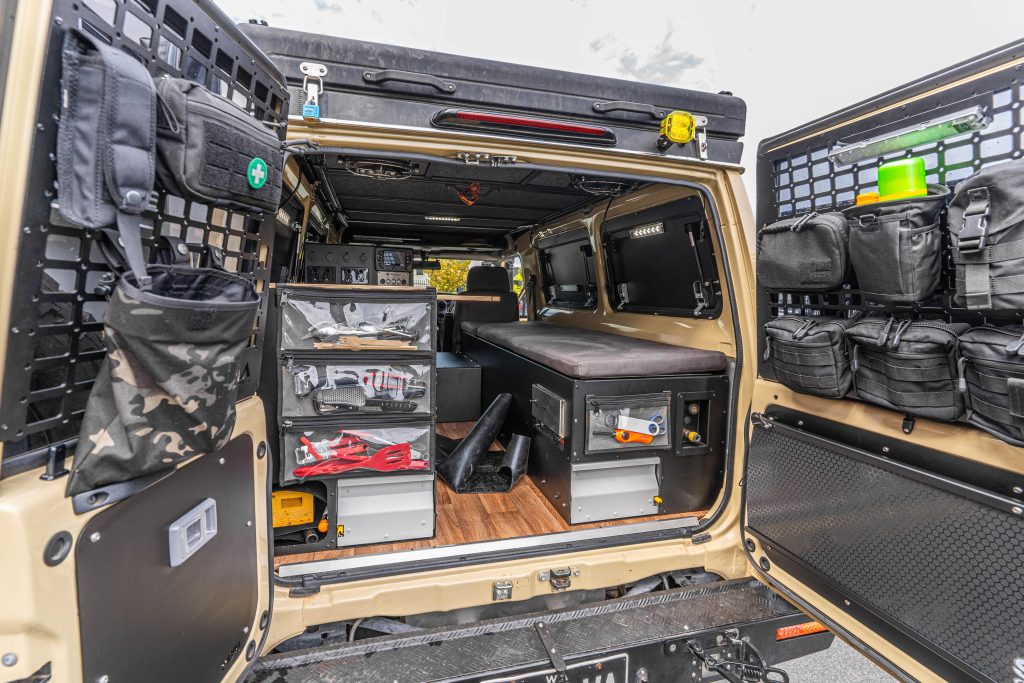
There is no universal winner because the best storage design changes with how the vehicle is actually used.
A weekend camper has very different requirements from someone living out of a truck for months. Likewise, a daily-driven SUV needs different compromises from a dedicated expedition vehicle.
Weekend Overlanding and Camping
For occasional weekend trips, a complete permanent drawer system may be more than you need.
If most trips involve carrying a tent, cooler, stove, recovery equipment, chairs, and a few storage bins, a simple DIY platform or modular container system can provide excellent organization without permanently consuming much cargo space.
DIY is particularly attractive when:
- You only camp a few weekends per year.
- Your gear changes frequently.
- You need to remove the system for everyday driving.
- You want to keep the investment low.
- You enjoy building your own equipment.
Goose Gear becomes more attractive when weekend trips are frequent and you want a consistent setup that can be packed quickly.
Long-Distance Overlanding
Long-distance travel increases the value of organization.
When you’re away from home for days or weeks, you’ll likely carry more food, water, tools, spare parts, recovery equipment, clothing, cooking equipment, and electrical gear.
In that situation, dedicated storage can make a substantial difference. A consistent location for every item means you don’t have to unpack half the vehicle to find a tool or cooking accessory.
Goose Gear’s modular approach is particularly suited to this type of use because its ecosystem can combine storage drawers with kitchen and refrigerator modules.
DIY can be equally effective, particularly when you need a layout tailored specifically to your equipment.
For long-distance overlanding, the better choice is usually the system that provides the most efficient organization without consuming excessive payload or cargo space.
Full-Time Overlanding
Full-time overlanding places the greatest demands on storage.
The vehicle becomes more than transportation—it becomes a living and working environment. Storage must accommodate food, clothing, cooking equipment, tools, electronics, water, recovery gear, and personal belongings.
In this situation, accessibility becomes extremely important. A drawer that saves five minutes every day can provide much more value over months of travel than it would on an occasional camping trip.
Goose Gear positions its Explore Series for both full-time global overlanders and weekend users, and its modular platform allows components such as drawers and kitchen systems to be combined.
DIY may be the better solution when full-time living requires unusual storage dimensions or integrated systems that commercial modules don’t accommodate.
For full-time use, prioritize ergonomics and serviceability over simply maximizing storage volume.
Budget Builds
DIY generally has the strongest advantage for budget-conscious builds.
You can begin with the basics:
- A simple plywood platform
- Affordable storage boxes
- One or two drawers
- Basic tie-down points
- A homemade fridge slide
Then upgrade the system later.
This approach also prevents you from spending thousands of dollars on storage before determining how you actually use the vehicle.
A recent community example illustrates the flexibility of DIY: one builder designed a modular drawer system around Baltic birch and removable high-load slides, with the goal of being able to install or remove the entire system using basic tools.
However, don’t sacrifice critical hardware simply to reduce cost. Quality drawer slides and secure mounting are areas where saving money can create problems later.
For a budget build, DIY is usually the better starting point.
Highly Customized Rigs
Highly customized vehicles are where DIY can really shine.
If your rig has unusual electrical equipment, a custom water system, specialized recovery gear, a non-standard refrigerator, auxiliary fuel storage, or a complicated sleeping arrangement, designing around those components from the beginning can be more efficient than adapting commercial modules.
DIY also lets you exploit small areas that standardized systems may leave unused.
Goose Gear still has an advantage when your vehicle is supported and your requirements fit its modular ecosystem. Its vehicle-specific systems can eliminate much of the measuring and fabrication work.
But when the objective is maximum use of every available inch, a custom DIY design generally offers greater freedom.
Daily-Driven Overland Vehicles
Daily-driven vehicles require a different approach because the storage system has to coexist with normal life.
You may need the rear cargo area for:
- Groceries
- Work equipment
- Sports gear
- Family luggage
- Passengers
- Home-improvement materials
A large permanent drawer system may make overlanding easier while making everyday use less convenient.
In this situation, consider a removable or modular design. A low-profile platform, removable drawers, or stackable storage boxes can provide overland organization without permanently sacrificing cargo flexibility.
Goose Gear can work well if you choose a configuration appropriate to the vehicle’s everyday role. Some current systems are specifically designed around reversible or bolt-in installation, which can help preserve the option of returning the vehicle to its original configuration.
DIY can provide even more flexibility because you control exactly how much of the cargo area becomes permanent.
For a daily driver, prioritize removability and flexible cargo space over maximum drawer capacity.
Goose Gear vs DIY Storage Systems: Which One Should You Choose?
There is no universal winner in the Goose Gear vs DIY storage systems debate. The better choice depends on how you use your rig, how much you want to spend, how much fabrication you can handle, and whether you prioritize a polished installation or maximum customization.
Goose Gear’s current Explore Series is designed as a modular ecosystem: vehicle-specific plate systems can serve as the foundation for drawer modules, refrigerator slides, CampKitchen systems, and other equipment. Its current drawer modules use Baltic birch drawer boxes, 350-pound-rated full-extension guides, locking compression latches, and MaxLite extrusion.
DIY, meanwhile, gives you control over almost every variable. You can build a simple platform and storage-bin arrangement or fabricate a complete drawer, kitchen, fridge, and sleeping-platform system.
Choose Goose Gear If You Want…
A faster path to a professional-looking setup. If you don’t want to spend multiple weekends measuring, cutting, testing, and rebuilding components, Goose Gear removes much of the design and fabrication work.
Vehicle-specific fitment. Goose Gear produces systems for numerous specific vehicle configurations. For example, its current 6th-generation 4Runner rear plate is designed specifically around that vehicle and provides predefined dimensions and compatibility with particular drawer configurations.
A modular system you can expand. You can start with a plate and add drawers, refrigerator storage, or kitchen modules rather than designing everything simultaneously. Goose Gear specifically positions its plate systems as foundations for adding these modules.
High-quality drawer hardware. Current Goose Gear drawers use full-extension guides rated at 350 pounds, locking compression latches, and dovetail-finished 11-ply drawer boxes.
Less fabrication work. Many applications are designed around bolt-in or no-drill installation, although requirements vary by vehicle. The current 6th-generation 4Runner rear plate, for example, is described as 100% bolt-in and reversible.
A long-term, frequently used setup. If your rig is used for regular weekend trips, long-distance travel, or full-time overlanding, the convenience of having every item assigned to a dedicated location can justify the higher initial investment.
The main compromise is price. Current Goose Gear listings show individual drawer modules commonly costing roughly $1,100–$1,800 or more depending on dimensions, while larger double-drawer and side-by-side configurations can exceed $2,000.
Choose DIY If You Want…
Maximum customization. You can design every drawer, shelf, compartment, and platform around your actual equipment rather than adapting your equipment to predetermined module dimensions.
Lower potential cost. Plywood, aluminum extrusion, drawer slides, hardware, and storage boxes can often produce a capable system for substantially less than a premium commercial setup. Your final cost will depend heavily on hardware quality and how elaborate the design becomes.
A storage system built around unusual equipment. DIY makes particular sense when you have specialized water tanks, electrical equipment, compressors, tools, refrigerators, recovery gear, or sleeping arrangements that don’t fit neatly into commercial modules.
The ability to change the design. You can make drawers removable, add compartments later, modify mounting points, or replace individual components without being tied to one manufacturer’s dimensions.
A hands-on fabrication project. If you already have woodworking or fabrication skills, the time spent designing and building the system may be part of the enjoyment rather than a disadvantage.
A lightweight design tailored to your vehicle. You can choose materials and dimensions specifically to minimize unnecessary weight. But don’t assume DIY automatically weighs less: overbuilding with thick plywood, oversized hardware, and excessive reinforcement can make a homemade system surprisingly heavy.
DIY’s biggest disadvantage is that you become the designer, engineer, fabricator, and installer. A cheap system isn’t a good deal if it rattles apart on rough trails or requires rebuilding after a few trips.
Choose a Hybrid System If You Want the Best of Both
A hybrid setup can be the most practical solution for overlanders who don’t want to choose completely between commercial and DIY components.
For example, you could use a Goose Gear vehicle-specific plate as the foundation and build your own storage modules on top. Goose Gear’s plates are specifically designed as foundations for its own drawer and kitchen modules, and some current systems provide pre-drilled anchor points for securing equipment.
Other combinations can include:
- Commercial plate + DIY drawer boxes
- Goose Gear fridge slide + DIY cabinet
- Commercial drawer slides + DIY storage boxes
- Goose Gear platform + removable storage bins
- Commercial kitchen module + DIY auxiliary storage
- Commercial mounting hardware + custom shelving
The hybrid approach is particularly useful when you value secure vehicle-specific mounting but don’t need every component to come from the same manufacturer.
It can also spread the investment over time. You might begin with a platform and basic storage, then add a commercial refrigerator slide or drawer later after determining which equipment you use most frequently.
Before mixing components, however, verify dimensions, mounting points, load ratings, clearances, and compatibility. A commercial module shouldn’t simply be assumed to fit a homemade platform.
Final Decision Checklist
Before spending money or cutting your first sheet of plywood, answer these questions:
| Question | Lean Goose Gear | Lean DIY |
|---|---|---|
| Do you want minimal fabrication? | ✓ | |
| Is professional finish important? | ✓ | |
| Is your vehicle supported by a specific system? | ✓ | |
| Do you want maximum customization? | ✓ | |
| Is upfront cost your biggest concern? | ✓ | |
| Do you enjoy woodworking/fabrication? | ✓ | |
| Do you need unusual dimensions? | ✓ | |
| Do you want modular commercial components? | ✓ | |
| Will you modify the system frequently? | ✓ | |
| Do you want a combination of both? | Hybrid |
Also consider payload before committing. A storage system is only one part of your vehicle’s total load. The current 6th-generation 4Runner non-hybrid Goose Gear rear plate, for example, weighs 38 pounds before additional modules and gear are added. Its hybrid version weighs 48 pounds.
Goose Gear or DIY for Your Overland Rig?
The simplest way to make the decision is to identify what you value most: convenience, finish, and engineered integration—or cost, flexibility, and customization.
Goose Gear Wins for Convenience and Finish
Goose Gear’s biggest advantage isn’t simply the materials used in its products. It’s the amount of work you don’t have to do.
Instead of designing drawer dimensions, determining mounting points, selecting slides, creating latches, and figuring out how everything fits together, you select compatible components designed to work within a particular system.
Its current Explore Series includes plate systems, CampKitchen, IceBox, Solo fridge slides, and several drawer configurations.
The result is a cleaner and more predictable installation, particularly when the vehicle has a supported application.
This makes Goose Gear particularly attractive if:
- You have limited fabrication experience.
- You value your time.
- You want a polished appearance.
- You travel frequently.
- You want dedicated drawers and kitchen/fridge integration.
- You’re comfortable paying a premium for convenience.
Its pricing is undeniably substantial. A current Goose Gear single drawer module can cost well over $1,000, with larger configurations reaching $2,000 or more.
Therefore, the value proposition isn’t “cheap storage.” You’re paying for engineering, fitment, hardware, finish, modularity, and reduced build time.
DIY Wins for Value and Customization
DIY wins when the commercial system’s standard dimensions don’t match your needs—or when you simply don’t want to spend premium money on storage.
A competent builder can create exactly the configuration required for the vehicle.
For example, rather than purchasing two large drawers, you could build:
- One shallow tool drawer
- One deep recovery-gear drawer
- A dedicated refrigerator compartment
- A removable kitchen box
- A narrow electrical-access compartment
- Open space for large equipment
You can also design the system around the gear you already own.
The strongest reason to choose DIY, therefore, isn’t simply “it’s cheaper.” It’s that DIY lets you decide where every inch of cargo space goes.
The downside is that the final result depends on your design and construction quality. Good drawer slides, strong joints, secure mounting, proper latching, and protection against vibration are essential for off-road use.
The Best Choice Depends on Your Build
For most overlanders, the decision can be summarized this way:
Choose Goose Gear if you want a polished, modular system and would rather spend money than spend weekends fabricating storage.
Choose DIY if you have the skills and time to build around your exact requirements and want to control the budget and design.
Choose hybrid if you want reliable commercial components where they matter most while keeping the rest of the system custom.
There is also no requirement to build everything at once. A smart approach is to start by identifying the equipment you use most frequently, determine how much permanent storage you actually need, and then build the system around those priorities.
FAQ Section
Is Goose Gear worth the money?
Goose Gear can be worth the money if you value vehicle-specific fitment, professional finish, modularity, and reduced installation effort. It is harder to justify if your primary goal is the lowest possible storage cost.
Current Goose Gear products are clearly positioned as premium modular components rather than inexpensive cargo organizers. For example, current single drawer modules are commonly priced above $1,000, while larger drawer configurations can exceed $2,000.
The value comes from more than the drawer box itself: you are also paying for the engineered system, hardware, fitment, finish, and compatibility with other modules.
Is DIY overland storage cheaper than Goose Gear?
Usually, it can be—but not always.
A basic DIY platform made from plywood and storage bins can be dramatically cheaper. However, a sophisticated DIY system using premium drawer slides, aluminum extrusion, quality latches, coatings, and custom hardware can become surprisingly expensive.
DIY is most cost-effective when you already have the necessary tools and can perform the fabrication yourself.
How much does a Goose Gear drawer system cost?
Prices vary significantly according to drawer width, depth, height, configuration, vehicle, and whether the module includes a fitted top plate.
As of August 2026, Goose Gear’s current product listings show examples such as single drawer modules starting around $1,140–$1,250 for certain configurations, with larger/deeper versions reaching approximately $1,700–$1,840. Double-drawer configurations can start around $1,695 and rise above $2,000.
A complete vehicle setup costs more because you may also need a vehicle-specific plate, fridge slide, kitchen module, or other accessories. For example, Goose Gear currently lists a Solo fridge slide from about $539 and a CampKitchen 2.2 around $1,945.
Because prices and configurations can change, check the manufacturer’s current listing before purchasing.
Are Goose Gear drawers durable enough for off-road use?
Yes, they are specifically designed for demanding vehicle use. Current Goose Gear drawer modules use 11-ply dovetail-finished Baltic birch drawer boxes, 350-pound-rated full-extension guides, locking compression latches, and MaxLite extrusion.
That doesn’t mean they are indestructible. Installation, mounting, vehicle payload, and how the drawers are loaded still matter.
Can you build a DIY drawer system for an overland vehicle?
Absolutely. A DIY system can range from a simple plywood drawer to a sophisticated multi-drawer cabinet with refrigerator storage, kitchen equipment, and a sleeping platform.
The critical point is to design for dynamic off-road loads, not merely the drawer’s static contents. Use appropriately rated slides, strong joints, positive latches, and secure mounting points.
Also test the system before taking it onto difficult trails. A drawer that operates smoothly in your driveway may behave differently when loaded and subjected to repeated vibration.
Does Goose Gear add significant weight?
It adds weight, but the amount depends heavily on the configuration.
For example, Goose Gear lists its current 6th-generation non-hybrid 4Runner rear plate at 38 pounds and the hybrid version at 48 pounds, before additional modules and equipment are installed.
Additional drawers, fridge slides, kitchen modules, and cargo obviously increase the total.
Goose Gear also emphasizes weight reduction in its current drawer construction, including MaxLite extrusion, which the company says is 26% lighter.
The important comparison is therefore complete system weight, not just the weight of an individual drawer.
Can DIY drawers be as strong as Goose Gear?
Yes, a properly engineered DIY drawer can be very strong, but strength depends on the design and hardware.
A DIY builder can use high-quality drawer slides, thick or appropriately engineered panels, strong joints, reinforced mounting points, and reliable latches.
However, matching a commercial system requires more than copying its appearance. You need to consider load capacity, vibration, fastener strength, drawer deflection, mounting structure, and repeated cycling.
DIY gives you control, but it also gives you responsibility for the engineering.
Which is better for a daily-driven overland vehicle?
For a daily driver, a modular or removable DIY system may offer the greatest flexibility, particularly if you regularly need the cargo area for groceries, work equipment, passengers, or general hauling.
Goose Gear can still be an excellent choice when you want a permanent, polished system. Some vehicle-specific Goose Gear platforms are designed to be reversible; the current 6th-generation 4Runner rear plate, for example, is described as 100% bolt-in and completely reversible.
The key is avoiding a storage system that solves your weekend-overlanding problem while creating a daily-driving inconvenience.
Can Goose Gear and DIY components be combined?
Yes, a hybrid approach is possible, but compatibility must be checked component by component.
Goose Gear’s own system is designed around a plate-and-module architecture, with drawers, kitchen modules, and refrigerator systems attaching to compatible plate systems.
You can use that commercial foundation while customizing other parts of the vehicle with DIY storage, bins, shelves, or cabinetry.
For any mixed system, verify dimensions, mounting locations, hardware, load ratings, clearances, and interference with vehicle components before installation.
Read More: Dometic CFX3 vs ARB Zero Fridge: Who Makes the Best Portable Fridge?