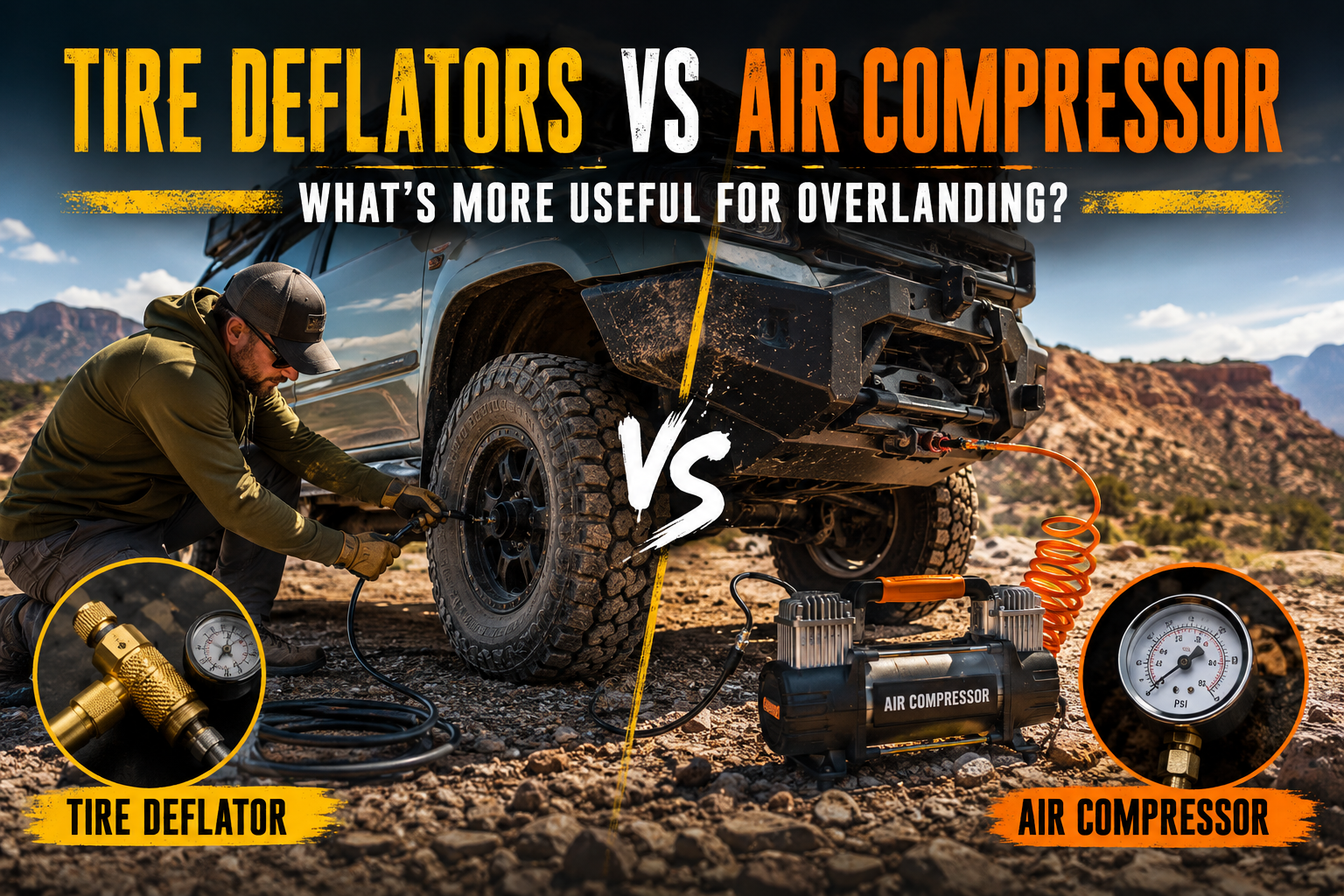
When you leave pavement for an overlanding trail, tire pressure becomes one of the most important variables affecting traction, ride quality, and tire performance. Lowering tire pressure can allow the tire to conform better to uneven terrain and increase its footprint, while restoring pressure before returning to pavement is essential for safe highway driving. The correct pressure, however, depends on the vehicle, tire, wheel, load, terrain, and driving conditions—there is no universal off-road PSI.
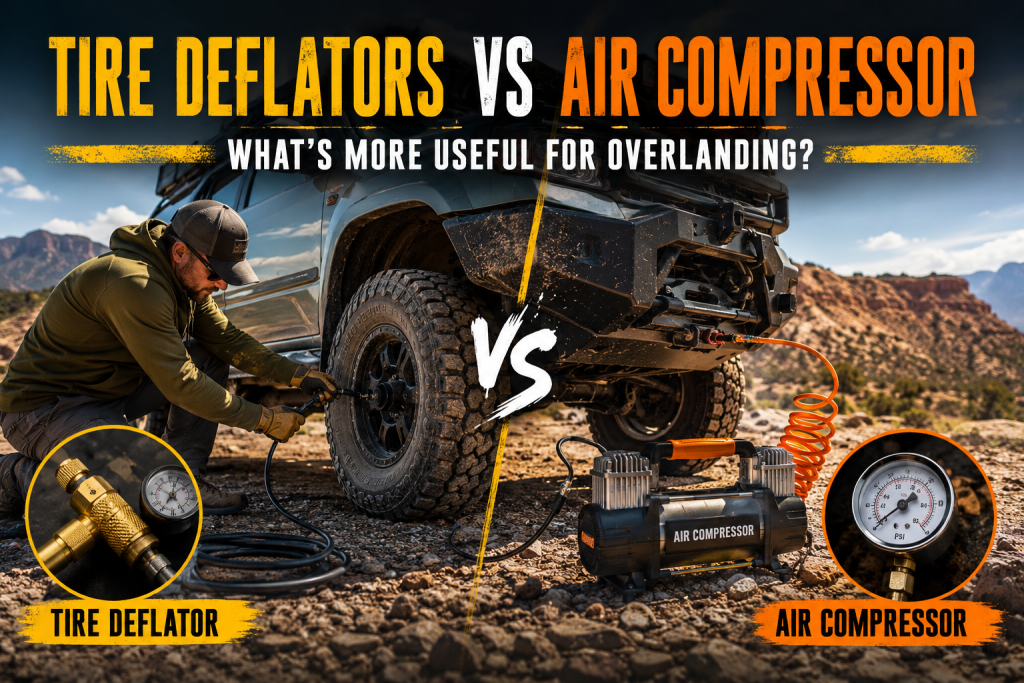
That makes tire deflators vs air compressor a slightly misleading either-or comparison. The two tools perform opposite jobs. A tire deflator helps you remove air quickly and consistently when preparing for off-road travel, while an air compressor lets you put air back into the tires when the trail ends or when pressure needs to be adjusted.
For most overlanders who regularly travel off pavement, the most useful setup is therefore not choosing one over the other. A deflator makes airing down faster and more controlled; a capable compressor provides the ability to reinflate anywhere without depending on a gas station or other external air source.
The key question is how much you value each function. Someone who only occasionally drives dirt roads may get by with a simple deflator and access to an air source. Someone traveling remote trails, sand, rocks, or multi-day routes will generally benefit much more from carrying both.
Tire Deflators vs Air Compressor: What Does Each Tool Do?
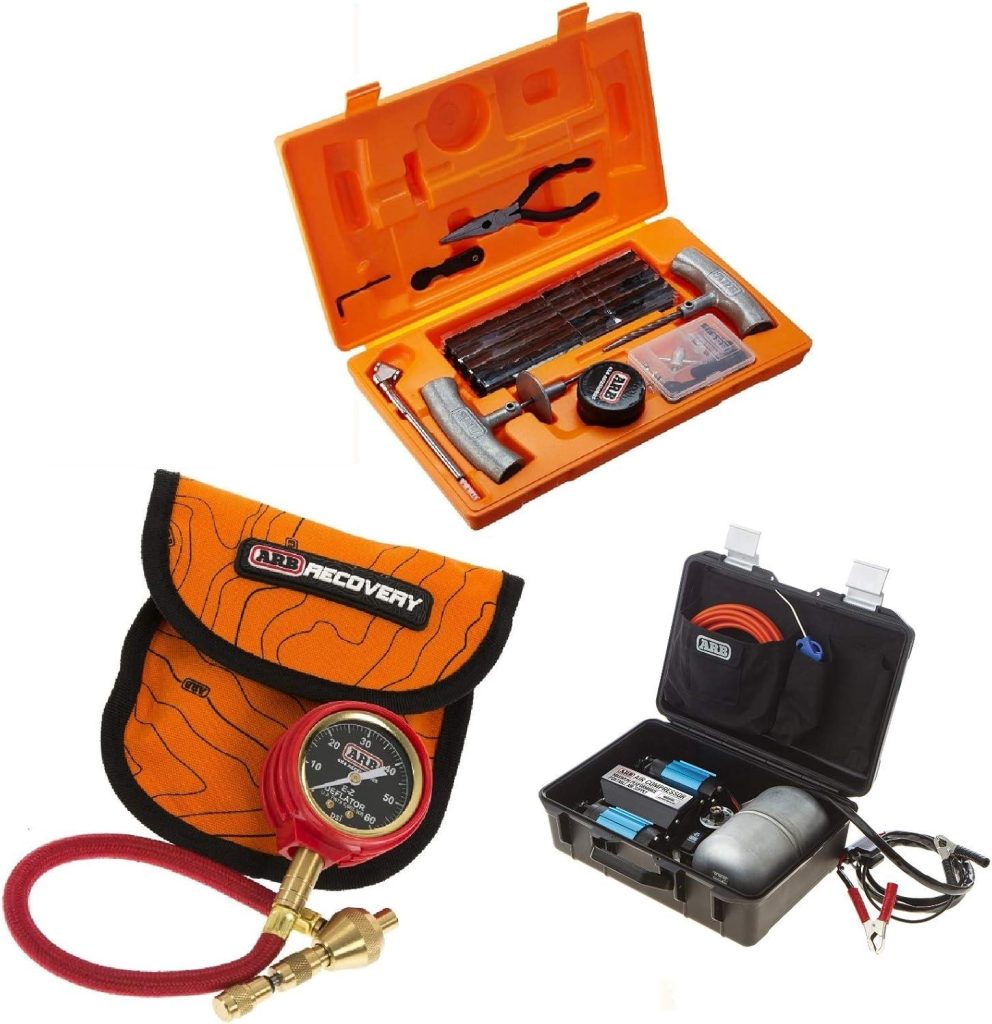
What Is a Tire Deflator?
A tire deflator is a tool designed to release air from a tire in a controlled way. Instead of repeatedly pressing the valve core and checking the pressure with a separate gauge, a dedicated deflator makes the process faster and easier.
Basic deflators allow you to manually release air while monitoring a built-in pressure gauge. More advanced models can remove the valve core and vent air rapidly, while preset or automatic deflators can stop at a selected pressure. This is particularly useful when you need all four tires to reach approximately the same target pressure.
For example, an overlander might reduce pressure before entering sand or a rocky trail. Lower pressure can increase the tire’s contact area and allow the tread and sidewall to conform to uneven surfaces. The exact target should be based on the vehicle and tire setup rather than blindly following a generic PSI chart.
A good deflator provides three major benefits:
- Faster airing down than manually pressing valve stems.
- Better pressure control through an integrated or separate gauge.
- More consistent pressure across multiple tires.
Some systems can even connect to multiple tires simultaneously. XOverland, for example, describes using a two-hose system that can inflate or deflate two tires together while keeping their pressures matched.
However, a tire deflator has one major limitation: it only removes air. It cannot restore tire pressure after the trail.
What Is an Air Compressor?
An air compressor reverses the job of a deflator. It uses mechanical energy to compress air and deliver it through a hose into the tire.
For overlanding, portable and onboard 12V compressors are particularly useful because they can operate from the vehicle’s electrical system without requiring a gas station or external power source.
Compressor capability varies considerably. A small compressor may be adequate for occasional use on smaller tires, while larger truck and 4×4 tires require a higher-output model designed for repeated inflation. Airflow, measured in CFM or L/min, is one of the most useful specifications to compare, but the airflow figure should be considered alongside the manufacturer’s measurements at actual tire pressure.
For example, ARB’s current CKMTP12 twin-motor portable compressor is rated at 6.16 CFM at zero PSI and 4.68 CFM at 29 PSI under its specified test conditions. It is also rated for continuous operation and draws up to 68.6 amps at maximum load, illustrating the electrical demands of a high-output compressor.
Smaller systems can be substantially more compact. ARB’s single-motor portable CKMP12V2, for example, is rated at 3.08 CFM at zero PSI and 2.34 CFM at 29 PSI, with a 50% duty cycle.
A compressor is useful for much more than simply returning from trail pressure to highway pressure. Depending on the equipment and attachments, it can also inflate:
- Tires
- Air mattresses
- Paddle boards
- Inflatable kayaks
- Sports equipment
- Other camping inflatables
Some onboard systems can additionally be integrated with air lockers or air tanks when configured with the appropriate accessories.
The biggest advantage is independence: you can air back up wherever you finish the trail.
Why Overlanders Often Need Both
The simplest way to understand the tire deflators vs air compressor debate is to think of them as two halves of the same tire-management system.
Deflator = air out.
Compressor = air in.
Suppose your vehicle normally runs at highway pressure and you reach a rough trail. You use the deflator to reduce tire pressure to an appropriate trail setting. The lower pressure can improve tire conformity and traction on loose or uneven terrain. When you finish the trail, however, those tires are no longer at their normal road pressure.
That’s where the compressor becomes essential.
Driving long distances on pavement with significantly underinflated tires can negatively affect handling, tire behavior, and tire wear. Reinflating before returning to sustained highway speeds is therefore an important part of the airing-down process.
This is why experienced overlanders commonly carry both tools:
At the trailhead:
Deflator → lower tire pressure → better suited to terrain.
On the trail:
Pressure gauge → monitor pressure and make adjustments if necessary.
At the trail exit:
Compressor → restore road pressure → return to pavement.
There is also an important practical advantage to having both: speed and consistency. A quality deflator reduces the time spent manually releasing air, while a properly sized compressor reduces the time spent reinflating four tires.
Tire Deflators vs Air Compressor: Head-to-Head Utility Comparison
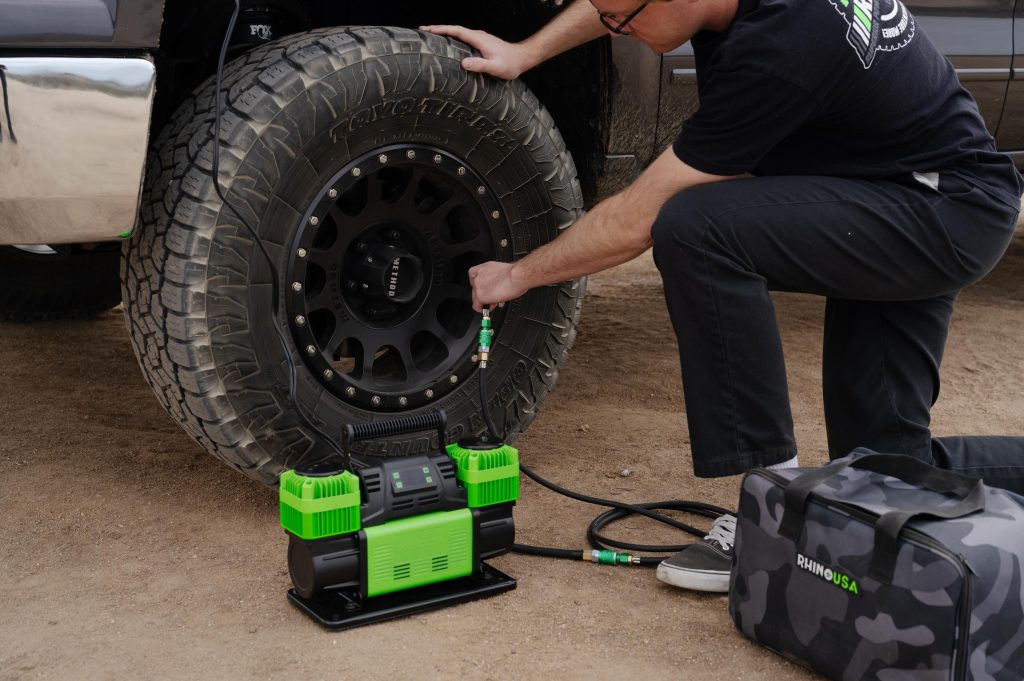
The two tools cannot be judged solely by price because they solve different problems. A deflator is usually simpler, smaller, and cheaper, but an air compressor provides a much broader capability and becomes particularly valuable when you are far from reliable air sources.
Airing Down Speed
For airing down, the tire deflator wins.
You can release air simply by pressing the valve core with a small tool, but this requires repeatedly checking pressure and moving from tire to tire. A dedicated deflator combines the air-release function with pressure measurement, making the process much more controlled.
Some deflators are designed specifically for rapid pressure reduction. Others allow you to set a target pressure and automatically stop releasing air when that pressure is reached.
The biggest advantage becomes obvious when you have four large tires. Removing several PSI from four tires manually can become tedious, especially when you’re trying to achieve reasonably consistent pressures.
A compressor cannot compete in this category because it is designed to add air rather than remove it.
Winner: Tire deflator
Reinflation Speed
For reinflation, the air compressor wins by default because a deflator cannot add air.
But not every compressor performs equally well.
The time required to inflate a tire depends on tire size, starting pressure, target pressure, compressor airflow under load, temperature, electrical supply, hose size, and the compressor’s duty cycle. A compressor’s advertised maximum PSI alone does not tell you how quickly it will inflate a tire.
For example, ARB’s published figures show that its CKMTP12 produces 6.16 CFM at zero PSI but 4.68 CFM at 29 PSI, demonstrating why airflow at working pressure is more meaningful than simply looking at a maximum-pressure rating.
For larger tires or vehicles that repeatedly air down during a trip, a higher-output compressor can save significant time. A smaller compressor may still work, but it may require longer operating periods and more attention to its duty-cycle limitations.
Winner: Air compressor
Accuracy and Pressure Control
This category is more balanced.
A quality tire deflator can provide excellent control when airing down because you can monitor the pressure as air is released. Automatic models can make the process even easier by stopping at a preset pressure.
During reinflation, however, the compressor itself is not necessarily the most accurate pressure-measuring device. The quality of the tire inflator and pressure gauge attached to the compressor matters.
Some modern compressor kits combine the compressor with a digital tire inflator specifically to provide precise PSI control. ARB’s onboard system, for example, pairs its compressor with a digital tire inflator designed to allow the user to set and monitor tire pressure accurately.
Regardless of which tool you use, check pressure with a reliable gauge and use a consistent measurement method. Do not assume that the pressure displayed by one gauge will perfectly match another.
Winner: Tie—depending on the setup
Emergency Use
An air compressor generally has the advantage for emergency tire management.
If you experience a slow leak on the trail, the ability to add air can help you maintain sufficient pressure while looking for a permanent repair or reaching a safer location. A compressor can also be useful after repairing a puncture with a plug kit.
A deflator has much less emergency utility because deliberately removing air is rarely what you need after suffering a puncture or air leak.
That said, a deflator can still be valuable during recovery situations. Adjusting tire pressure may improve traction or help a vehicle navigate certain terrain, provided the pressure remains appropriate for the tire and wheel combination.
For true emergency preparedness, the compressor should be accompanied by a pressure gauge, tire-repair kit, valve-core tools and spare valve cores rather than treated as a standalone recovery solution.
Winner: Air compressor
Portability and Storage
The tire deflator wins for portability.
Most deflators are small enough to store in a glovebox, center console, door pocket, or compact recovery bag. They generally require no electrical connection and can be ready to use immediately.
Compressors are considerably larger. A portable compressor may require a dedicated storage location, electrical connections, hoses, clamps, and accessories. High-output models can be particularly heavy. For example, ARB lists its CKMTP12 portable twin compressor at 33 lb, while its single-motor CKMP12V2 is listed at 15.4 lb.
An onboard compressor solves some of the storage problem because it can be permanently mounted in the vehicle. However, installation takes additional space, wiring, and cost.
Winner: Tire deflator
Cost and Value
A tire deflator generally costs much less than a quality 12V compressor.
That’s because the mechanical requirements are relatively simple. A basic deflator can provide everything needed for occasional airing down, while automatic multi-tire systems cost more because of their additional valves, hoses, gauges, and controls.
A compressor represents a larger investment, but its usefulness is broader. It can restore road pressure, handle slow leaks, inflate camping equipment, and potentially support other pneumatic accessories.
Therefore, the better value depends on your use case.
If you already have convenient access to an air source after every trip, a deflator may deliver excellent value.
If you regularly travel remote trails where there may be no reliable air source for many miles, the compressor’s additional cost can be justified much more easily.
Winner: Tire deflator for low-cost utility; air compressor for broader capability
Durability and Maintenance
Both tools can be durable, but their maintenance requirements are different.
A tire deflator has relatively few moving parts. The main concerns are keeping the tool clean, protecting the gauge from impact, checking seals and connections, and avoiding damage to the valve mechanism.
A compressor has more components that experience heat, vibration, electrical load, and mechanical wear. Depending on its design, maintenance can involve cleaning the air filter, checking electrical connections, inspecting hoses and fittings, and allowing the compressor to cool according to its duty-cycle requirements.
Duty cycle is particularly important. A compressor rated at 50% duty cycle should not be treated like a continuous-duty unit. ARB’s CKMP12V2, for example, is rated at 50% duty cycle, while its CKMTP12 twin compressor is rated for continuous operation under the specified conditions.
Environmental protection also matters for overlanding. Dust, water, mud, heat, and vibration can be hard on equipment. Some compressors are specifically designed with weather resistance and thermal protection; ARB’s CKMTP12, for example, is listed with IP55 protection and a thermal cut-out system.
Winner: Tire deflator for simplicity; quality compressor for demanding repeated use
Suggested Comparison Table
| Feature | Tire Deflator | Air Compressor | Better Choice |
|---|---|---|---|
| Airing down | Excellent | Not designed for it | Deflator |
| Reinflating tires | No | Excellent | Compressor |
| Pressure control | Very good with quality gauge/auto-stop | Very good with proper inflator/gauge | Tie |
| Emergency tire support | Limited | Excellent | Compressor |
| Portability | Excellent | Good to moderate | Deflator |
| Storage space | Very little | More space required | Deflator |
| Electrical power | Not required | Required | Deflator |
| Multi-tire capability | Available on some systems | Usually one or more with accessories | Depends on setup |
| Camping inflation | No | Yes | Compressor |
| Maintenance | Minimal | More involved | Deflator |
| Upfront cost | Usually lower | Usually higher | Deflator |
| Long-distance remote travel | Useful | Highly useful | Both |
| Frequent airing down/up | Useful | Essential for airing up | Both |
When comparing tire deflators vs air compressor, there isn’t a true winner because they perform complementary jobs. The deflator is the better tool for quick, controlled airing down, while the compressor is the more versatile tool for reinflation and emergency tire management.
For a vehicle that only occasionally leaves pavement, a simple deflator may be enough to start. For serious overlanding—especially remote travel where you may air down repeatedly—a quality deflator plus a suitably sized 12V compressor is the more complete solution.
Which Is More Useful for Different Overlanding Situations?
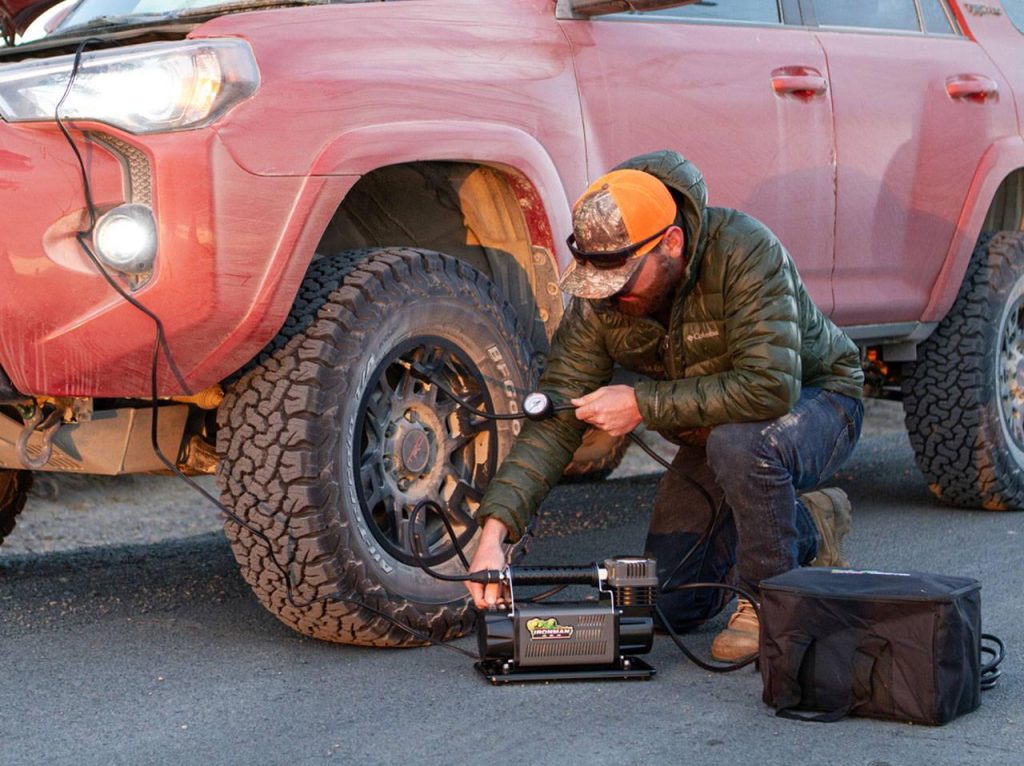
The usefulness of a tire deflator vs air compressor changes significantly depending on how, where, and how often you travel. A driver who spends most weekends on maintained dirt roads has very different tire-management needs from someone crossing remote deserts or spending several days on technical trails.
One important rule applies to every situation: do not treat any PSI number as universal. The correct off-road pressure depends on tire size and construction, vehicle weight, load, wheels, terrain, and speed. Current off-road guidance consistently recommends using vehicle- and tire-specific starting points rather than blindly following a generic PSI chart.
Weekend Off-Road Trips
For occasional weekend trips, a tire deflator may provide the better value if you already have access to reliable air at the end of the trail.
If your typical trip involves a few hours on dirt roads, gravel, mild rocks, or relatively short trails, you may only need to reduce tire pressure temporarily to improve comfort and traction. A deflator makes this process considerably easier than manually releasing air from each valve.
An air compressor becomes more valuable if your weekend trips routinely finish far from paved roads or reliable service stations. Even on a short trip, a puncture or slow leak can turn a simple outing into a recovery problem. Having your own compressor means you can make pressure adjustments or add air without depending on someone else’s equipment.
Best choice:
- Occasional, accessible trails: Tire deflator
- Remote weekend trails: Tire deflator + compressor
For beginners, this is often the point where buying a basic quality deflator first makes sense, then adding a compressor as off-road travel becomes more frequent.
Long-Distance Overlanding
For multi-day or multi-week overlanding, the air compressor becomes significantly more important, although the best setup still includes a deflator.
Long-distance routes can cross several surfaces in a single day. You might leave pavement, travel gravel roads, cross rocky sections, enter sand, and eventually return to highway speeds. Each surface can benefit from a different pressure strategy.
For example, current off-road guidance generally suggests greater pressure reduction for soft sand and more conservative pressures on rocky terrain because of the different traction and tire-protection requirements.
This makes repeated pressure changes part of the journey rather than a one-time task.
A compressor gives you independence from fuel stations and public air pumps. That’s particularly important when traveling through remote areas where the next reliable source of compressed air may be many hours or days away.
A deflator also saves time whenever you need to air down. Instead of manually releasing and checking each tire repeatedly, a quality deflator can make the process faster and more consistent.
Best choice: Both.
For serious overlanding, the compressor is arguably the more important single piece of equipment, but the combination of compressor + deflator creates a much more efficient tire-management system.
Sand and Dunes
For sand and dunes, a tire deflator is extremely useful, but the compressor becomes equally important once you’re ready to leave the sand.
Sand generally rewards a larger tire footprint because spreading the vehicle’s weight over more surface area can reduce the tendency of the tires to dig into soft ground. Expedition Portal identifies lowering tire pressure as one of the most important factors in successful sand driving.
Current guides commonly give lower starting pressures for soft sand than for rocky terrain, but the actual pressure should be determined by your vehicle, tire, load, wheels, and conditions. Some guides list approximately 15–18 PSI for soft sand on typical 4WDs, while other setups may safely use different pressures.
A deflator is especially useful because you may need to adjust pressure gradually. If the vehicle continues to struggle in soft sand, reducing pressure further may improve flotation—provided you remain within the safe operating limits of the tire and wheel.
But there is an important second half: air back up before returning to pavement.
After leaving the dunes, a compressor allows you to restore road pressure immediately rather than driving a long distance on tires that have been intentionally softened for low-speed sand travel.
Best choice: Both
Why: Deflator for flotation-focused airing down; compressor for airing back up.
Rocky and Technical Trails
Rocky and technical trails make both tools valuable, but pressure management requires more caution.
Airing down can allow the tire to conform around rocks and obstacles, improving mechanical grip and reducing the harshness of impacts. However, very low pressure also allows greater sidewall flex and increases the risk of bead unseating or wheel/rim damage, particularly during aggressive steering or when the tire is loaded against a sharp obstacle.
Cooper Tires, for example, notes that lower pressures can help tires envelop rocks and obstacles, while pressures below roughly 20 PSI can increase the risk of pushing a tire off the rim on some vehicles.
This is why a deflator is useful for controlled, incremental pressure reduction rather than simply dumping as much air as possible.
A compressor is equally important if the trail includes multiple sections requiring different pressures. You may want a lower setting for a slow technical section but a higher pressure for faster gravel or when returning to pavement.
Best choice: Both
Use the deflator to make controlled adjustments and the compressor to restore or increase pressure when terrain changes.
Mud
Mud is more complicated than sand because lower pressure is not automatically better.
A moderate reduction can increase the contact patch and improve traction, but the ideal pressure depends heavily on mud depth, consistency, tire design, vehicle weight, and what is underneath the mud.
Cooper Tires notes that thick mud with a loose base can benefit from reduced pressure, while watery mud over a firm base may work better with higher pressure.
Aggressive mud-terrain tires also behave differently from all-terrain tires. Tread design and the tire’s ability to self-clean can be more important than simply reducing PSI.
A deflator is useful when you need a controlled reduction before entering a muddy section. If the vehicle begins to struggle, you can make gradual adjustments rather than immediately going to an extremely low pressure.
The compressor becomes valuable after the muddy section, especially if the route transitions to faster gravel or pavement.
Best choice: Both, particularly for extended trips.
Remote Expeditions
For remote expeditions, the air compressor is the more important single tool, but carrying a deflator as well is strongly preferable.
When you’re hundreds of miles from the nearest service station, an air compressor is not merely a convenience. It becomes part of your self-sufficiency equipment.
A compressor can help you:
- Restore tire pressure after airing down.
- Compensate for a slow leak.
- Reinflate after a puncture repair.
- Adjust pressure for changing terrain.
- Inflate compatible camping equipment with the right adapters.
A tire-repair kit should accompany the compressor because a compressor cannot permanently repair a puncture. The ideal approach is to identify and repair the air leak first, then use the compressor to restore pressure.
Remote travel also increases the value of redundancy. A compressor failure can become serious if there is no alternative air source nearby, so protecting the compressor, electrical connections, hoses, and fittings from dust, water, and physical damage is important.
Best choice: Both, with priority given to a reliable compressor.
For expedition vehicles, a permanently mounted compressor can be attractive because it reduces setup time and keeps the equipment organized, while a portable compressor provides greater flexibility between vehicles.
Daily Driver + Occasional Overlanding
If your vehicle is primarily a daily driver and only occasionally goes off-road, a tire deflator is usually the easiest starting point.
You may only air down a few times per year. In that situation, buying a large high-output compressor may not provide enough additional value to justify the extra cost and storage space.
A compact deflator and accurate pressure gauge can handle the basic airing-down requirement. If you have access to a reliable compressor or air station near the trail exit, you can restore pressure there.
However, if your occasional trips take you into remote areas—or if you want to be prepared for punctures and slow leaks—adding a portable compressor becomes worthwhile.
Best choice: Tire deflator for basic use; compressor if self-sufficiency matters.
How to Choose Between a Tire Deflator and Air Compressor
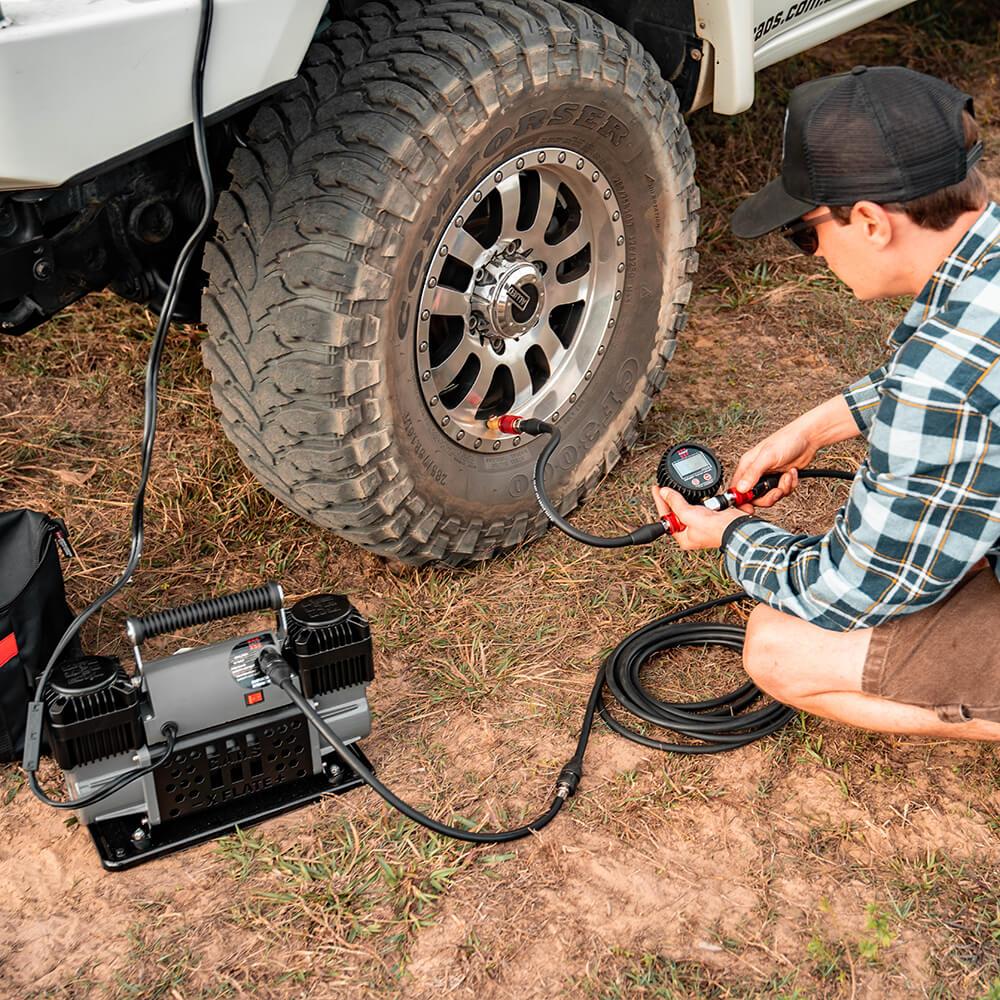
The easiest way to decide is to identify which part of tire management you actually need.
Choose a Tire Deflator If…
A tire deflator is the better first purchase if:
- You mainly need to air down before trails.
- You already have reliable access to compressed air afterward.
- You only go off-road occasionally.
- Storage space is limited.
- You want the smallest and simplest tire-pressure tool.
- You frequently change pressure between different trail surfaces.
- You want to make airing down faster and more consistent.
A quality deflator can turn a repetitive process into a quick routine. Automatic or preset models can be particularly convenient when all four tires need to reach approximately the same target pressure.
However, don’t confuse convenience with precision. The gauge should be checked periodically against a known-accurate pressure gauge.
Choose an Air Compressor If…
An air compressor should be your priority if:
- You regularly travel remote trails.
- You frequently air down.
- There may be no reliable air source after the trail.
- You want self-sufficiency during long trips.
- You want equipment capable of handling slow leaks or puncture repairs.
- You have larger tires that take longer to reinflate.
- You also want to inflate camping equipment.
- You expect to travel long distances between service stations.
For larger off-road tires, pay attention to actual airflow at working pressure, duty cycle, electrical requirements, hose length, and thermal protection—not simply the advertised maximum PSI.
A high-output compressor can require substantial electrical current. For example, some twin-motor 12V compressors draw more than 60 amps at maximum load, so wiring and power connections must be appropriate for the compressor.
Choose Both If…
For most serious overlanders, both tools provide the most complete solution.
The workflow is straightforward:
1. Arrive at the trail → use the deflator.
2. Select an appropriate trail pressure → verify with a reliable gauge.
3. Drive according to the terrain and reduced-pressure limitations.
4. Reach the end of the trail → use the compressor.
5. Restore road pressure before sustained highway driving.
This setup also gives you greater flexibility when terrain changes.
For example, you could run one pressure on gravel, reduce it further for soft sand, increase it for a rocky section, and then return to your road pressure before highway travel.
There is no universally correct off-road PSI. Vehicle weight, tire construction, load, wheel type, terrain, and speed all influence the appropriate setting.
What Else Should Be in the Tire-Pressure Kit?
A deflator and compressor should not be considered a complete tire-management kit by themselves.
A practical overlanding tire-pressure kit should include:
- Reliable tire-pressure gauge — preferably one you can verify against another known-good gauge.
- Tire deflator — manual, preset, or automatic depending on your needs.
- 12V air compressor — sized for your tire volume and intended frequency of use.
- Quality air hose — long enough to reach all tires without awkward positioning.
- Valve-core tool — useful for valve maintenance and emergency repairs.
- Spare valve cores and valve caps — inexpensive and easy to carry.
- Tire-repair/plug kit — essential for punctures that can be safely repaired.
- Gloves — useful when working around hot, dirty, or muddy wheels.
- 12V electrical connectors or appropriate heavy-duty leads — especially important for high-current compressors.
- Extension hose or multi-tire inflation system — useful for larger vehicles or faster pressure equalization.
- TPMS monitoring — where compatible with the vehicle and wheel setup.
The most important point is that a compressor is not a substitute for a tire-repair kit. If a tire has a puncture, adding air repeatedly without addressing the leak is only a temporary measure.
Tire Deflators vs Air Compressor—Which Should You Buy?
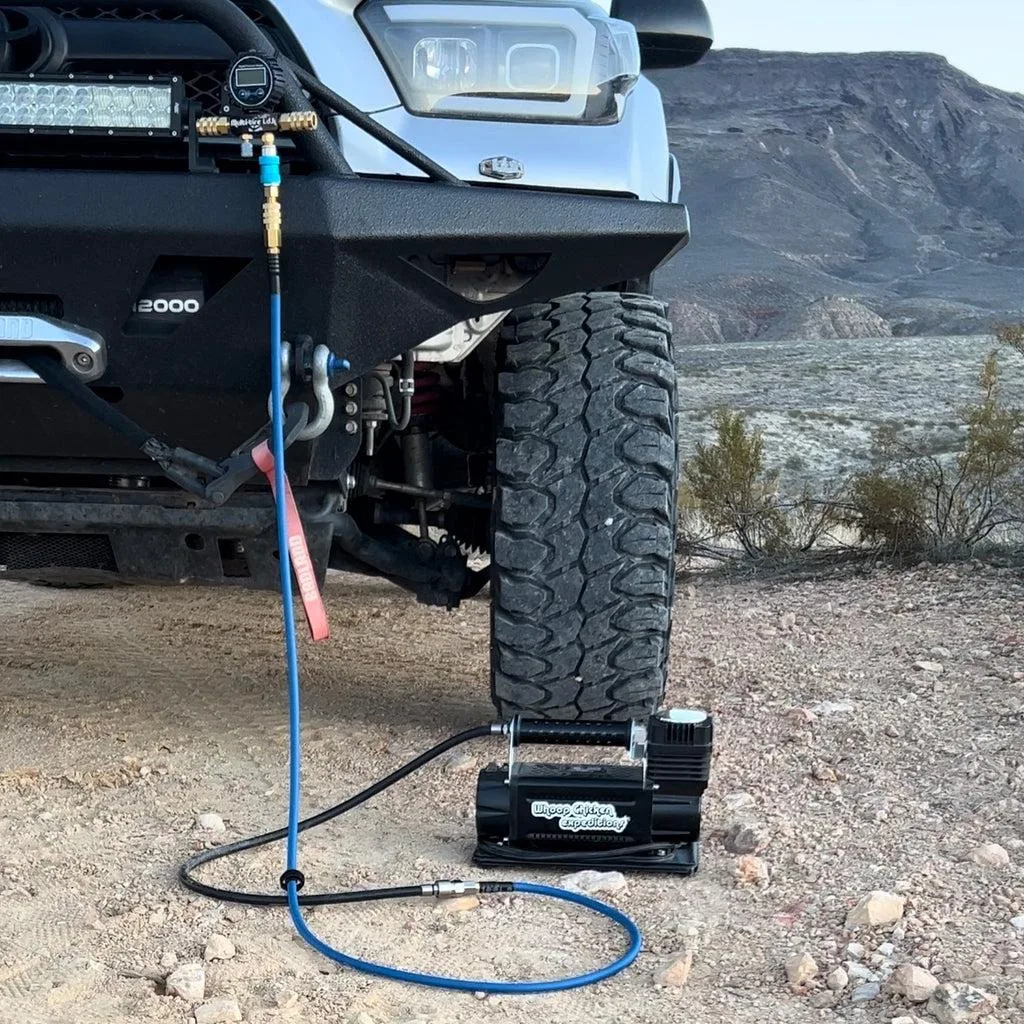
The answer depends on what you expect the tool to accomplish.
If you only need to release air before occasional off-road trips, a deflator is the simpler and more economical purchase. If you regularly travel away from reliable air sources, a compressor provides much greater practical value.
For dedicated overlanding, however, choosing only one means accepting a significant limitation.
The Best Single Tool for Most Overlanders
If you absolutely have to choose one, an air compressor is generally the more versatile tool for most overlanders.
The reason is simple: there are alternative ways to release air, including manually using a valve tool or basic deflation device. There are far fewer practical ways to restore tire pressure in a remote location without compressed air.
A compressor can also assist with slow leaks and post-repair reinflation, giving it an important emergency function.
That doesn’t mean every driver needs an expensive high-output compressor. Choose a model appropriate for your tire size, vehicle electrical system, expected duty cycle, and travel style.
Single-tool winner: Air compressor
The Best Tool for Frequent Airing Down
If your primary concern is speed and convenience when lowering tire pressure, the tire deflator is the clear winner.
This is especially true for drivers who air down frequently for sand, rocks, mud, or rough trails. A preset or automatic deflator can make repeated pressure adjustments much easier.
The benefit becomes even greater when several vehicles travel together and everyone needs to air down at the same trailhead.
Frequent airing-down winner: Tire deflator
The Best Complete Setup
For serious overlanding, the best setup is:
Quality tire deflator + capable 12V compressor + accurate pressure gauge + tire-repair kit.
This combination covers both directions of tire-pressure management.
The deflator handles the air-out process quickly and consistently.
The compressor handles the air-in process and provides an important backup when dealing with leaks or repaired punctures.
The gauge gives you an independent way to verify pressure.
The repair kit addresses the cause of a puncture instead of simply replacing lost air.
Together, these components create a compact but highly useful tire-management system.
Final Recommendation
When comparing tire deflators vs air compressor, the best answer isn’t that one tool replaces the other.
A tire deflator is better at making controlled airing down fast, simple, and consistent. An air compressor is more versatile because it can restore pressure, support puncture-repair situations, and provide independence from external air sources.
For a daily driver that only occasionally visits easy trails, start with a quality deflator and reliable pressure gauge.
For frequent or remote overlanding, prioritize a capable compressor.
For serious long-distance expeditions, carry both.
Most importantly, don’t copy a generic PSI number without considering your vehicle, tire, load, wheels, and terrain. Lower pressure can improve traction and flotation, but excessive pressure reduction increases the risk of bead unseating and tire or wheel damage. And once you’re finished with the off-road section, reinflating to the appropriate road pressure before sustained pavement driving should be part of the routine.
Read More: Softshell Tent vs Ground Tent: Which is More Comfortable?