Vehicle lifting is a routine part of vehicle ownership, but it becomes considerably more demanding when you’re overlanding far from paved roads, workshops, and roadside assistance. A flat tire on a highway usually means finding a level surface and using the vehicle’s supplied jack. On a remote trail, the same tire problem can involve soft sand, mud, rocks, uneven ground, a heavily loaded vehicle, and larger-than-stock tires.
This is why overlanding vehicle jacks should be selected according to the conditions in which the vehicle will actually be used—not simply because a particular jack fits in the cargo area.
Most vehicles come with a factory emergency jack designed primarily for basic roadside tire changes. It may be perfectly adequate for a stock vehicle under normal conditions, but its limited lifting height, small footprint, modest capacity, or awkward operation can become a disadvantage on difficult trails. A loaded overland vehicle may also sit differently from its unloaded configuration, while suspension modifications and larger tires can increase the amount of lift required to remove a wheel.
A jack can become useful in several situations during an expedition:
- Flat or damaged tires: A jack may be needed to lift the vehicle high enough to remove a deflated tire and install the spare.
- Stuck vehicles: Raising one end or one wheel can allow recovery boards or other traction equipment to be positioned underneath the tires.
- Suspension or under-vehicle work: A suitable lifting system can assist with trail repairs, although a vehicle must never be worked underneath while supported only by a jack.
- Tire changes: Larger off-road tires can be substantially heavier and may require more clearance than the original equipment.
- Recovery operations: Some purpose-built mechanical jacks can be combined with compatible lifting points and recovery accessories for specialized off-road applications.
Safety authorities consistently emphasize that a jack must have an adequate rated capacity, be used at the correct lifting points, and be placed on a sufficiently stable surface. A raised vehicle should not be treated as safely supported simply because a jack is holding it.
The right off-road vehicle jack therefore depends on several factors: the vehicle’s actual loaded weight, minimum and maximum lifting height, available jacking points, ground conditions, jack footprint, storage space, and the type of work or recovery situation you expect to encounter.
For an overlander, the goal isn’t necessarily to find the biggest or strongest jack. It’s to build a lifting system that works with the vehicle and the terrain you travel through. A compact bottle jack may be ideal for one truck, while a lifted 4×4 traveling through technical terrain may benefit from a Hi-Lift-style jack and suitable accessories. Someone regularly crossing deep sand or mud may have an entirely different requirement.
Why You Need the Right Jack for Overlanding
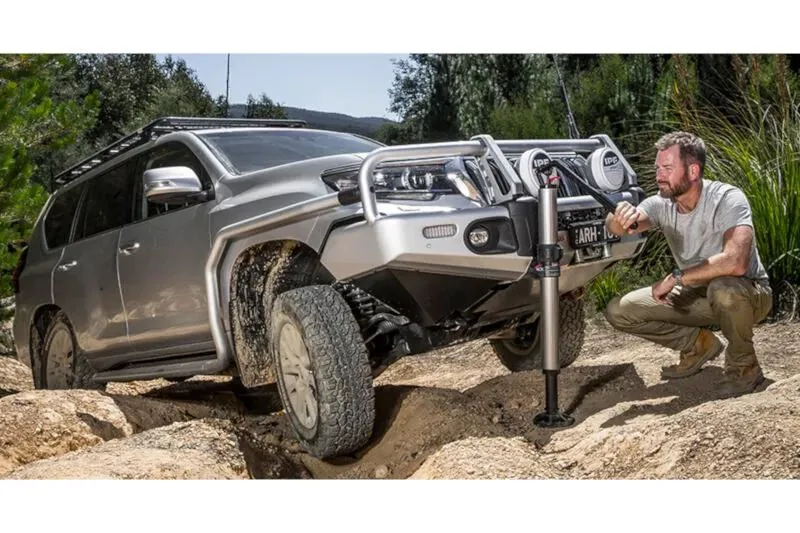
A conventional vehicle jack is designed around relatively predictable conditions. Overlanding removes many of those advantages. Instead of a hard, level driveway, you may need to lift a vehicle on gravel, sand, mud, rocks, or a sloping trail. The vehicle may also be carrying hundreds of kilograms of passengers, fuel, water, recovery equipment, camping gear, a roof rack, and a rooftop tent.
That combination can make an ordinary jack much less useful than expected.
Why Standard Vehicle Jacks Can Struggle Off-Road
Factory scissor and emergency jacks are generally compact because they are intended to be stored in the vehicle and used for emergency tire changes. Their small footprint is useful for storage but can be a disadvantage on soft or uneven ground.
A jack that works well on pavement may sink into sand or loose soil. On uneven terrain, its lifting range may also be insufficient to compensate for suspension articulation or a wheel that has dropped into a rut.
Ground movement is another concern. When a jack is loaded, it needs a stable relationship between its base, lifting point, and vehicle. If the base sinks or the jack becomes unstable, the lifting operation can become dangerous. Safety guidance recommends using a firm, level foundation and appropriate blocking or cribbing when necessary.
The Challenges of Mud, Sand, Gravel, Rocks and Uneven Trails
Mud: Soft mud can allow a narrow jack base to sink rapidly. A wide, purpose-built jack base or suitable load-spreading material can help prevent this, provided it creates a genuinely stable foundation.
Sand: Sand presents a similar problem but can be even more difficult because the surface continuously shifts under concentrated loads. A conventional bottle or scissor jack can dig into the surface rather than raising the vehicle effectively.
Gravel: Loose gravel can move under the jack’s base, reducing stability. Clearing loose material and finding the firmest available surface is important.
Rocks: Rocks can create an uneven contact surface and may prevent a jack from sitting squarely. Positioning the vehicle as safely and levelly as the terrain permits is preferable to trying to compensate for a poor foundation with an unstable setup.
Uneven trails: A vehicle parked across a slope or with one side substantially higher than the other presents additional stability challenges. When possible, reposition the vehicle to a safer, flatter location before lifting.
This is one reason a dedicated overland recovery jack should be considered as part of a larger recovery system rather than simply a tool for changing tires.
How Larger Tires and Suspension Lifts Affect Jack Requirements
Modified vehicles can require considerably different lifting equipment from stock vehicles.
A suspension lift can increase the distance between the ground and the vehicle’s frame or designated lifting points. Larger tires can also require more vertical clearance before the wheel is free from the ground.
At the same time, increased suspension travel means that simply lifting the chassis does not always produce immediate tire clearance. The suspension can extend as the vehicle rises, requiring additional jack travel.
This makes both minimum and maximum jack height important. A jack with an excellent maximum height may still be unsuitable if its minimum height is too tall to fit beneath the vehicle or its lifting point.
Why a Loaded Overlanding Vehicle Changes Your Lifting Needs
The vehicle you drive to work every day may not be the vehicle you take into the backcountry.
An overlanding setup can add significant weight through:
- Passengers
- Fuel
- Water
- Recovery boards
- Winch and recovery equipment
- Roof rack
- Rooftop tent
- Camping equipment
- Cooking equipment
- Tools and spare parts
- Auxiliary batteries
- Larger spare tire
That additional weight affects how much capacity the lifting equipment needs and can change the vehicle’s ride height and suspension behavior.
For this reason, don’t select a jack solely from the vehicle’s empty or curb weight. Determine the approximate loaded travel weight and choose equipment with an appropriate rated capacity. A jack’s manufacturer’s rated capacity should never be exceeded.
Emergency Tire Changes vs. Trail Recovery
These are related but different jobs.
For a straightforward tire change on relatively firm ground, a compact bottle, scissor, or factory jack may be sufficient if its capacity and lifting range are appropriate.
Recovery situations are more demanding. If a vehicle is deeply stuck in sand or mud, the objective may be to raise a wheel or axle enough to place traction boards underneath, remove material from around a tire, or reposition the vehicle.
That is where specialized equipment—including certain high-lift mechanical jacks, wide-base systems, or inflatable recovery jacks—can become valuable.
However, a jack should not automatically be treated as a recovery solution for every situation. Its suitability depends on the vehicle’s approved lifting points, terrain, jack design, and the manufacturer’s instructions.
When a Dedicated Overlanding Jack Is Worth Carrying
A dedicated 4×4 jack becomes increasingly worthwhile when your trips involve:
- Lifted suspension
- Oversized tires
- Heavy vehicle loads
- Remote travel far from assistance
- Frequent sand or mud driving
- Technical trails
- Rock crawling
- Long-distance expeditions
For occasional camping on maintained roads, carrying a large recovery jack may add unnecessary weight and storage requirements. For remote travel, however, the ability to safely lift the vehicle can become an important part of self-recovery and field repair.
The key is to match the jack to the vehicle rather than assuming one jack type is universally best.
Types of Overlanding Vehicle Jacks: Which One Is Right for Your Rig?
There is no single best jack for every overland vehicle. The major categories differ significantly in lifting height, capacity, portability, stability, and recovery capability.
Hi-Lift/Farm Jacks

A Hi-Lift jack is a tall mechanical jack designed around a climbing mechanism that moves the lifting mechanism along a vertical steel bar. The design provides substantial lifting range and makes the jack particularly attractive to owners of high-clearance 4x4s.
One of its major advantages is versatility. Depending on the specific application and compatible accessories, a Hi-Lift can be used with suitable bumpers, rock sliders, wheel-lifting adapters, and other recovery equipment. Hi-Lift also describes its products as multipurpose tools capable of lifting, winching, spreading, and clamping.
However, its versatility does not make it universally safe or appropriate. A Hi-Lift requires a compatible lifting point and a stable setup. Because the jack is tall and can introduce significant leverage, instability is a serious consideration.
Hi-Lift’s own safety guidance emphasizes correct operation, inspection, lubrication, and careful control of the handle during lifting and lowering.
Best suited for: Lifted 4x4s, technical trails, and recovery applications where compatible lifting points are available.
Main limitation: It requires appropriate attachment points and careful operation; it isn’t simply a universal jack for placing underneath any part of a vehicle.
Hydraulic Bottle Jacks

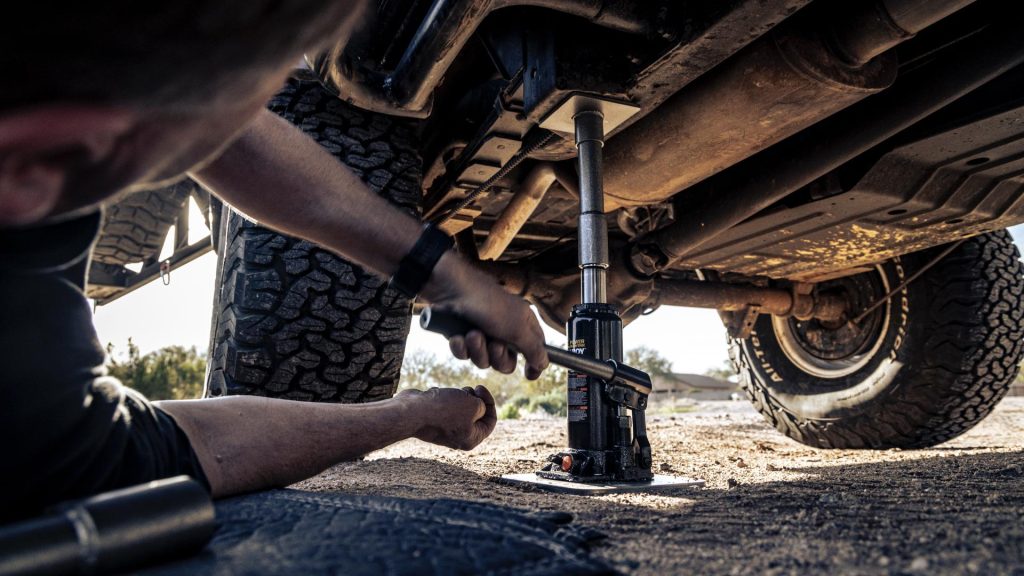
Bottle jacks use a compact hydraulic mechanism to generate substantial lifting force. Their vertical design gives them a high lifting capacity relative to their physical size, making them popular for trucks and SUVs.
For overlanding, a bottle jack can be an excellent choice when the vehicle has an appropriate axle, frame, or other manufacturer-approved lifting point. It can provide the capacity needed for heavier rigs while taking considerably less storage space than a large floor jack.
The primary limitation is ground clearance and stability. A bottle jack needs to fit beneath the selected lifting point at its lowest height, and its relatively small base can be unsuitable for soft terrain unless used with an appropriate stable base.
Best suited for: Heavy SUVs, pickups, and trucks where compact storage and high lifting capacity are priorities.
Main limitation: Limited suitability on soft or highly uneven terrain without additional base support.
Hydraulic Floor Jacks
Hydraulic floor jacks are excellent workshop tools because their long chassis and wheels allow the jack to move as the vehicle is raised. They can be particularly convenient for tire changes and mechanical work on hard, level ground.
For overlanding, however, their size and weight are major disadvantages. A full-size floor jack takes considerable cargo space and is generally impractical for remote trails where there is no firm, level surface.
They make more sense for an overlander who performs repairs at camp, maintains vehicles at a base location, or carries a dedicated support vehicle than for someone trying to minimize expedition weight.
Best suited for: Camp, garage, workshop, or firm-ground maintenance.
Main limitation: Heavy, bulky, and poorly suited to soft or uneven trail conditions.
Scissor and Factory Jacks
Scissor jacks and other OEM emergency jacks are compact, inexpensive to store, and often included with the vehicle.
For a stock vehicle traveling mainly on paved roads or maintained routes, the factory jack may be perfectly adequate for an emergency tire change. But its limitations become more obvious when the vehicle is heavily loaded, lifted, fitted with larger tires, or operated on difficult terrain.
The small base can also be problematic on soft ground, while the lifting range may not be sufficient for a modified suspension setup.
A factory jack should therefore be viewed according to its intended purpose. It may be a useful emergency tool, but that doesn’t automatically make it a complete off-road recovery system.
Air/Inflatable Bag Jacks
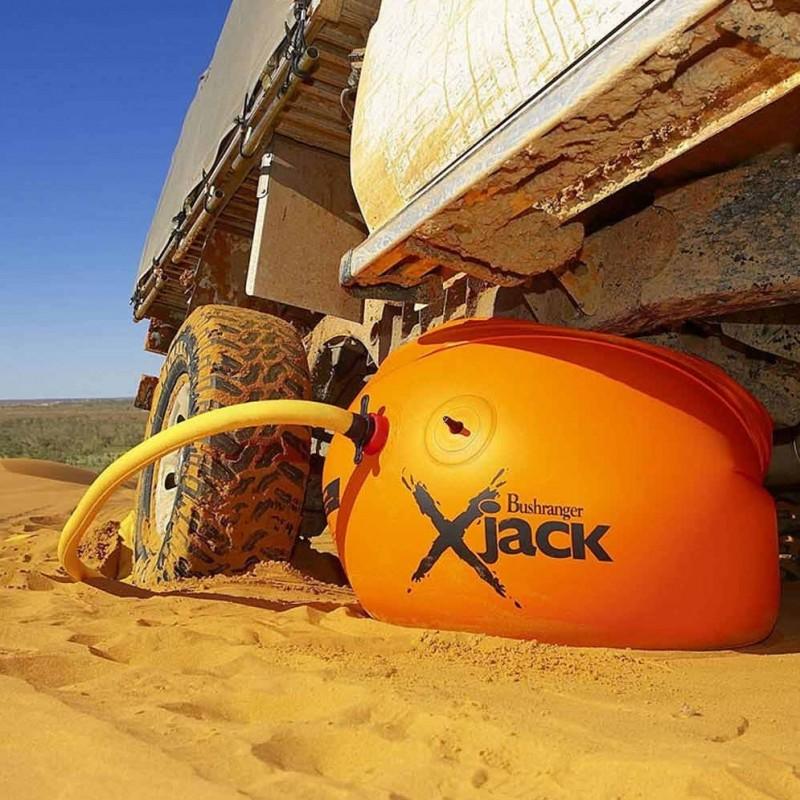
Inflatable or exhaust-style jacks use a large air bag that expands beneath the vehicle to provide lifting force. Unlike a narrow mechanical or hydraulic jack, the inflated bag spreads its load over a much larger area.
That makes this type of jack particularly interesting for sand, mud, and other soft terrain, where a conventional jack can sink.
However, inflatable jacks have their own limitations. They require careful positioning, must be protected from sharp rocks and hot components, and should only be used according to the manufacturer’s instructions. They are also specialized recovery equipment rather than a universal replacement for a conventional jack.
Best suited for: Soft sand, mud, snow, and recovery situations where conventional jack bases are likely to sink.
Main limitation: Requires careful positioning and inspection, and may not be the best choice for every lifting or repair task.
Exhaust Jacks vs. Mechanical and Hydraulic Jacks
Each jack type has a different strength:
| Jack type | Main strength | Best terrain/use |
|---|---|---|
| Hi-Lift/Farm jack | High lift and recovery versatility | Technical trails, lifted 4x4s |
| Bottle jack | High capacity in a compact package | Firm ground, trucks and SUVs |
| Floor jack | Easy workshop lifting | Garage, camp, hard surfaces |
| Scissor/OEM jack | Compact emergency use | Stock vehicles, tire changes |
| Inflatable/exhaust jack | Broad load distribution | Sand, mud, soft terrain |
The best choice depends on how and where you travel. A remote expedition vehicle may even benefit from combining two complementary systems—for example, a compact high-capacity bottle jack for routine tire changes and separate recovery equipment for soft terrain.
Whatever type you choose, the fundamental requirements remain the same: stay within the jack’s rated capacity, use the correct vehicle lifting points, create the most stable foundation possible, and never rely on a jack alone to support a vehicle while someone works underneath it.
How to Choose the Best Overlanding Vehicle Jack

Choosing an overlanding vehicle jack is not simply a matter of buying the jack with the highest weight rating. The correct setup needs to match your vehicle, its loaded travel weight, suspension configuration, lifting points, terrain, and the type of repairs or recovery work you expect to perform.
A jack that works perfectly for a stock SUV on firm ground may be a poor choice for a heavily loaded, lifted 4×4 traveling through sand or technical rock trails. Before buying, evaluate the following factors.
Check Your Vehicle’s Loaded Weight
Start with the vehicle’s actual travel weight, not just the curb weight listed by the manufacturer.
Curb weight generally represents the vehicle in a relatively standard configuration, while an overland vehicle can carry substantially more equipment. Your loaded weight may include:
- Passengers
- Fuel
- Drinking and utility water
- Recovery boards
- Winch and recovery gear
- Roof rack
- Rooftop tent
- Camping equipment
- Cooking equipment
- Tools and spare parts
- Auxiliary batteries
- Fridge or freezer
- Larger spare tire
- Additional skid plates and accessories
The important point is that the jack must have a rated capacity appropriate for the load you intend to lift. OSHA guidance states that a jack’s marked rated capacity must not be exceeded.
You also should not assume that a jack rated for the vehicle’s total weight will necessarily be suitable for every lifting operation. In many trail situations, you’re lifting one end, axle, or wheel rather than the entire vehicle. However, the load distribution varies depending on the selected lifting point and vehicle configuration, so the jack manufacturer and vehicle manufacturer instructions should take priority.
For example, a 4×4 with a nominal curb weight of 2,300 kg may weigh considerably more once it is equipped for a multi-day expedition. Selecting a jack based only on the 2,300-kg figure can leave insufficient capacity for the vehicle’s actual configuration.
Consider Minimum and Maximum Lift Height
A jack needs to fit under the vehicle before lifting and reach high enough to accomplish the intended job.
Minimum height is particularly important for vehicles with a low frame, axle, or designated jacking point. A bottle jack with a relatively tall closed height may not fit beneath a vehicle when a tire is completely flat.
Maximum height becomes more important with:
- Lifted suspension
- Larger tires
- Long-travel suspension
- Deep ruts
- Wheel changes on articulated terrain
- High-clearance 4x4s
A lifted vehicle may have a substantial distance between the ground and its approved lifting point. A jack with insufficient extension may raise the chassis without providing enough wheel clearance to remove the tire.
Suspension behavior also matters. As the vehicle is lifted from a frame or body lifting point, the suspension can extend before the tire leaves the ground. This means the required jack travel may be greater than the simple ground-to-frame measurement suggests.
Before purchasing, measure the vehicle at its actual loaded ride height and consider the lowest and highest positions where the jack will be used.
Check Your Vehicle’s Jacking Points
The correct lifting point is one of the most important parts of a safe setup.
Vehicles can have designated:
- Factory jack points
- Frame lifting points
- Axle lifting points
- Differential or axle-housing lifting locations where specifically approved
- Reinforced chassis points
- Manufacturer-approved accessory lifting points
Do not assume that a strong-looking component is automatically a safe jacking point.
Modern vehicles can have different lifting locations depending on model, drivetrain, suspension configuration, and model year. The Automotive Lift Institute notes that OEM lifting points can vary by vehicle and model year and recommends using vehicle-specific lifting-point information rather than guessing.
This is particularly important with aftermarket equipment.
A steel bumper, rock slider, receiver-mounted accessory, or recovery point may appear strong enough to support a vehicle but may not have been designed or rated for lifting. Use these components only when the manufacturer specifically states that they are suitable for the intended lifting operation.
Your owner’s manual should be the first reference for factory lifting points.
Consider Ground Conditions
Terrain can determine whether a jack works effectively at all.
Hard pavement: Almost any correctly sized vehicle jack can be easier to use because the surface is firm and relatively stable.
Dirt: Firm dirt can work, but loose soil may shift under the jack.
Gravel: Loose stones can move beneath a narrow jack base, so choose the firmest available location and use an appropriate base when necessary.
Sand: Sand can allow a jack to sink rapidly. A broad, purpose-built base or load-spreading solution is particularly useful.
Mud: Mud can be unstable and may allow both the jack and vehicle to move. A recovery-oriented lifting system may be more appropriate than a small factory jack.
Rocks: Uneven rocks can prevent the jack from sitting properly. Look for the most stable surface available rather than balancing a jack on loose or irregular stones.
Snow: Snow can compress and shift under load. A wide base and a firm supporting layer are important.
OSHA specifically recognizes situations where a firm foundation is necessary and states that the jack base should be blocked or cribbed when required.
A jack’s lifting capacity therefore isn’t the only specification that matters. Ground compatibility is equally important.
Consider Weight, Size and Storage
Overlanding equipment competes for limited storage space, so a jack that is technically capable may still be impractical if it consumes too much room.
Common storage locations include:
- Interior cargo area
- Rear cargo compartment
- Rear swing-out carrier
- Roof rack
- Dedicated external jack mount
- Underbody storage where the vehicle design permits it
Roof storage keeps heavy equipment out of the cabin but adds weight higher on the vehicle. External storage provides quick access but exposes the jack to rain, mud, dust, salt, and trail debris.
Interior storage protects the equipment better but can make emergency access more difficult when the vehicle is fully packed.
Consider not only the jack’s weight but also its shape. A long Hi-Lift may be difficult to store inside a compact SUV, while a bottle jack can fit into a much smaller storage compartment.
Whatever location you choose, the jack should be firmly secured so it cannot become a projectile during sudden braking or a rollover.
Look at Build Quality and Serviceability
A jack carried into remote terrain is safety-critical equipment. Build quality, maintenance requirements, replacement parts, and manufacturer support therefore deserve attention.
For hydraulic jacks, inspect:
- Hydraulic seals
- Pump mechanism
- Ram
- Release valve
- Welds and structural components
- Base
- Saddle
For mechanical jacks, inspect:
- Load-bearing components
- Pins
- Mechanical runners
- Springs
- Handle
- Base
- Locking or reversing mechanisms
Corrosion is another consideration for equipment exposed to rain, mud, salt, and moisture.
Regular inspection and lubrication are important. OSHA recommends regular lubrication and inspection according to service conditions, while Hi-Lift provides service information and replacement-part support for its jacks.
Avoid choosing a critical recovery tool solely because it is the cheapest option. A low purchase price can become less attractive if replacement parts are unavailable, the mechanism cannot be serviced, or the jack deteriorates quickly in harsh environments.
For remote expeditions, serviceability can be more valuable than a long list of features.
Essential Jack Accessories for Overlanding
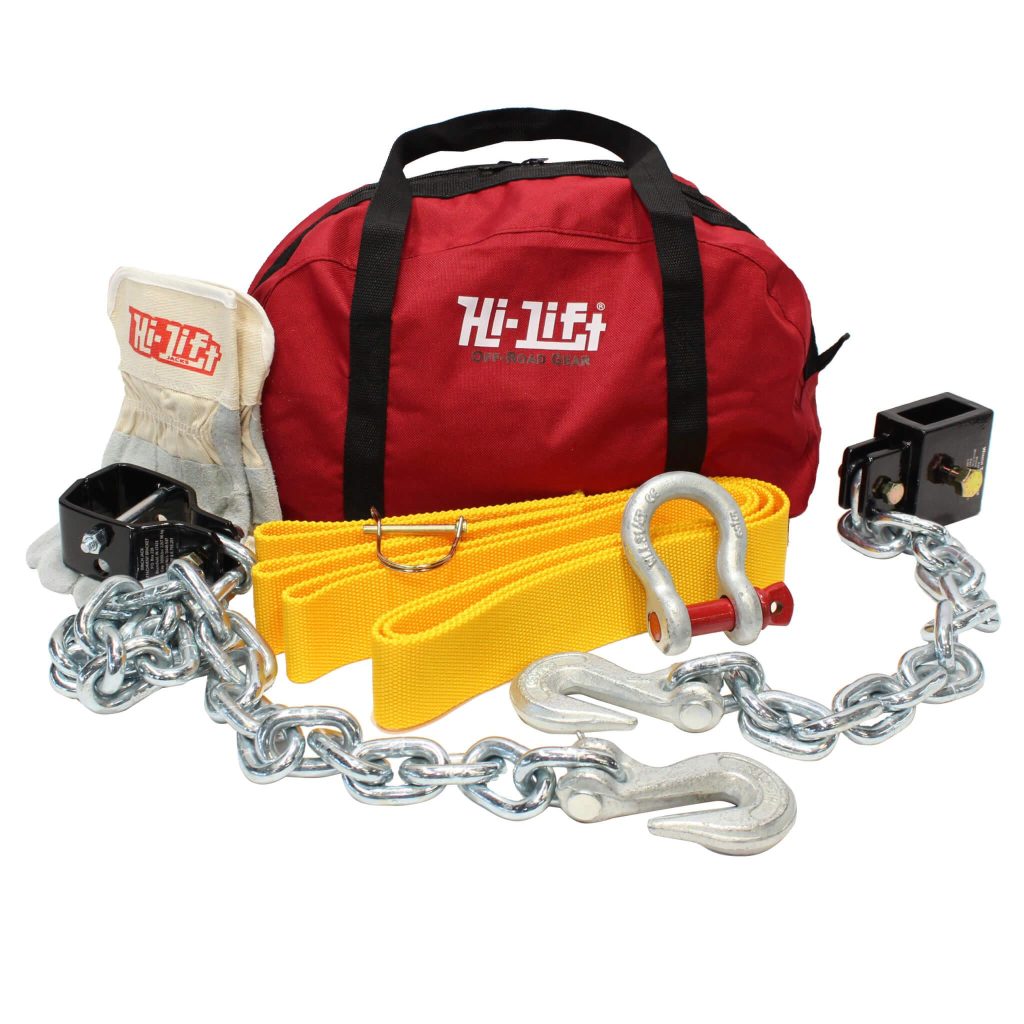
A jack is only one part of a complete vehicle-lifting system. The right accessories can make a major difference when the vehicle is sitting on soft terrain, has limited lifting points, or requires additional support.
Jack Base Plates
A jack base plate increases the contact area between the jack and the ground.
This is particularly useful on:
- Sand
- Mud
- Soft dirt
- Snow
- Loose gravel
The objective is to distribute the jack’s load over a larger area so that the base is less likely to sink or become unstable.
A base plate must be compatible with the specific jack. It should not create an unstable connection or interfere with the jack’s normal operation.
On very soft ground, simply increasing the base size does not eliminate all risks. The supporting surface still needs to be as stable as reasonably possible.
Lift-Mate and Wheel-Lifting Adapters
Wheel-lifting adapters allow certain jacks to raise a vehicle by engaging an appropriate wheel or wheel-related location.
The Hi-Lift Lift-Mate, for example, is designed as an accessory for compatible Hi-Lift applications, while the company also provides instructions for using its Lift-Mate and Off-Road Base.
Wheel-lifting equipment can be useful when the vehicle’s chassis does not provide a convenient high-lift point.
However, compatibility matters. The wheel, tire, suspension, and adapter must all be suitable for the application. Never assume that an accessory is safe simply because it physically fits.
Jacking/Recovery Points
Dedicated lifting points can make a major difference on modified 4x4s.
Possible solutions include:
- Off-road bumper lifting points
- Purpose-designed rock slider lift points
- Receiver-mounted jack points
- Manufacturer-approved recovery/lifting interfaces
The critical distinction is between a recovery point and a lifting point.
A component designed to accept a winch load or recovery strap is not automatically designed to carry the concentrated load created by a jack. Use only attachment points specifically intended for lifting.
Jack Stands
A jack raises the vehicle; a properly rated support stand is designed to support it after it has been raised.
This distinction is fundamental.
If you need to work underneath a vehicle, transfer the vehicle’s weight onto appropriately rated support equipment. OSHA requires raised loads to be cribbed, blocked, or otherwise secured, and safety guidance consistently warns against relying on a jack alone.
For remote travel, conventional jack stands may be difficult to use on uneven terrain. They should only be placed on a firm, stable foundation and at approved support points.
Never substitute unstable objects such as loose rocks or improvised stacks for properly rated support equipment.
Wheel Chocks
Wheel chocks help prevent the vehicle from rolling while another part of it is being lifted.
Use them on wheels that remain on the ground, positioned according to the vehicle and lifting operation.
For example, when lifting one front wheel, chocking the appropriate opposite wheel can help reduce vehicle movement. NHTSA-published vehicle instructions specifically recommend parking in Park, applying the parking brake, and blocking the wheel diagonally opposite the tire being changed.
A parking brake should not be treated as the only measure preventing movement.
Gloves, Storage Mounts and Protective Covers
A pair of durable work gloves is useful when handling dirty or corroded lifting equipment.
Storage mounts should:
- Secure the jack firmly
- Prevent rattling
- Allow quick access
- Protect other equipment from sharp edges
- Resist vibration
A protective cover can reduce exposure to rain, dust, mud, and road salt, particularly when the jack is mounted outside the vehicle.
External storage also requires periodic inspection because corrosion and trail debris can affect the mechanism.
Recovery Boards and Cribbing Materials
Recovery boards can provide traction, but in certain situations suitable load-spreading or cribbing materials may also help create a more stable foundation for lifting equipment.
The principle is simple: spread the load and improve stability rather than allowing the jack to sink into soft terrain.
However, improvised stacks can be dangerous. Loose rocks, unstable timber piles, or damaged materials can shift unexpectedly.
Only use materials that are appropriate for the load and application, and follow the jack manufacturer’s instructions.
How to Safely Use a Jack on the Trail
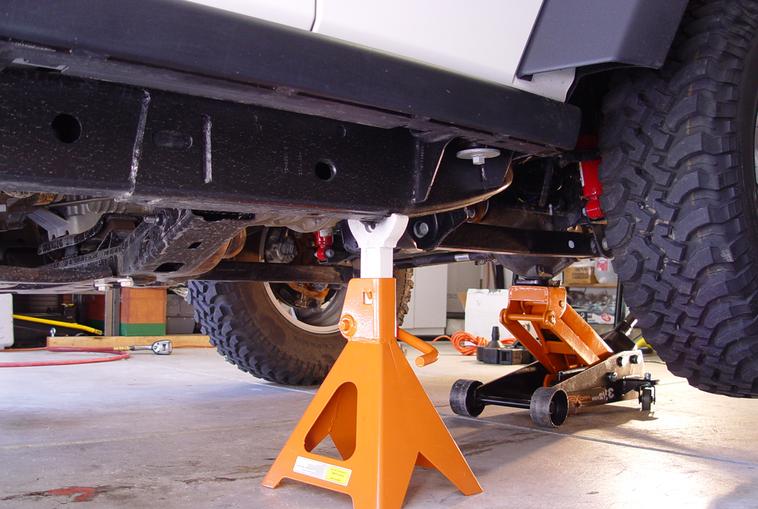
Safe jack operation begins before the handle is moved. A remote trail can make a lifting accident considerably more serious because professional assistance may be far away.
Inspect the Jack Before Use
Inspect the jack before putting it under load.
Look for:
- Cracks
- Bent components
- Damaged welds
- Corrosion
- Hydraulic leaks
- Damaged pins
- Worn mechanisms
- Loose hardware
- Damaged base plates
- Malfunctioning handles or release mechanisms
Operate the jack without a load when appropriate to confirm that the mechanism functions normally.
Mechanical components should be lubricated according to the manufacturer’s instructions. OSHA also recommends regular jack inspection and lubrication, with inspection frequency depending on service conditions.
If a jack has been damaged, overloaded, dropped, or subjected to an abnormal shock load, don’t simply put it back into service without inspection.
Prepare the Vehicle
Before lifting:
- Stop on the most level and stable surface available.
- Move away from traffic and other hazards.
- Apply the parking brake.
- Put the transmission in Park or the appropriate gear.
- Switch off the engine when appropriate.
- Chock the wheels that remain on the ground.
- Remove unnecessary people from the immediate area.
- Locate the correct lifting point.
- Gather the spare tire and required tools before raising the vehicle.
NHTSA-published vehicle guidance recommends Park, the parking brake, wheel blocking, and shutting the engine off during tire-changing procedures.
If the vehicle is in a location where it could slide, roll, or be struck by another vehicle, moving to a safer location should take priority whenever possible.
Create a Stable Base
Clear loose rocks, mud, branches, and other debris from beneath the jack.
If the ground is soft, use an appropriate jack base or load-spreading solution.
The jack should remain as vertical and stable as the application permits. Do not use a stack of unstable objects simply to make up for inadequate jack height.
If you cannot establish a stable foundation, reassess the situation before lifting.
Use the Correct Jacking Point
Always consult the vehicle owner’s manual for approved lifting points.
Do not lift from:
- Thin body panels
- Random suspension components
- Plastic trim
- Exhaust components
- Fuel tanks
- Differential housings unless specifically approved
- Bumpers or sliders not designed for lifting
Vehicle-specific lifting information matters because lifting points can vary between models and model years. The Automotive Lift Institute’s current guide emphasizes using OEM-recommended points rather than guessing.
Lift Slowly and Monitor the Vehicle
Raise the vehicle gradually.
Watch the:
- Jack
- Vehicle body
- Tires
- Ground beneath the jack
- Lifting contact point
- Chocks
Stop immediately if the jack begins to tilt, the base sinks, the vehicle shifts unexpectedly, or the lifting point begins to deform.
Do not stand in a position where you could be struck by the vehicle or jack if the setup fails.
Hi-Lift specifically warns users about unexpected handle movement and recommends keeping the handle secured upright when the user’s hands are not on it.
Never Work Under a Vehicle Supported Only by a Jack
This is one of the most important rules in vehicle lifting.
A jack is a lifting device, not a substitute for a properly rated support system.
Never place your body underneath a vehicle that is supported only by a jack. NHTSA-published vehicle instructions explicitly warn against getting underneath a vehicle supported only by a jack, while workplace safety guidance recommends transferring the load to appropriate support stands.
If under-vehicle work is necessary, use properly rated stands or other manufacturer-approved support equipment on an appropriate foundation.
Lower the Vehicle Carefully
Before lowering:
- Remove tools from underneath the vehicle.
- Ensure nobody is in the danger zone.
- Confirm the wheel and landing area are clear.
- Keep control of the jack.
- Lower the vehicle gradually.
- Confirm the vehicle is fully stable before removing the jack.
Do not rush the final stage. A controlled lowering procedure is just as important as a controlled lift.
Best Jack Setup for Different Overlanding Vehicles and Situations

Different vehicles and environments call for different lifting systems.
Stock SUV or Crossover
For a mostly stock SUV or crossover, the factory jack may be adequate for emergency tire changes if it has sufficient capacity and lifting range.
A compact bottle jack can provide a useful alternative when the vehicle has a suitable lifting point and the jack’s minimum height fits.
For frequent remote travel, consider adding a suitable base plate and dedicated recovery equipment rather than relying entirely on the OEM emergency jack.
Lifted Jeep or 4×4
A lifted 4×4 is one of the strongest candidates for a Hi-Lift-style setup.
The additional ride height can make a high-lift jack useful, but only if the vehicle has suitable lifting points.
A practical setup may include:
- Hi-Lift-style jack
- Compatible base
- Wheel-lifting adapter where appropriate
- Dedicated lifting points
- Wheel chocks
- Recovery boards
Always verify that the bumper, slider, or recovery accessory is specifically rated for lifting.
Full-Size Pickup Truck
A full-size pickup generally benefits from a higher-capacity jack with sufficient height.
A bottle jack can be attractive because it offers substantial capacity without the length of a Hi-Lift.
A Hi-Lift may be useful on a modified pickup when appropriate lifting points are available, particularly for certain recovery applications.
Heavy Overland Truck
Heavy expedition trucks require careful capacity planning.
A high-capacity hydraulic bottle jack may provide a compact solution, while larger support systems may be appropriate for vehicles substantially heavier than conventional pickups.
Weight and storage become significant considerations. Carrying multiple high-capacity lifting devices can add considerable expedition weight, so the equipment should be selected around the vehicle’s actual configuration.
Sand and Desert Overlanding
Sand creates one of the strongest arguments for a wide-base lifting system.
A useful setup may include:
- Wide jack base
- Inflatable recovery jack where appropriate
- Recovery boards
- Sand shovel
- Suitable wheel-lifting equipment
The objective is to prevent the lifting equipment from sinking and to create a stable working platform.
Mud and Swamp Trails
Mud requires particular attention to foundation stability.
A jack base, recovery boards, and other suitable load-spreading equipment can help, but deep mud may require recovery rather than simply lifting.
A jack should be viewed as one component of the recovery system—not a replacement for traction boards, winching equipment, recovery straps, or appropriate recovery techniques.
Rock Crawling and Technical Trails
Technical trails often favor equipment with substantial lifting range and compatible high-clearance attachment points.
A Hi-Lift can be useful where the vehicle is specifically equipped for it.
Wheel-lifting accessories may provide another option, but the attachment method must be compatible with the vehicle and tire/wheel configuration.
Long-Distance Remote Expeditions
Remote expeditions place a premium on reliability.
Consider:
- Mechanical simplicity
- Repairability
- Replacement parts
- Spare components
- Corrosion resistance
- Manual operation
- Compatibility with the vehicle
- Redundancy
A jack that can be inspected and serviced in the field may be more valuable than one with complicated features that are difficult to repair.
Overlanding Vehicle Jack Buying Checklist
Before purchasing an overlanding jack, verify the following:
- Vehicle’s loaded travel weight
- Jack’s rated lifting capacity
- Minimum lifting height
- Maximum lifting height
- Vehicle-approved lifting points
- Terrain where the jack will be used
- Jack footprint
- Jack weight
- Storage location
- Base plate compatibility
- Wheel-lifting/recovery accessories
- Replacement parts availability
- Manufacturer support
- Maintenance requirements
- Corrosion resistance
- Ease of operation
- Compatibility with suspension and tire modifications
The best overlanding vehicle jack is the one that can safely perform the jobs you actually expect to encounter while fitting your vehicle’s weight, height, lifting points, terrain, and storage limitations.
Frequently Asked Questions
What is the best jack for overlanding?
There is no single best jack for every overlanding vehicle. A compact bottle jack can be excellent for a heavy SUV or pickup when used on a suitable lifting point, while a Hi-Lift can be valuable for a lifted 4×4 equipped with compatible lifting points. Inflatable jacks can be useful in soft sand and mud.
The best choice depends on vehicle weight, clearance, lifting points, terrain, and intended use.
Is a Hi-Lift jack good for overlanding?
Yes, a Hi-Lift can be highly useful for some overland 4x4s, especially vehicles with suitable bumpers, sliders, or other approved lifting points. Hi-Lift also designs certain accessories to expand the jack’s recovery versatility.
However, it requires careful operation and is not automatically appropriate for every vehicle.
What size Hi-Lift jack do I need for an overland vehicle?
Choose a Hi-Lift length based primarily on the vehicle’s lifting-point height and the amount of usable travel required, rather than choosing solely according to vehicle weight.
The jack must be able to reach the approved lifting point and provide sufficient travel for the intended task. Verify the dimensions and application against your vehicle before buying.
Are bottle jacks better than Hi-Lift jacks for overlanding?
Neither is universally better.
A bottle jack is usually more compact and can provide high lifting capacity, making it attractive for trucks and SUVs.
A Hi-Lift provides greater lifting range and can support specialized recovery applications when compatible lifting points and accessories are available.
Can I use my factory jack for overlanding?
You can use it if it is appropriate for the vehicle, its loaded configuration, and the intended tire-changing situation.
However, the factory jack may have limited lifting range, capacity, or ground stability for a heavily modified overland vehicle. NHTSA-published guidance also states that an alternative jack must have adequate capacity for the vehicle’s weight, including cargo and modifications.
Do I need a jack base plate for sand and mud?
A wide jack base can be very useful on soft terrain because it increases the contact area and helps reduce sinking.
It does not eliminate the need for a stable foundation. The base itself must remain supported, and the jack must be compatible with the base.
How much weight should an overlanding jack support?
The jack must have a manufacturer-rated capacity appropriate for the load being lifted and must never be operated beyond its rating. OSHA explicitly requires the marked rated capacity of a jack not to be exceeded.
When calculating your requirements, consider the vehicle as it is actually equipped and loaded for travel rather than relying only on its empty or curb weight.
Can I use a Hi-Lift jack under any 4×4?
No.
A Hi-Lift requires a suitable lifting point and stable operating conditions. A random frame, bumper, suspension component, or body panel should not be assumed to be safe.
Use vehicle-approved lifting points and follow the jack manufacturer’s instructions.
Do I need jack stands when overlanding?
If you need to work underneath a raised vehicle, you need an appropriately rated support system rather than relying on the jack alone.
For simple trail tire changes, you generally should not place yourself underneath the vehicle. For repairs requiring underbody access, properly rated support equipment and a suitable foundation are essential.
Where should I mount my overlanding vehicle jack?
The best mounting location is secure, protected from unnecessary weather exposure, and accessible when the vehicle is packed.
Common options include a rear carrier, interior cargo area, or dedicated external mount. Roof mounting can save interior space but adds weight higher on the vehicle.
Whatever location you choose, secure the jack so it cannot move during rough travel.
Can a Hi-Lift jack be used as a recovery tool?
Some Hi-Lift models and accessories can perform additional functions such as winching, clamping, and spreading. Hi-Lift officially describes compatible attachments for these applications.
However, recovery use requires appropriate equipment, attachment points, rated capacities, and operating procedures. A Hi-Lift should not be treated as a universal substitute for a winch or other dedicated recovery equipment.
What jack should I carry for a lifted truck?
For a lifted truck, first determine the minimum and maximum lifting height required and identify the manufacturer’s approved lifting points.
A bottle jack can be an excellent compact option when its closed height and maximum height match the truck. A Hi-Lift can be useful when the truck has compatible high-lift points and the owner understands its safe operation.
For remote travel, adding a suitable base and other recovery accessories can make the overall lifting system considerably more capable than carrying a jack alone.
Read More: Fuel Management: Storage and Safety for Overlanding