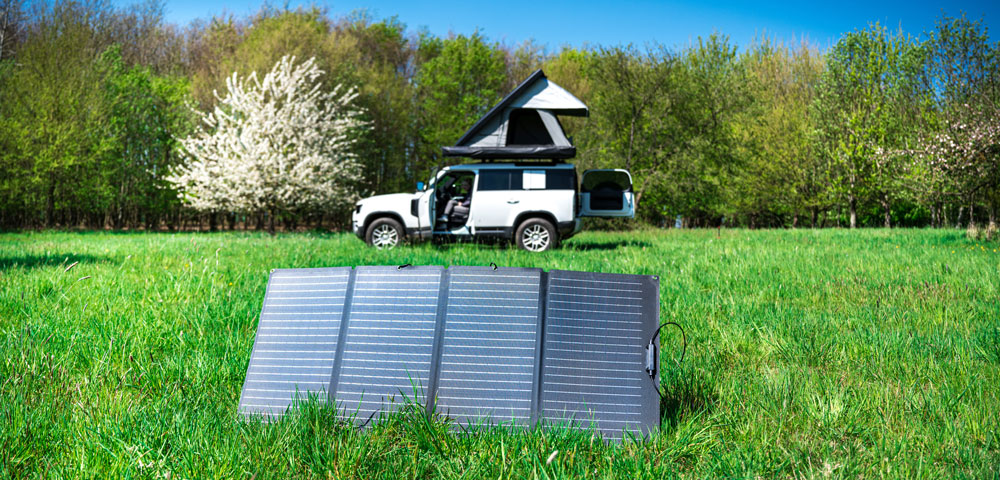
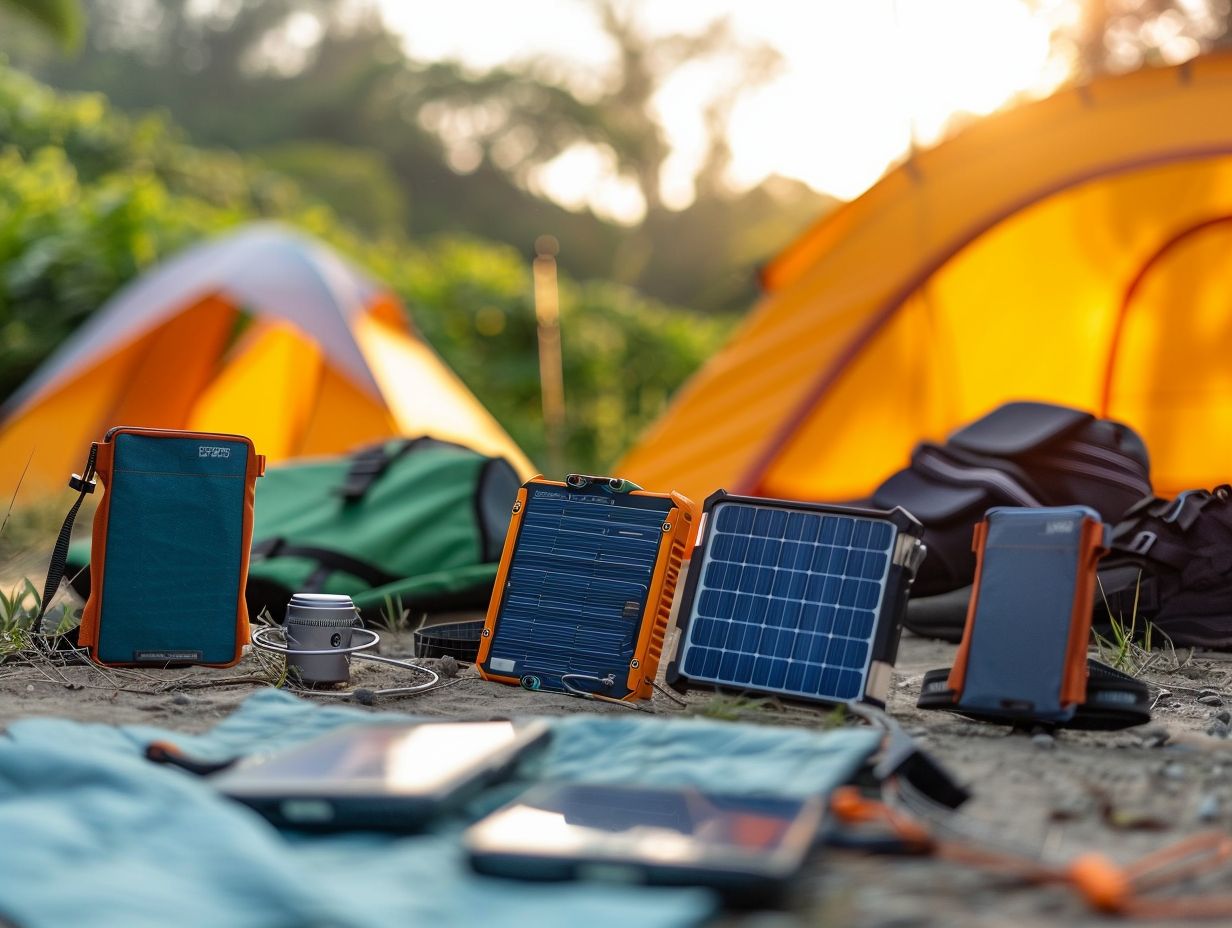
Best solar chargers for camping give you peace of mind on trips. A good solar charger keeps phones, lights, GPS units, and small devices running. It matters when you are far from power. Campers and RV travelers need gear they can trust.
Being off-grid brings real challenges. Clouds, shade, and nightfall cut solar output. Devices drain from maps, music, and emergency use. Without a backup, a dead battery can end a trip early. You also must manage limited space and weight in a pack or RV.
This article will review top picks for the best solar chargers for camping. I will show five products that fit different needs. You will find foldable panels and solar power banks. Each review will list specs, pros, and cons. I will compare their use for hiking, car camping, and long RV stays. By the end, you’ll know which model fits your trip. Read on to choose a charger that keeps you powered and safe.
What to Look For in a Solar Charger for Camping & RV Use
Battery capacity vs. Output wattage
Power banks store energy inside a battery. Solar panels send power straight to a device while the sun shines. If you want power at night, pick a power bank with big mAh. A 20,000 mAh bank gives many phone charges. Small banks (5,000–10,000 mAh) are lighter but refill less often.
Output wattage matters for direct-sun panels. A 30 W panel can deliver more current than a 10 W panel in good sun. Higher wattage helps charge laptops or refill big power banks faster. Even so, panels give peak watts only in perfect sun and angle. For steady use, combine a panel with a power bank. The panel tops up the bank during the day. The bank powers devices at night or in shade.
Port types and device compatibility
Check ports before you buy. USB-A is common and works with most older cables. USB-C is newer and can support faster charging. Look for USB-C Power Delivery (PD) if you need fast phone or laptop charging. Some chargers offer Quick Charge for compatible phones. Also check output current (amps) and voltage. A 5 V / 3 A port will charge faster than 5 V / 1 A. Make sure the charger matches the cables you plan to use.
Weather resistance and ruggedness
Camping gear faces rain, dust, and knocks. Pick chargers with an IP rating if you expect wet or dusty conditions. IP65 or IP67 means good water and dust resistance. Rugged power banks often have rubber edges and sealed ports. Panels can be thin and fragile, so look for reinforced corners or a tough fabric cover. If you bond panels to a pack or hang them on a tent, add a light screen to shield from wind and abrasion.
Portability and weight
Think about how you will travel. Hikers need low weight and small packed size. A 10 W panel or a small power bank fits a daypack. RV users can carry bulkier gear and a 30 W panel or a large power bank. Foldable panels fold flat and save space. Heavy power banks offer many charges but add weight. Match size and weight to your trip plan.
Real-world conditions: sun angle, shade, panel efficiency
Manufacturers list peak wattage under ideal sun. Real life gives lower output. Sun angle, clouds, and tree shade cut power. Panels should face the sun and tilt for best results. Monocrystalline cells usually give higher conversion efficiency than polycrystalline ones. That means more power in the same size. Yet no panel will work well in deep shade. Plan for slower charging on cloudy days.
Price and brand reliability
Price matters, but so does support. Big brands often offer better warranties and tested hardware. Cheaper models can still work well, but check reviews and return policies. Warranties protect you if a cell or battery fails. Also consider spare cables or adapters you might need. In the long run, a reliable product can save money by lasting longer and giving steadier power.
Quick Comparison Table for The Best Solar Chargers for Camping and RV Trips
| Product | Type | Output / Capacity | Weight | Key Strength | Best For |
|---|---|---|---|---|---|
| SOLUPUP 30W Foldable Panel | Panel | 30 W | ~2.5 lb | High wattage for charger/power-bank refill | Moderate-use campers |
| BLAVOR 10,000 mAh Solar Power Bank | Power Bank | 10,000 mAh | ~9.3 oz | Compact emergency backup, USB-C + wireless | Lightweight hikers |
| Durecopow 20,000 mAh Rugged Power Bank | Power Bank | 20,000 mAh | ~8.7 oz | Large capacity + rugged outdoor features | RV trips / multi-charge need |
| REDIGOO 10W Foldable Panel | Panel | 10 W | ~16 oz | Ultra-light direct charge | Ultralight campers with existing bank |
| Luvknit 30W Panel USB + Type-C | Panel | 30 W | — | Dual ports + IP67 weather resistance | Campers & RVs needing robust panel |
Top 5 Best Solar Chargers for Camping & RV Trips
Finding the best solar chargers for camping means choosing gear that fits your travel style. Some campers need a compact power bank, while others want foldable panels for steady energy. Below are the five top-rated solar chargers that work well for both camping and RV trips. Each product includes its features, specs, pros, and cons to help you decide.
#1 SOLUPUP 30W Foldable Portable Solar Charger
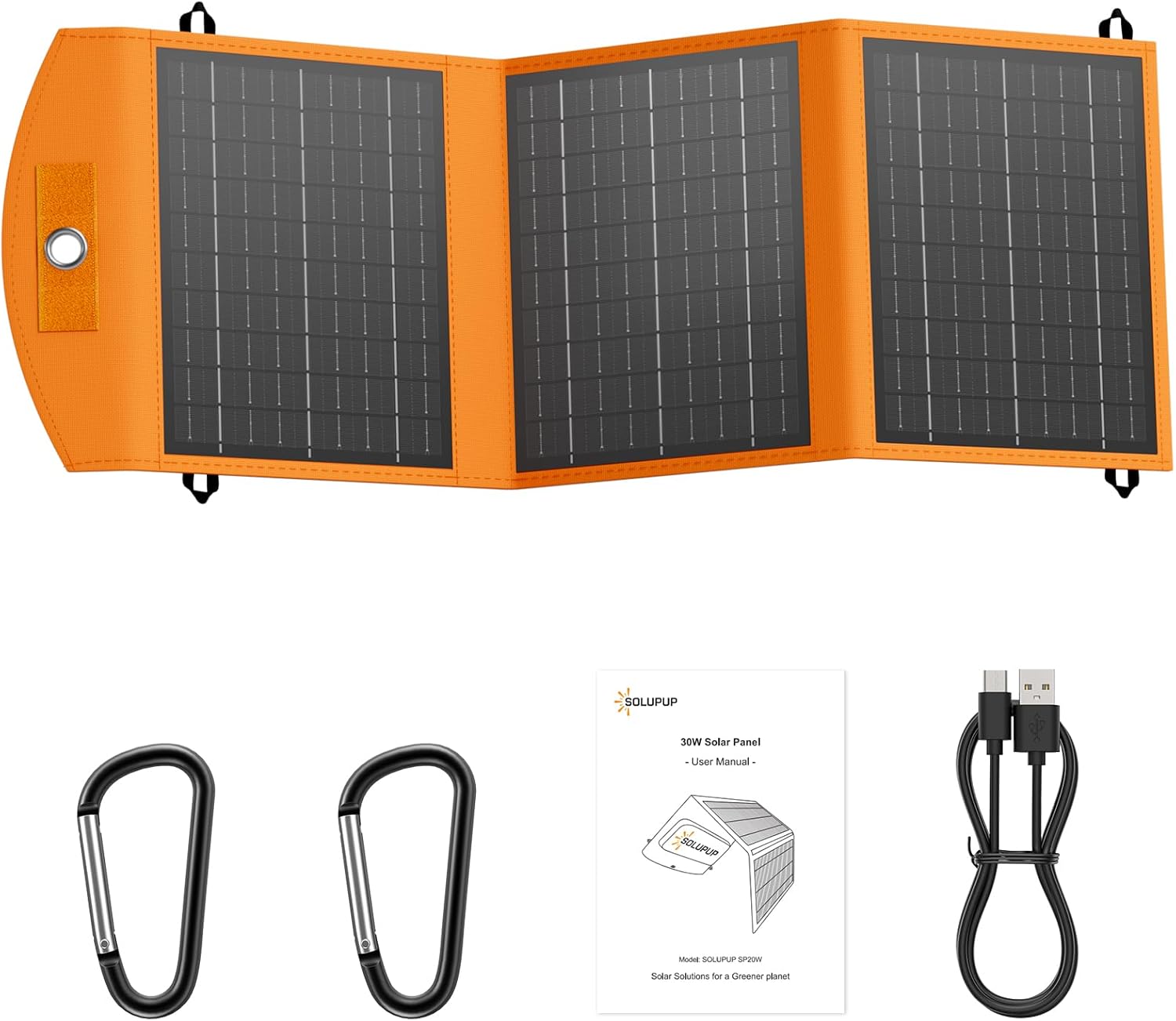
The SOLUPUP 30W Foldable Portable Solar Charger is designed for campers who want reliable energy without the bulk. This foldable panel unfolds easily and connects through USB-A or USB-C ports to charge phones, tablets, and power banks. Its waterproof and dust-resistant design makes it suitable for outdoor use. The built-in kickstands help position the panel toward the sun for better efficiency.
- Maximum Power: 30W
- Output Voltage: 5V DC
- Ports: USB-A and USB-C
- Dimensions (unfolded): 29.92 × 11.41 × 0.15 inches
- Weight: 2.51 lb
- Extras: Charging indicator, waterproof layer, carabiners, and carry bag
Pros
- High 30W output allows faster charging for larger devices
- Foldable design saves space and improves portability
- Strong build and weather resistance for outdoor use
Cons
- Limited to 5V output (not suitable for high-voltage devices)
- Works best only under full sunlight
#2 BLAVOR Solar Charger Power Bank (10,000 mAh)

The BLAVOR Solar Charger Power Bank is a compact option with a built-in solar panel and a 10,000 mAh battery. It can charge smartphones, wireless earbuds, or small lights. The solar panel mainly works as an emergency backup, while the internal battery provides steady power. Its flashlight and wireless charging feature make it a handy all-in-one tool for short camping trips.
Specifications
- Battery Capacity: 10,000 mAh
- Ports: USB-C and USB-A
- Charging Speed: Up to 20W (USB-C fast charging)
- Dimensions: 5.9 × 3.1 × 0.8 inches
- Weight: 9.3 oz
- Extras: LED flashlight, wireless charging pad, splash-proof design
Pros
- Lightweight and pocket-sized for easy carrying
- Supports both USB-C and wireless charging
- Works well as an emergency power source
Cons
- Solar charging is slow; best used for topping up only
- Smaller capacity limits multiple device charges
#3 Durecopow 20,000 mAh Solar Power Bank (Rugged)

The Durecopow 20,000 mAh Solar Power Bank is built for outdoor durability, combining high capacity with a tough design. It’s waterproof, dustproof, and shock-resistant, making it perfect for camping, hiking, and RV trips. Equipped with a compass and bright LED flashlight, it doubles as an emergency tool during off-grid adventures. The large-capacity battery offers several full phone recharges, and the sturdy casing withstands tough conditions with ease.
Specifications
- Battery Capacity: 20,000 mAh
- Ports: Dual USB outputs
- Dimensions: 5.5 × 2.9 × 0.7 inches
- Weight: 8.7 oz
- Extras: LED flashlight, compass, carabiner, rugged waterproof shell
Pros
- Large capacity provides multiple full device charges
- Built to handle rain, dust, and shocks
- Handy tools (compass and flashlight) for outdoor survival
Cons
- Solar panel recharges slowly; best to precharge before trips
- Slightly heavier than smaller power banks
#4 REDIGOO Portable 10W Foldable Solar Panel Charger

The REDIGOO 10W Foldable Solar Panel Charger is a lightweight, minimalist charging solution for hikers and campers. It uses high-efficiency monocrystalline cells to deliver steady energy directly to small devices like phones, GPS units, or cameras. Designed without a built-in battery, it’s best for real-time charging during daylight hours. Its compact foldable form and durable cover make it ideal for easy packing and outdoor reliability.
Specifications
- Maximum Power: 10W
- Ports: USB-A and USB-C
- Dimensions (folded): 8.28 × 6.46 × 0.98 inches
- Weight: 16 oz
- Extras: Smart charging tech, foldable kickstands, durable fabric cover
Pros
- Very compact and easy to carry on hikes
- Efficient monocrystalline solar cells
- Simple and reliable design
Cons
- No internal battery storage
- Low wattage—charges slower than larger panels
#5 Luvknit 30W Portable Solar Panel Charger (USB + Type-C)

The Luvknit 30W Portable Solar Panel Charger combines performance and protection for serious outdoor users. With USB-A and Type-C ports, it charges two devices at once, providing up to 5V/3A output in full sunlight. Its IP67 waterproof rating ensures dust and water resistance, ideal for camping, hiking, and RV trips. The foldable design, rugged case, and integrated kickstand make it a reliable solar companion for any adventure.
Specifications
- Maximum Power: 30W
- Ports: USB-A and Type-C
- Output: 5V / 3A max (combined)
- Water Resistance: IP67 rated
- Extras: Foldable kickstand, rugged fabric case, multiple device charging
Pros
- Dual output ports charge two devices simultaneously
- IP67 rating gives strong protection against rain and dust
- High 30W power for faster charging in sunlight
Cons
- Performance drops under cloudy conditions
- Slightly heavier than smaller panels
How to Use Solar Chargers Well on Camping & RV Trips
Positioning & Setup for Maximum Sun
Getting the most out of your solar charger starts with proper placement. Always position your solar panels at an angle facing the sun, ideally between 30° to 45°. This angle captures more sunlight and improves charging speed. Avoid placing panels under trees or shaded spots, as even partial shade can reduce power dramatically. In the morning, orient panels eastward to catch the early rays, then shift them south or west during the afternoon for consistent power. For RV users, using adjustable mounts or kickstands helps reposition panels throughout the day. If you’re camping in windy areas, secure your panels firmly using ground stakes or bungee cords to prevent damage.
Charging Strategy: Power Bank vs Direct Charging
While solar panels can charge devices directly, relying solely on them can be risky when sunlight fluctuates. The smarter approach is to charge a power bank during the day and then use that stored energy to recharge devices later. This ensures continuous access to power even after sunset or on cloudy days. Panels like the SOLUPUP 30W or Luvknit 30W pair perfectly with a mid-range 20,000 mAh power bank. Direct charging works best for low-demand gadgets like GPS trackers or LED lanterns when sunlight is strong. For high-drain devices such as phones, tablets, or cameras, always charge through a power bank first to prevent inconsistent charging.
Managing Devices: What to Charge, When
Energy management matters when you’re off-grid. Prioritize charging essential devices first—phones, GPS units, and emergency radios. Once those are topped up, move on to lighting gear, cameras, or speakers. Keep a charging schedule during daylight hours to avoid overloading your panel. Devices like BLAVOR or Durecopow power banks can charge multiple items simultaneously, but doing so can slow overall efficiency. Use USB splitters cautiously and check that each device is getting enough current. If you’re on a long RV stay, stagger your charging times—mornings for communication devices, afternoons for lighting equipment, and evenings for topping up smaller gadgets.
Maintenance & Care in the Wild
Proper care extends the life and performance of your solar charger. Dust, dirt, and water spots can block sunlight, reducing efficiency by up to 30%. Clean panels gently with a soft cloth or brush and avoid harsh detergents. Always let the charger cool before wiping if it has been under strong sun. Don’t leave it exposed to rain unless it’s rated IP65 or higher. During hot weather, keep power banks shaded to prevent overheating. When packing up, fold or roll the panels neatly, and store them in a dry, ventilated area overnight. If your charger has fabric edges, let them dry completely before storage to prevent mold.
Safety and RV Integration
Integrating solar chargers into an RV system requires extra caution. Use regulators or charge controllers to prevent overcharging your RV’s 12V battery. Connect your solar panel using thick, insulated cables and ensure all ports are moisture-protected. For small accessories, plug directly into a 12V adapter or USB port connected to your RV’s system. Avoid mixing incompatible voltages; always check whether your solar panel supports 12V or 18V outputs. Secure wires along interior panels to prevent tripping or snagging. For maximum safety, unplug panels during thunderstorms or when the RV is in motion. Regularly inspect cables for frays or loose ends to ensure safe and efficient energy transfer.
Choosing the Right One for Your Type of Trip
Short hike vs. long RV stay:
If your trip lasts a day or two, a compact unit like the BLAVOR 10,000 mAh power bank will suffice. For extended RV stays or off-grid adventures, high-wattage panels like SOLUPUP 30W or Luvknit 30W provide reliable power for multiple devices.
Solo vs. group:
Solo travelers can rely on smaller banks or panels that charge phones and flashlights. Groups need larger capacity—consider the Durecopow 20,000 mAh for shared charging or multiple devices.
Budget vs. premium:
Budget buyers might prefer REDIGOO 10W or BLAVOR units that offer affordability with essential features. Those seeking premium performance, faster charging, and multiple port options should choose Luvknit 30W.
Device load:
If you only charge a phone or headlamp, smaller panels work fine. For laptops, tablets, and cameras, opt for panels above 20W with both USB and Type-C outputs.
Final Verdict
When it comes to the best solar chargers for camping, your ideal choice depends on trip length, power needs, and portability. Lightweight adventurers may love the BLAVOR or REDIGOO, while long-term RV users will benefit from SOLUPUP or Luvknit for higher wattage and durability. The Durecopow remains a great all-rounder—rugged, affordable, and high-capacity. With proper positioning, charging strategy, and maintenance, any of these solar chargers can keep your adventures powered safely and sustainably, no matter how far off the grid you go.