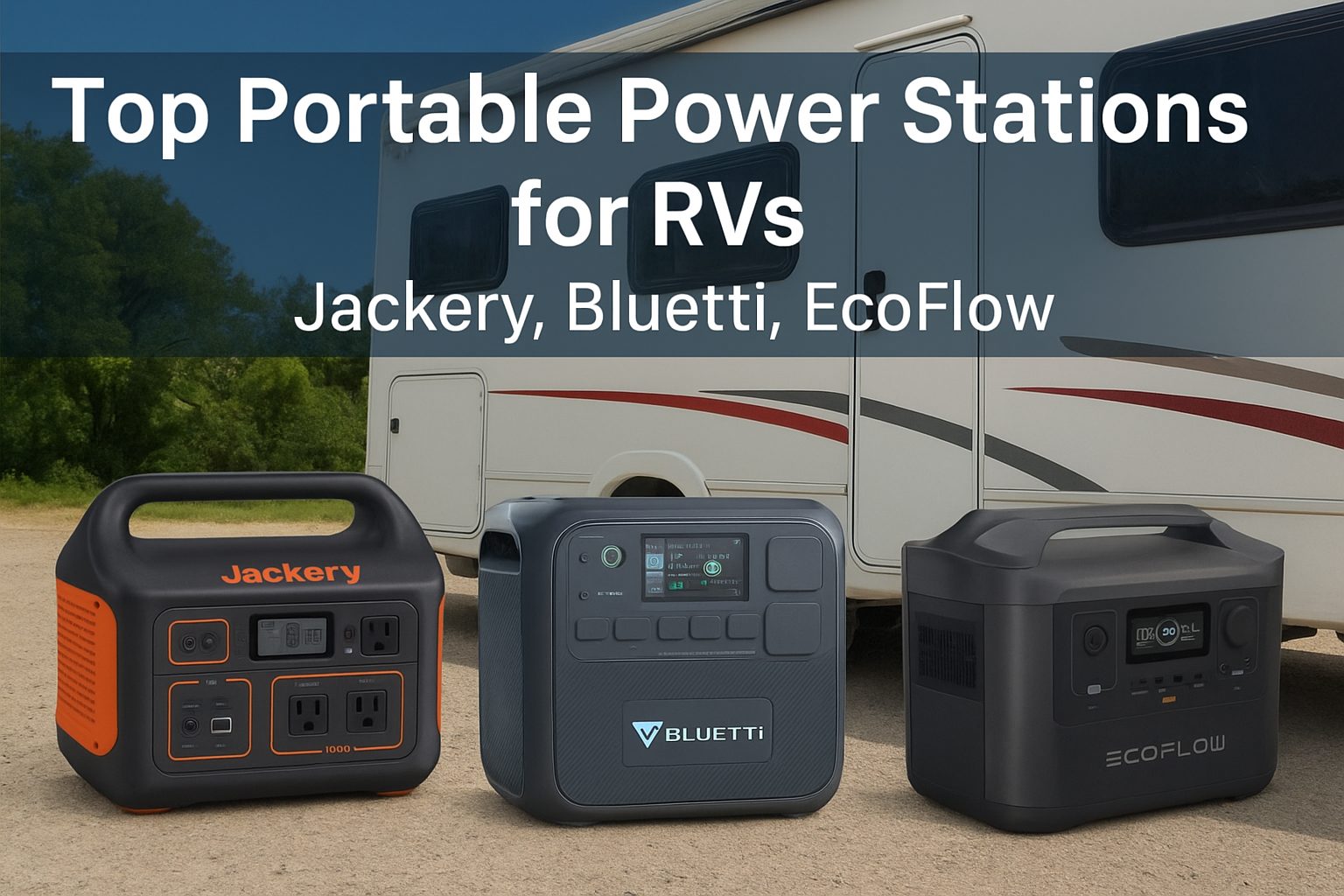
Power independence is mission-critical for RV travelers. When you’re parked miles from the nearest outlet or boondocking under the stars, your ability to run lights, keep a refrigerator cold, charge devices, or power small appliances determines whether a trip feels liberating or limiting. Relying solely on campsite hookups or noisy gas generators forces schedule constraints, creates fumes and noise, and limits where — and how long — you can stay off-grid. That’s why many RVers now treat portable power as essential gear, not a luxury.
Portable power stations have exploded in popularity for a reason. Over the last few years, advances in battery chemistry, inverter technology, and solar charging have made them lighter, more powerful, and far more user-friendly. Instead of wrestling with fuel, pull-starts, and maintenance, you can now carry a quiet, emission-free battery system that charges from wall power, a vehicle, or solar panels. Whether you’re weekend camping, crossing the country full-time, or preparing for emergencies, portable power stations provide reliable, low-maintenance electricity that fits into an RV garage or cargo bay.
This guide walks you through everything an RV owner needs to know to pick the right unit. We’ll explain what portable power stations are, why they’re frequently a better option than traditional gas generators, and which features matter most for RV life. Then we’ll dive into detailed comparisons of five top models — including options from Jackery, Bluetti, and EcoFlow — covering real-world specs, strengths, and trade-offs so you can match a unit to your rig and lifestyle. If you’re searching for the best portable power stations for RVs, you’ll find everything you need right here.
What Is a Portable Power Station and Why RV Owners Need One
What it is (simple definition)
A portable power station is a self-contained battery system with an inverter and multiple output ports (AC outlets, USB-A/C, 12V DC) designed to store electricity and deliver it on demand. Think of it as a rechargeable, silent generator with modern electronic controls: it stores energy in batteries and converts that stored DC energy to the AC and DC outputs your appliances use.
How it differs from a traditional gas generator
-
Noise & emissions: Unlike gas generators, portable power stations operate almost silently and produce no exhaust while discharging. That makes them ideal for campground environments and enclosed spaces where fumes and noise are a problem.
-
Maintenance: Portable stations require minimal upkeep — no oil changes, spark plugs, or fuel stabilizers. You recharge batteries instead of handling gasoline.
-
Instant power & safety: Many units provide clean, stable pure sine wave output that’s safe for sensitive electronics (laptops, CPAPs, inverters). They also power equipment instantly without the warm-up or choke controls that gas units need.
-
Limitations: They do have finite energy storage (measured in watt-hours) and must be recharged after depletion. For continuous high-load uses (like large RV air-conditioning units), either very large systems or hybrid solutions (battery + generator) are necessary.
Clean energy benefits
-
Noise-free operation: Running a portable power station is quiet — typically the only sound is a fan when charging or under heavy load. That keeps campsites peaceful and avoids disturbing neighbors.
-
Eco-friendly: Because they discharge stored electricity, portable power stations generate no local emissions while in use. When paired with solar panels, they enable truly fossil-fuel-free operation for much of your trip.
-
Rechargeable & upgradeable: Many modern units support multiple recharge methods (AC wall, car/12V, solar) and offer expandable battery modules so you can scale capacity without buying a whole new generator.
How they power RV essentials (practical examples)
-
Lights & outlets: LED lights, phone chargers, and small appliances (coffee makers, slow cookers) draw modest wattage — easy to run for hours on most mid-capacity stations.
-
Refrigerator: A 12V or AC RV fridge often cycles on and off; a good 1,000–2,000 Wh unit can keep a fridge running through the night or for a full day, depending on ambient temperature and fridge efficiency.
-
Laptops, TVs, and CPAPs: Sensitive electronics benefit from the clean power of a pure sine wave inverter typical in modern stations. CPAP users especially appreciate the quiet, reliable backup power.
-
Small induction cooktops, microwaves, or power tools: These require higher surge and continuous wattage — you’ll need to check inverter output (continuous and peak) and battery capacity to ensure compatibility.
-
Air conditioners & heaters: These are the most demanding. Portable stations can sometimes handle short bursts (startup surge) but sustaining an RV air conditioner for hours requires large capacity (multiple kWh) or an onboard generator.
Subpoints (practical considerations for RVers)
-
Match capacity to usage: Estimate your daily watt-hour needs (fridge + lights + devices) and choose a battery with comfortable headroom, not just bare minimum.
-
Understand continuous vs. surge watts: Continuous watts tell you what can run steadily; surge watts indicate what the inverter can handle for motor starts (fridge compressor, air conditioner). Both matter for RV appliances.
-
Recharge strategy: If you boondock, plan how you’ll recharge — short drives + DC charging, shore power at some stops, or solar panels to top up during the day.
-
Portability & placement: Consider weight and where the unit will live in your RV. Many power stations are designed to be carried easily but still require thoughtful storage for ventilation and safety.
-
Battery chemistry matters: LiFePO₄ batteries typically last longer (more cycles) than traditional lithium-ion cells, which can be an important factor for full-time RVers.
Portable power stations translate modern battery tech into practical, quiet, and increasingly affordable electricity for RV life. They’re not a one-size-fits-all replacement for large onboard generators yet, but for most RVers — weekenders and long-distance travelers alike — they provide a flexible, low-maintenance, and greener way to stay powered on the road.
Key Factors to Consider When Choosing a Portable Power Station for RVs
Choosing the right portable power station for your RV is about more than just capacity. To ensure it meets your needs, you’ll want to evaluate several important factors. Below are the key considerations — explained — with examples of why brands like Jackery, EcoFlow and Bluetti are frequent top picks in the RV space.
1. Battery Capacity (Wh)
-
Definition: The watt-hour rating (Wh) indicates how much energy the battery can store. For example, a 1,000 Wh unit theoretically could supply 100 watts for 10 hours.
-
Why it matters: The larger the capacity, the more devices you can run and the longer you can stay off-grid without recharging. For RVs, this often means running a fridge, lights, devices, occasionally small appliances.
-
Example: If your RV fridge draws ~80 watts and cycles half the time, you might use ~40-50 watts continuously; a 1,000 Wh battery gives you ~20–25 hours of that use (in theory) assuming ideal conditions.
-
Practical tip: Always plan for more than the “ideal” — losses, inefficiencies and real load variations reduce runtime.
2. Output Power (W): Continuous vs. Surge
-
Continuous wattage: The power the inverter can safely deliver on a steady basis (e.g., 1,500 W continuous).
-
Surge (or peak) wattage: The higher power the unit can deliver briefly — important for devices with motors or compressors (like refrigerators or air conditioners) which draw a spike at startup.
-
Why it matters: Even if battery capacity is sufficient, if the inverter can’t handle the starting surge of a fridge or AC unit, it may fail to start or shut down.
-
Example: A power station rated for 1,500 W continuous but only 3,000 W surge may handle certain loads well; if your AC startup requires more than that surge, it won’t work reliably.
3. Battery Type: LiFePO₄ vs. Lithium-Ion
-
LiFePO₄ (Lithium Iron Phosphate): Longer lifecycle (more charge/discharge cycles), higher thermal stability, better for repeated deep discharges.
-
Standard lithium-ion (e.g., NCM, NCA): Lighter and often cheaper but shorter lifespan and more sensitivity to heat and deep discharge.
-
Why it matters: For full-time RVers or those expecting years of use, LiFePO₄ is often a better investment.
-
Example: Jackery, EcoFlow and Bluetti are increasingly using LiFePO₄ chemistry in their higher end RV-ready models to support longer lifespan and reliability.
4. Recharge Options
-
AC Wall Charging: Plug into standard outlet — convenient when shore power is available.
-
Car/12V Input: Useful while driving or from vehicle alternator.
-
Solar Input: Allows recharge off-grid during daylight — ideal for camping or remote stays.
-
Why it matters: More recharge flexibility = more freedom. If you plan boondocking or remote RV stays, solar input becomes a big plus.
-
Example: EcoFlow models often support fast AC recharge plus solar input; Bluetti offers solar-friendly models; Jackery bundles also offer solar kits.
5. Portability: Size, Weight, and Handle Design
-
Why it matters: In an RV, space is premium and you may need to move the unit occasionally (loading/unloading). A heavy, bulky station may be impractical.
-
Consider: Weight (lbs or kg), dimensions, whether it has wheels or handles, ventilation requirements, where you’ll store it in the RV.
-
Practical tip: Even if you want high capacity, balance that with how convenient it will be to maneuver or install.
6. Expandability: Extra Battery Modules or Solar Integration
-
Expandability means the system can grow with your power needs: additional battery packs, stacking modules, or linking more solar panels.
-
Why it matters: Your RV lifestyle might change (longer trips, more appliances) — a scalable system allows you to start modest and upgrade later.
-
Example: Bluetti’s “swappable battery” feature or EcoFlow’s modular expansions are examples of how expandability can future-proof your purchase.
7. Brand Reputation and Warranty
-
Reputation: Brands like Jackery, EcoFlow and Bluetti are leading the charge in reliable RV-ready power stations. Their customer support, firmware updates, and track record matter.
-
Warranty & Support: A longer warranty period, accessible service, and good reviews reduce risk.
-
Why it matters: You want to invest in a unit that will hold up on the road, under vibration, heat changes, and with minimal downtime.
-
Practical tip: Check user reviews from RV users specifically (not just general home use) to get real-world feedback.
Comparison Table: Best Portable Power Stations for RVs
| Product | Capacity (Wh) | Output (W) | Battery Type | Weight | Notable Feature | Best For |
|---|---|---|---|---|---|---|
| Jackery Explorer 1000 V2 | 1,070 | 1,500 | LiFePO₄ | 23.8 lbs | Fast charging | Short trips |
| Jackery Explorer 2000 V2 | 2,042 | 2,200 | LiFePO₄ | 39.5 lbs | High capacity | Long RV stays |
| EcoFlow DELTA 2 | 1,024–3,000 | 1,800 | LiFePO₄ | 27 lbs | Expandable | Tech users |
| Bluetti AC180 / T | 1,432 | 1,800 | LiFePO₄ | 35 lbs | Swappable battery | Reliable power |
| Jackery Solar Gen 1000 V2 | 1,070 | 1,500 | LiFePO₄ | 24 lbs | Solar charging | Off-grid use |
The 5 Best Portable Power Stations for RVs (2025 Edition)
Whether you’re heading into the mountains for a weekend getaway or living full-time in your RV, having a reliable power source is essential. Below are the five best portable power stations for RVs in 2025, featuring models from Jackery, EcoFlow, and Bluetti — brands trusted by adventurers and off-grid travelers alike. Each unit is evaluated based on capacity, performance, portability, and overall value for RV owners.
#1 Jackery Explorer 1000 V2
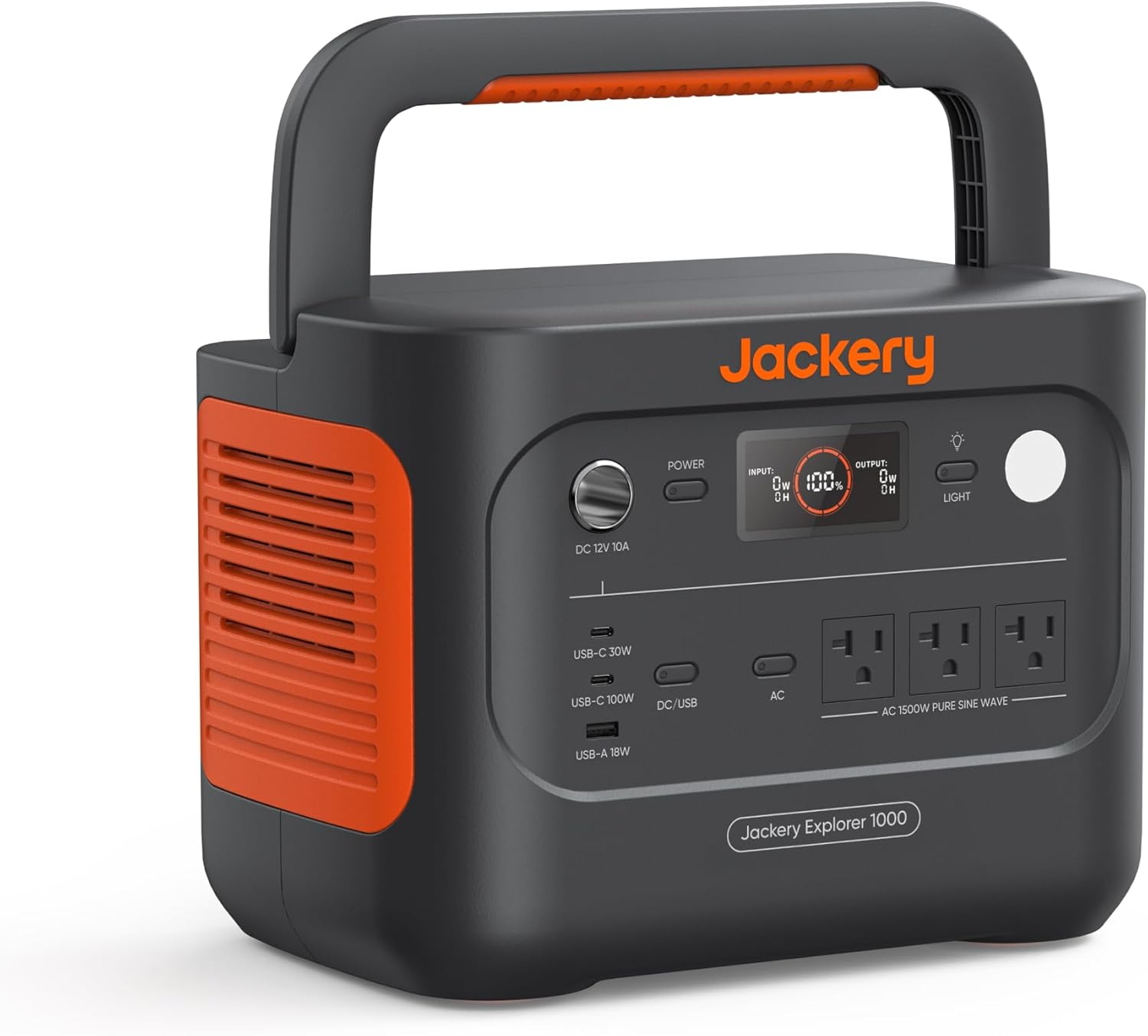
The Jackery Explorer 1000 V2 is one of the most balanced portable power stations for RV users who value convenience and reliability. With a compact, lightweight body, it’s perfect for smaller RV setups or campers who prefer a minimalist setup while still powering lights, smartphones, laptops, fans, and even small kitchen appliances. Featuring a LiFePO₄ battery for extended cycle life and quick recharge times, it’s a dependable choice for modern adventurers.
- Capacity: 1,070 Wh (LiFePO₄ battery for long cycle life)
- Output: 1,500 W continuous / 3,000 W surge
- Weight: ~23.8 lbs
- Recharge Time: About 1 hour to full charge (fast AC input)
- Charging Options: AC wall outlet, car outlet, or solar panel
- Lightweight and easy to carry
- Quick recharge time compared to similar models
- Reliable LiFePO₄ battery with improved durability
- Quiet, emission-free operation
- Excellent customer support and long warranty
- Not ideal for running heavy-duty RV appliances (like air conditioners)
- Smaller capacity limits power for extended off-grid use
#2 Jackery Explorer 2000 V2

The Jackery Explorer 2000 V2 is designed for serious RV travelers needing high capacity and reliable power. Its robust output easily handles multiple appliances simultaneously, including refrigerators, microwaves, CPAP machines, and small tools. Ideal for extended boondocking or full-time RV living, this power station combines advanced LiFePO₄ battery technology with fast-charging and a rugged build.
- Capacity: 2,042 Wh
- Output: 2,200 W continuous / 4,400 W surge
- Weight: ~39.5 lbs
- Recharge Time: 0–80% in 66 minutes via fast AC charging
- Charging Options: AC wall charger, car outlet, or solar input
- Large capacity for long RV stays
- Can handle high-power appliances easily
- Reliable and efficient fast-charging technology
- Rugged build designed for outdoor and travel use
- Advanced LiFePO₄ battery ensures longer life cycles
- Heavier and bulkier than mid-range options
- Pricier compared to smaller models
#3 EcoFlow DELTA 2

The EcoFlow DELTA 2 is ideal for RVers seeking flexibility, smart controls, and fast recharging. Start with a 1,024 Wh unit and expand up to 3 kWh with add-on batteries. Featuring LiFePO₄ chemistry, solar charging support, and a smart companion app, it allows real-time monitoring and remote control, making it a top choice for off-grid adventures.
- Capacity: 1,024 Wh (expandable up to 3 kWh with extra battery)
- Output: 1,800 W continuous
- Recharge Time: 0–80% in ~50 minutes
- Battery Type: LiFePO₄ (3,000+ cycles)
- Weight: ~27 lbs
- App Connectivity: Bluetooth + Wi-Fi
- Exceptionally fast recharge time
- Expandable battery options for growing power needs
- Smart app for remote monitoring and updates
- Reliable LiFePO₄ chemistry with long cycle life
- Supports solar charging for full off-grid use
- Add-on batteries can significantly raise total cost
- Slightly heavier than basic units
#4 Bluetti AC180 / AC180T

The Bluetti AC180 / AC180T is a mid-range portable power station built for RVers and outdoor enthusiasts seeking a balance of capacity, performance, and flexibility. Featuring hot-swappable LiFePO₄ batteries, it allows extended runtime and easy expansion. With strong inverter performance and excellent solar charging, it’s perfect for long off-grid adventures.
- Capacity: 1,432 Wh
- Output: 1,800 W continuous / 3,600 W surge
- Battery Type: LiFePO₄
- Weight: ~35 lbs
- Recharge Options: AC, solar, car input
- Special Feature: Hot-swappable batteries for extended use
- Swappable battery system extends usability
- Durable build with strong inverter performance
- LiFePO₄ battery for safety and longevity
- Excellent solar charging performance
- Long-term reliability backed by Bluetti’s warranty
- Heavier than smaller options
- Additional batteries increase total cost
#5 Jackery Solar Generator 1000 V2 (Bundle)

The Jackery Solar Generator 1000 V2 bundle is ideal for eco-conscious RV owners seeking portable renewable energy. It combines the Jackery Explorer 1000 V2 power station with a 100W solar panel, allowing users to recharge anywhere with sunlight. Perfect for weekend travelers, this setup ensures quiet, clean, and reliable off-grid power.
- Capacity: 1,070 Wh
- Output: 1,500 W continuous / 3,000 W surge
- Includes: 100W solar panel
- Recharge Method: Solar input, AC, or car outlet
- Weight: ~26 lbs (with solar panel)
- Solar Charging: Dependent on sunlight and panel positioning
- Complete solar setup — ready for off-grid adventures
- Clean, quiet, and eco-friendly operation
- Compact and easy to set up in RV environments
- Great for weekend travelers or backup energy
- Solar recharging speed depends on weather conditions
- Limited for high-power appliances
How to Choose the Right Power Station for Your RV Setup
Selecting the ideal portable power station for your RV involves more than picking a popular brand — it’s about finding a model that matches your power demands, travel style, and long-term needs. Here’s a detailed step-by-step guide to choosing the right one:
1. Assess Your Daily Watt-Hour Consumption
Start by listing all the electrical devices you regularly use in your RV — lights, refrigerator, laptop, phone chargers, fans, coffee maker, etc. Each device has a power rating (in watts). Multiply the wattage by the number of hours you use it per day to get its daily consumption in watt-hours (Wh).
For example:
-
RV Fridge: 80W × 10 hours = 800Wh
-
Laptop: 60W × 3 hours = 180Wh
-
Lights: 40W × 5 hours = 200Wh
Add them all up — if your total daily usage is around 1,500Wh, you’ll need a power station with at least that capacity, ideally 20–30% extra for safety and efficiency losses.
2. Match Your Load to the Unit’s Output and Capacity
Once you know your energy needs, check each power station’s continuous output (W) and battery capacity (Wh):
-
If you use multiple appliances simultaneously, ensure the continuous output exceeds your combined wattage.
-
For heavy appliances like microwaves or portable ACs, make sure the surge power rating (the short burst capacity) can handle startup loads.
Example:
If your fridge and coffee maker run together at ~1,200W combined, a Jackery Explorer 2000 V2 (2,200W output) or EcoFlow DELTA 2 (1,800W) would work comfortably.
3. Consider Solar Expansion for Off-Grid Use
If you frequently camp away from traditional hookups, prioritize solar compatibility. Portable solar panels extend your power independence by allowing renewable charging during the day.
Models like the Jackery Solar Generator 1000 V2 and EcoFlow DELTA 2 are optimized for solar input and include MPPT (Maximum Power Point Tracking) controllers for efficient charging even in variable sunlight.
4. Prioritize LiFePO₄ Battery Chemistry
LiFePO₄ (Lithium Iron Phosphate) batteries are the gold standard for RV use because they offer:
-
3,000+ charge cycles (up to 10 years of regular use)
-
Better thermal stability (safer in hot RV environments)
-
More consistent voltage output
All three top brands — Jackery, Bluetti, and EcoFlow — now feature LiFePO₄ batteries in their latest 2025 models, making them superior long-term investments.
5. Consider Multiple Smaller Units for Redundancy
Instead of investing in one massive power station, some RVers prefer using two smaller units — one for kitchen appliances and another for entertainment or charging devices. This setup:
-
Adds backup security if one fails
-
Allows flexible placement in the RV
For example, pairing two Jackery Explorer 1000 V2s or an EcoFlow DELTA 2 with a Jackery 1000 V2 can create a highly adaptable RV power system.
6. Trust in Brand Reputation and Support
When investing in power systems that may cost over $1,000, reliability and warranty support are critical.
Jackery, Bluetti, and EcoFlow have established reputations for:
-
Consistent product performance
-
Excellent customer support
-
Multi-year warranties
-
Ongoing firmware and app updates (especially for smart models like the EcoFlow DELTA 2)
Tips for Maximizing Power Station Efficiency in an RV
Getting the most out of your power station is just as important as choosing the right one. Here are practical tips to extend its runtime and overall lifespan:
1. Use Energy-Efficient Appliances
Opt for low-wattage or energy-saving devices. For instance, LED lighting, efficient compressor fridges, and induction cooktops reduce power drain and extend battery life.
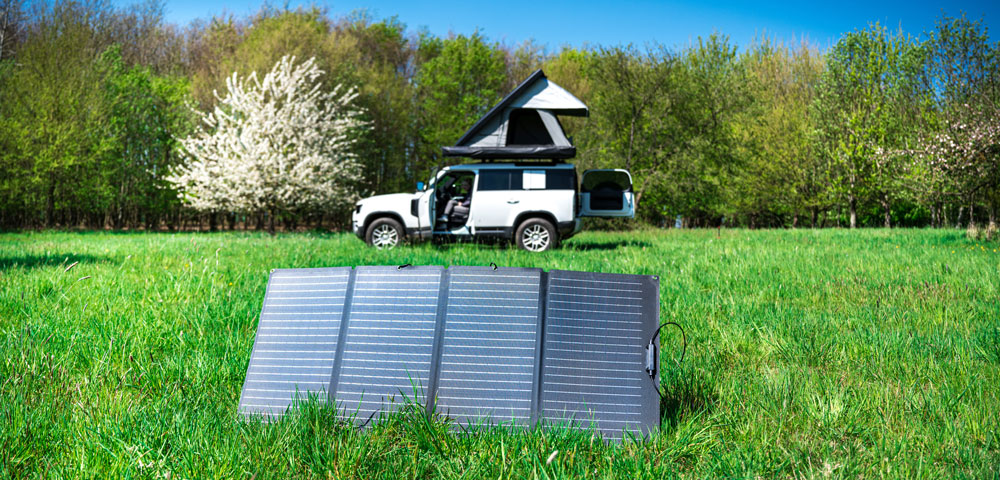
2. Pair with Solar Panels
Solar panels are a must for off-grid RV living. Pairing a Jackery SolarSaga panel or Bluetti PV200 panel with your power station allows daytime recharging and nearly infinite power cycles in good weather.
3. Avoid Deep Discharges
Try not to drain the battery below 20% capacity frequently. Regular deep discharges shorten battery life, even for LiFePO₄ models. Recharge whenever possible during daylight.
4. Store in Cool, Dry Conditions
Avoid exposing your power station to direct sunlight or damp storage areas. Heat and moisture degrade battery performance and internal components.
5. Keep Firmware Updated (for Smart Models)
Smart stations like the EcoFlow DELTA 2 receive firmware updates via their mobile apps, improving charging algorithms and efficiency over time. Regular updates ensure peak performance and safety.
Safety Tips for Using Portable Power Stations in RVs
Safety should always come first when operating high-capacity power stations in confined spaces like RVs. Follow these best practices:
1. Ensure Proper Ventilation
Even though power stations are emission-free, they generate heat during charging and discharging. Keep vents clear and avoid placing units inside closed compartments.
2. Keep Away from Moisture and Heat
Water exposure can short-circuit components. Always store your station on a dry, stable surface away from stoves, heaters, or windows prone to condensation.
3. Use Approved Cables and Adapters
Only use manufacturer-approved cords and adapters for AC, DC, and solar inputs. Incorrect cables can lead to voltage mismatches and internal damage.
4. Follow Solar Input Guidelines
When charging via solar panels, ensure the total voltage and amperage match the manufacturer’s recommendations. For example, connecting panels in series without understanding voltage limits can overload the input.
5. Store Safely During Off-Season
If not using your power station for weeks or months, store it at around 50–60% charge, and recharge it every few months to maintain battery health.
Which Is the Best Portable Power Station for RVs?
When it comes to choosing the best portable power station for RVs, there’s no universal answer — it depends on your energy needs, travel frequency, and personal preferences. Each of the top five models excels in a specific area:
| Model | Standout Feature | Best For |
|---|---|---|
| Jackery Explorer 1000 V2 | Lightweight, fast-charging | Weekend travelers, minimalists |
| Jackery Explorer 2000 V2 | Extended power for multiple devices | Long-term or full-time RVers |
| EcoFlow DELTA 2 | Expandability + smart control | Tech-savvy RV owners |
| Bluetti AC180 | Long-term reliability, hot-swappable batteries | Heavy users and off-grid adventurers |
| Jackery Solar Generator 1000 V2 | Solar-ready off-grid bundle | Eco-friendly travelers |
Each of these brands — Jackery, Bluetti, and EcoFlow — continues to innovate with safer LiFePO₄ batteries, faster charging, and modular expansion options that make life on the road easier and more sustainable.
Ultimately, the best portable power station is the one that matches your RV lifestyle:
-
If you’re a weekend camper → go lightweight and portable.
-
If you’re off-grid for days → choose higher capacity or solar expandability.
-
If you’re full-time on the road → invest in reliability and long battery lifespan.
With the right setup, your RV can remain powered, connected, and comfortable — wherever the road takes you.